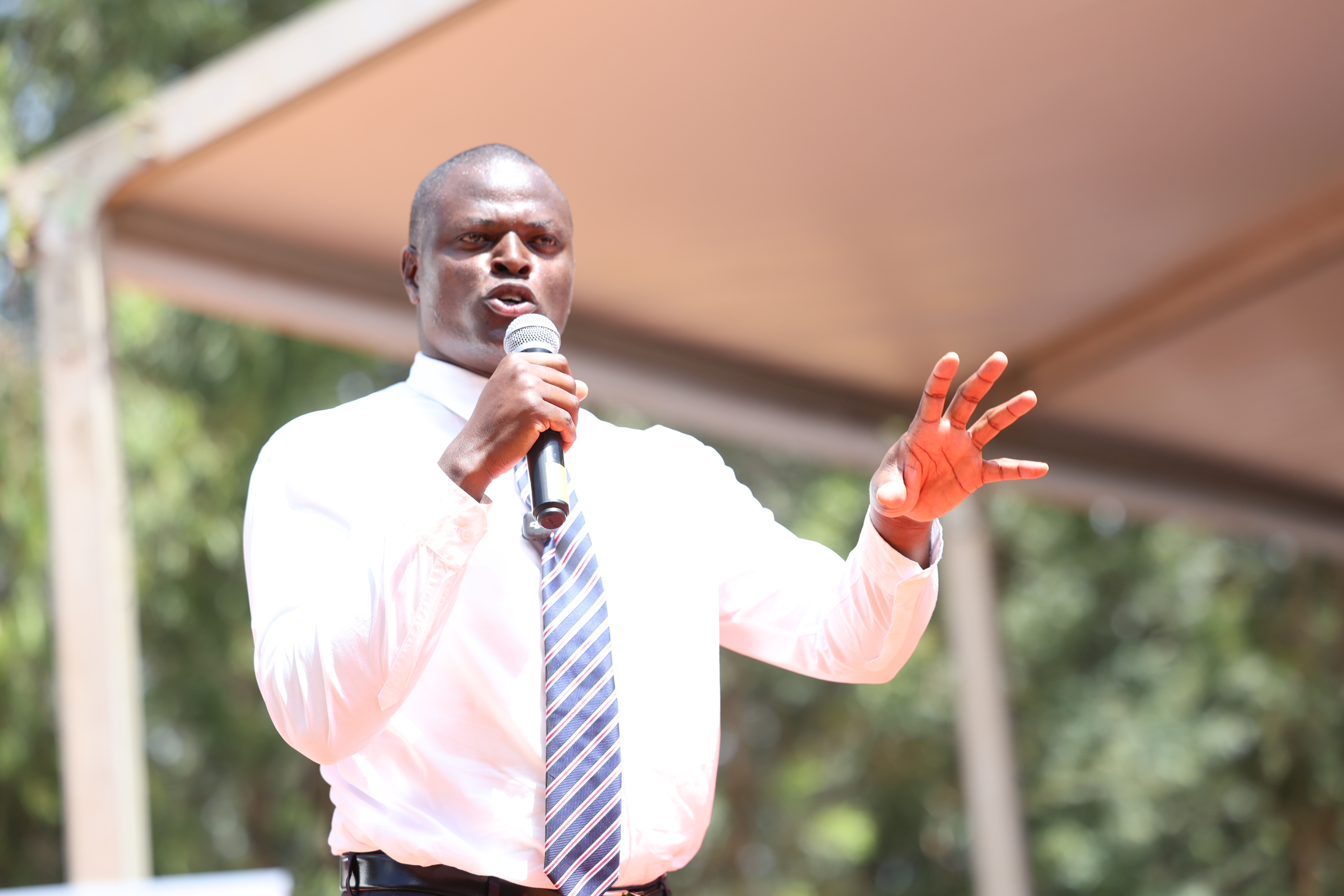
Kiharu MP Ndindi Nyoro has reiterated his opinion on President William Ruto’s plan to benchmark Kenya’s economic transformation against Singapore.
Speaking on JKLive on Wednesday, he argued that the two countries are fundamentally different in population, size and economic structure.
Nyoro said economic comparisons must be made between countries with similar conditions.
“In economics, just to bring it in terms of real life, if you’re a banana farmer, you can’t compare how well you’re doing with another banana farmer by using oranges or pears,” he explained.
“The economy that is actually close to what Kenya’s should be is South Korea. If we actually mean to emulate a country, it is South Korea.”
Nyoro highlighted the vast disparity in wealth between the two nations.
Singapore’s GDP per capita stands at approximately USD 90,000, compared with Kenya’s roughly USD 3,000.
He added that Singapore’s early growth relied heavily on state-led economic involvement, noting that government-linked firms such as Temasek dominate major companies—a model of state capitalism that contrasts with Kenya’s current push to privatise state-owned enterprises.
According to Nyoro, Kenya’s economic conditions are closer to South Korea’s than Singapore’s.
Both countries have populations of about 50 million, compared with Singapore’s six million, and share similarities in development pathways.
“If you compare the same with a country like South Korea, more or less, our ideals economically blend more. Our population is in the 50 millions; South Korea is in the 50 millions,” he said.
He pointed to the “Asian tiger” economies, which nurtured private enterprise, built labour-intensive industries first, then transitioned to capital- and technology-intensive sectors, and relied on foreign direct investment (FDI).
Nyoro cautioned that Kenya often confuses remittances with FDI, emphasising that “remittances are consumer-driven. FDI is investment-driven.”
“If you look at South Korea, that is what it advanced, especially from the rule of General Park, where the economy was so involved in growing the private enterprise that they had to create a cadre of companies called Chaebols,” he added.
Nyoro warned against mixing political influence with economic incentives and said corruption that distorts markets remains a key barrier.
He stressed that investment in human capital should be the country’s priority for sustainable growth.
Embakasi East MP Babu Owino supported Nyoro’s critique, noting the stark geographical and demographic contrasts.
Singapore covers just 736 square kilometres, roughly the size of Nairobi, while Kenya spans about 580,000 square kilometres.
He also highlighted population differences: 58 million Kenyans versus Singapore’s 6.1 million.
“How else will the 58 million Kenyans fit into Singapore which is smaller?” Babu Owino asked, arguing that Kenya’s development strategy should be homegrown rather than imported.
According to the MPs, Kenya’s economic blueprint should be tailored to its population size, land mass and socio-economic realities, making South Korea a more suitable reference point than Singapore.
Ruto has over time, reiterated his belief that Kenya can achieve rapid development similar to Singapore if it maintains discipline, stays the course on economic reforms and invests strategically in key sectors.
Speaking on December 14, 2025, in Kiambu during a church service at the Africa Inland Pentecostal Church Assembly (AIPCA), Gatundu North Diocese, he stressed that transformation cannot be achieved through political rhetoric alone but through concrete development programmes and consistent policy implementation.
He said the resources will be channelled into infrastructure, industrialisation and other productive sectors aimed at accelerating development and improving the quality of life for Kenyans.
“We are not joking, my friends. This country must be transformed by all means possible. We are very late. We are behind schedule in kicking out hunger and poverty,” Ruto said.
“This country can be transformed. If Singapore, South Korea and Malaysia did it, why not us?”