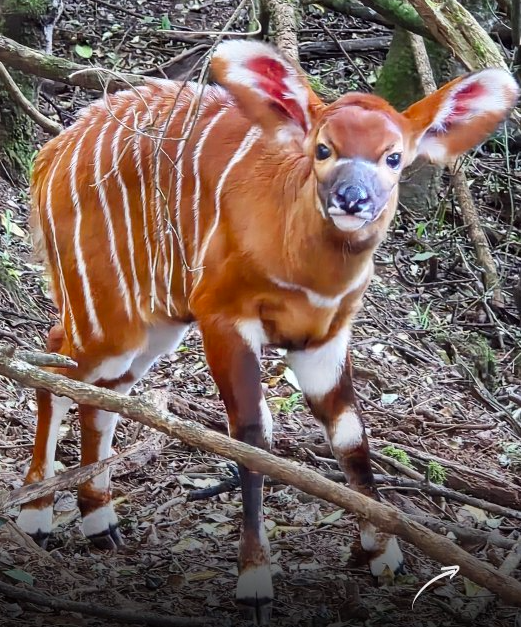
 The newly born Mountain Bongo calf/MKWC
At the foot of Mount Kenya, where mist clings to ancient trees and the forest hums with life, a quiet but extraordinary milestone has been reached.
The Mount Kenya Wildlife Conservancy has welcomed the birth of its 100th Mountain Bongo — a moment year in the making, and one rich with meaning.
“After years of care, patience and dedication, we are so happy to share that the 100th Mountain Bongo has been born,” the conservancy announced.
“This is not just another birth. It’s hope. It’s proof that our efforts matter and the future of this species is still possible.”
Located just 10km from Nanyuki town, the conservancy sits within the wider Mount Kenya forest ecosystem, a sanctuary where conservation is both a science and a long-term promise.
Its work revolves around three core programmes: breeding and rewilding the critically endangered Mountain Bongo, caring for orphaned wildlife, and educating communities about conservation.
Home to about 1,200 animals across 28 species, the conservancy has become a lifeline for the Mountain Bongo — a striking forest antelope once widespread across the Aberdare ranges, Mount Kenya, the Cherangany Hills and the Mau Forest Complex.
Today, only small, fragmented populations remain, mainly in the Aberdares and the Maasai Mau.
The decline has been steep and devastating. For years, estimates placed the wild population at fewer than 100 individuals. Yet recent data offers cautious optimism.
Kenya’s 2021 national wildlife census recorded 150 Mountain Bongos, a figure that rose to 176 in the 2025 census — a modest increase, but one that signals progress.
That progress is anchored in deliberate action. In 2003, Kenya launched a Bongo repatriation programme aimed at rebuilding the species through captive breeding in a natural setting.
The Mount Kenya Wildlife Conservancy became central to this vision. By last year, its captive herd had grown from 54 animals in 2021 to 93 — a steady climb shaped by careful management and long-term commitment.
A major boost came in February last year, when 17 Mountain Bongos — 12 females and five males — were repatriated from the Rare Species Conservatory Foundation in Florida, US.
They were released into the Marania and Mucheene Sanctuary in Meru county, part of a broader effort to establish a breeding and rewilding centre capable of restocking Kenya’s forests.
For now, the animals remain in protected enclosures as preparations continue for their eventual release into the wild — a critical step towards restoring self-sustaining populations in their native habitats.
The work does not stop with breeding alone. Kenya has developed a National Recovery and Action Plan for the Mountain Bongo, with the first phase running from 2019 -23, and a second plan (2026–30) now in preparation.
The long-term goal is ambitious: to secure a national population of at least 730 individuals over the next 50 years.
Alongside these efforts, the government, through the Kenya Wildlife Service, has fenced key forest ecosystems including the Aberdare, Mount Kenya and Eburu forests, tightened anti-poaching and anti-logging enforcement and invested in modern monitoring technologies such as camera traps.
Equally important are community-based conservation and education programmes, helping people living alongside these forests understand that the survival of the Mountain Bongo is inseparable from the health of the ecosystem itself.
In the birth of one calf — the 100th — lies a broader story: of resilience, collaboration and the slow, patient work of restoring what was nearly lost.
In the shadows of Mount Kenya, hope has taken a tangible form, standing quietly on four slender legs.