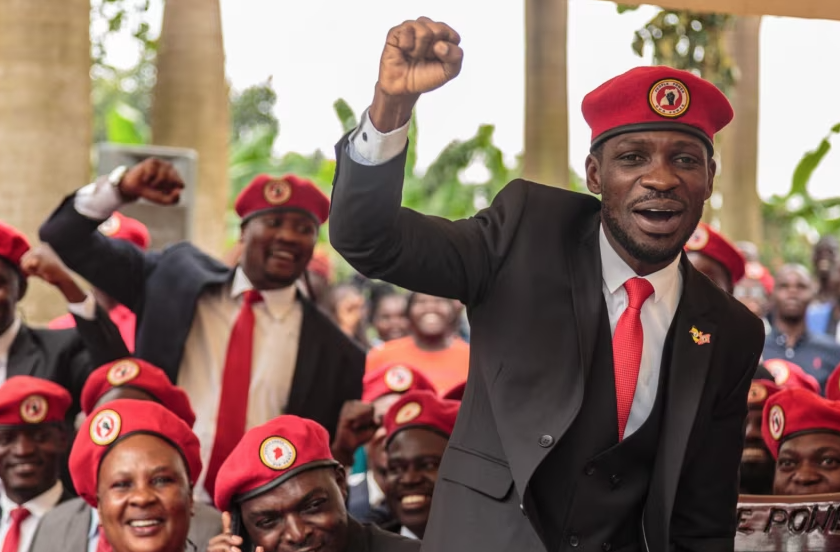
As Ugandans head to the polls today, attention remains firmly fixed on Robert Kyagulanyi Ssentamu, better known by his stage name Bobi Wine, the National Unity Platform (NUP) presidential candidate whose rise has shaped Uganda’s opposition politics over the past decade.
At 43, Wine remains the chief challenger to veteran President Yoweri Museveni, whose nearly four-decade rule continues to dominate the political landscape.
His journey from Kampala’s slums to national politics has made him both a symbol of youthful aspiration and a lightning rod in a deeply polarised system.
Early life and music
Born on February 12, 1982, at Nkozi Hospital to Jackson Willington Ssentamu and Margaret Nalunkuuma, Wine grew up in Kamwokya, a densely populated slum in north-eastern Kampala.
Raised in a large family of 34 siblings, he attended Kitante Hill School before moving to Kololo Senior Secondary School and later enrolling at Makerere University to study music, dance and drama.
He graduated with a diploma in 2003 and completed a Bachelor of Laws at Cavendish University in August 2024.
Wine is married to Barbara Itungo (Babi), whom he met at university.
The couple have four children and reside in Magere, Wakiso District.
In the early 2000s, he began performing as Bobby Rob and Toto, drawing inspiration from reggae legend Bob Marley and blending Kidandali, dancehall and Afrobeat.
Breakout singles such as Akagoma, Funtula and Sunda propelled him into the national spotlight.
Through groups like the Firebase Crew, he crafted a persona that earned him the moniker “Ghetto President.”
Songs like Situka, Sukuma and Tuli Banyo adopted increasingly political themes, foreshadowing his transition into formal politics.
From Pop Star to politician
Wine entered politics in 2017 when he declared his candidacy for the Kyadondo East parliamentary seat in Wakiso District.
Running as an independent, he won a competitive by-election, galvanising young urban voters under the People Power slogan.
The movement later gave birth to the National Unity Platform, which he assumed leadership of in 2021.
His activism predates his own nomination: he campaigned for opposition candidates, including Col. Kizza Besigye in 2016, and helped lead the Tojikwatako (“Do not touch it”) campaign against removing the presidential age limit.
In 2018 he joined protests against the controversial social media tax imposed on OTT services, which the government later scrapped in 2021.
Clashes with the State
Wine’s political ascent has been marked by multiple arrests and confrontations with security agencies.
The most consequential occurred during the 2018 Arua by-election, when his driver, Yasin Kawuma, was fatally shot.
Wine and several opposition figures were arrested and accused of treason, with allegations of mistreatment in custody.
He was later released and travelled to the United States for medical treatment.
In the lead-up to the 2021 election, he was detained repeatedly during his nomination and campaign, with police citing violations of public order and COVID-19 restrictions.
His arrest in November 2020 triggered protests in which dozens of people were reported dead.
After the disputed vote, he was placed under house arrest for nearly two weeks before international pressure forced authorities to lift it.
In October 2023, upon returning from South Africa, Wine was seized at Entebbe Airport and escorted home, preventing supporters from welcoming him.
In September 2024, NUP said he was recovering after being struck by a tear gas canister during a confrontation with police.
Campaign amid tension
His 2026 campaign has unfolded alongside frequent arrests of supporters and campaign workers.
At a rally in late 2025, Wine claimed 187 campaign members were detained on what he called “trumped-up charges” to weaken and isolate his team.
The atmosphere ahead of today’s vote has been tense.
Days before polling opened, the government imposed a nationwide internet shutdown and deployed soldiers across Kampala.
Officials said the measures would curb misinformation, but critics argue they undermine transparency and civil liberties.
Against this backdrop, Wine has urged Ugandans to remain vigilant.
On platform X, he called on voters not only to cast ballots but to “protect and defend” the integrity of the process, saying it was “critical that Ugandans turn out in big numbers to exercise their democratic rights.”
He has also criticised a night curfew he labelled “politically imposed” and “killing the economy,” especially for informal-sector workers dependent on nightlife.
During the campaign season, he framed the race as an ideological struggle: “We are going to war… a war imposed on us by our oppressors,” he told supporters.
Yet he also urged restraint, saying Ugandans must remain “solid, sober, calm and disciplined.”
Wine’s base consists largely of younger Ugandans who see him as a vehicle for change in a country where more than three-quarters of the population is under 35.
His music, activism and messaging resonate with those exasperated by unemployment, stagnation and corruption under a decades-long incumbent.
Critics argue his platform lacks detailed policy and caution that his rhetoric risks deepening polarisation in an already fraught political climate.
As voting continues and results are awaited in the coming days, Wine’s influence remains significant regardless of the final tally.
Whether he can convert popularity among young and urban voters into a credible challenge remains uncertain, especially amid heavy-handed security interventions.
What is clear is that Wine’s trajectory, from Kamwokya’s streets to the presidential ballot, has reshaped Uganda’s political discourse, forcing debates about power, youth representation and democratic reform into the mainstream.
The 2026 election may not be the end of that journey, but it underscores how deeply his story now intersects with Uganda’s future.