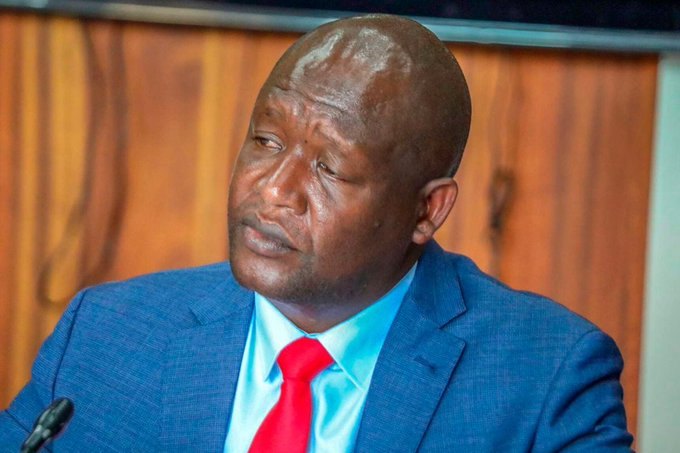
Kericho’s 2027 gubernatorial race is emerging as one of the most politically charged contests in the Rift Valley, reviving old rivalries while exposing unresolved fault lines within the United Democratic Alliance and the county’s broader power structure.
At the centre of the storm is the return of former Energy Cabinet Secretary Charles Keter, a move that has significantly complicated Governor Erick Mutai’s reelection calculus.
Mutai’s first term has been marked as much by administrative turbulence as by political survival, including two failed impeachment attempts since 2023—episodes that have both weakened and paradoxically consolidated his political profile.
Keter, one of Kericho’s most seasoned politicians, formally announced his intention to seek the governorship in December last year, declaring he would run on a UDA ticket.
His re-entry instantly reopens a political contest many believed was settled in 2022, when Mutai—then a relatively new face—defeated him in what was widely viewed as a generational upset.
That defeat was not merely personal; it symbolised a broader power shift within Kericho, disrupting long-established political hierarchies.
Mutai’s victory, secured with 126,038 votes against Keter’s 60,342, was anchored in a late-stage coalition that included engineer Fred Kirui, who dropped his own bid to become Mutai’s running mate.
While Kirui later ascended to deputy governor, his silence on 2027—and reported proximity to Keter—has reignited speculation about a possible political realignment aimed at correcting the 2022 outcome.
Yet the context has changed. The political terrain Mutai governs today is far less forgiving than the one he campaigned on three years ago.
His administration has been locked in recurrent conflict with the county assembly, culminating in impeachment motions in October 2024 and August last year.
Although both were dismissed by the Senate, they transformed Mutai into a polarising figure—hailed by supporters as resilient, but portrayed by critics as politically combative and administratively isolated.
The second impeachment attempt marked a turning point. In its aftermath, Mutai publicly dared county assembly speaker Patrick Mutai—widely perceived as a key architect of the motions—to challenge him at the ballot.
The speaker has since accepted that challenge, announcing his own bid for the governorship and adding a potent third force to the race.
His entry fundamentally alters Kericho’s electoral arithmetic.
Hailing from Kipkelion, a region with more than 160,000 registered voters and a long-standing grievance narrative around marginalisation, Mutai has quickly become the focal point of regional balancing politics.
With Sigowet-Soin leaders also leaning his way, his candidacy could consolidate a powerful bloc—especially if the race fragments further.
Kipkelion West MP Hillary Koskei has already endorsed the speaker, framing the contest as a rejection of unwritten zoning arrangements that have historically governed access to top county offices. But this regional framing is contested.
A growing segment of voters, particularly younger and urban residents, are pushing back against geography-based power sharing, arguing instead for competence, integrity and delivery.
Keter himself has attempted to sidestep the zoning debate, insisting that leadership should transcend geography.
He has cited his own political journey—from Buret to Belgut to Kipkelion East—as proof that county leadership need not be territorially constrained.
Still, his return inevitably revives unresolved questions about elite dominance, succession and whether Kericho is ready to fully close the chapter on its old political order.
Hovering above these local dynamics is UDA’s internal balancing act. As a ruling party stronghold, Kericho is deeply embedded in national power equations.
Senator Aaron Cheruiyot, seeking a third term, has adopted a cautious posture—critical of Mutai’s performance, yet publicly non-committal.
His historical ties to Keter and perceived long-term ambitions for the governorship beyond 2027 suggest strategic restraint rather than indecision.
Similarly, Belgut MP Nelson Koech is emerging as a key power broker.
As Defence Committee chairperson and an outspoken third-term aspirant, Koech is expected to mobilise the Belgut vote, a decisive bloc in any countywide contest.
Analysts note that his positioning could tip the balance, especially in a divided field.
Political analyst Malabu Jackson argues that Mutai’s rise in 2022 was not accidental but strategic—an ‘equaliser’ deployed to curb Keter’s long-standing dominance.
Whether that experiment has delivered tangible dividends is now central to the 2027 debate.
Development outcomes, Jackson notes, will weigh heavily, particularly amid perceptions that Ainamoi, Belgut and Buret have benefited disproportionately from flagship projects.
Contentious infrastructure decisions—such as the proposed Londiani Referral Hospital—have further sharpened regional tensions.
The dispute over whether the facility should be located in Kipkelion or Kericho town has exposed competing economic and political interests, underscoring how development has become both a policy and political weapon.
Beyond elites and regions, the race will also be shaped by Kericho’s unique voter blocs.
Tea estate workers, employed across multinational plantations, represent a sizeable pool of swing voters whose cross-county origins dilute traditional ethnic and regional loyalties.
Their concerns—cost of living, services, labour rights—could inject an unpredictable element into an otherwise elite-driven contest.
As things stand, Kericho’s 2027 race is no longer a simple rematch.
It is a three-way struggle layered with memory, ambition, regional grievances and unresolved questions about leadership renewal.
The central question remains whether anti-incumbent forces will coalesce behind a single challenger or fragment their challenge. If they unite, Mutai faces his toughest test yet. If they divide, incumbency may once again prove decisive.
Either way, the contest is shaping up as a referendum—not just on one governor’s record, but on Kericho’s political identity and the future of power within UDA’s Rift Valley heartland.
Instant analysis
Kericho’s 2027 gubernatorial race reflects a county caught between political memory and unfinished transition. The return of Charles Keter reopens a contest that symbolised generational change in 2022, while Governor Erick Mutai’s turbulent first term has turned the election into a referendum on leadership style, stability and delivery. The entry of county assembly speaker Patrick Mutai adds a powerful regional dimension, especially around Kipkelion’s long-standing grievances. With UDA keen to avoid internal fractures, the race will likely hinge on whether opposition forces unite or fragment—making alliances, not personalities, the decisive factor.