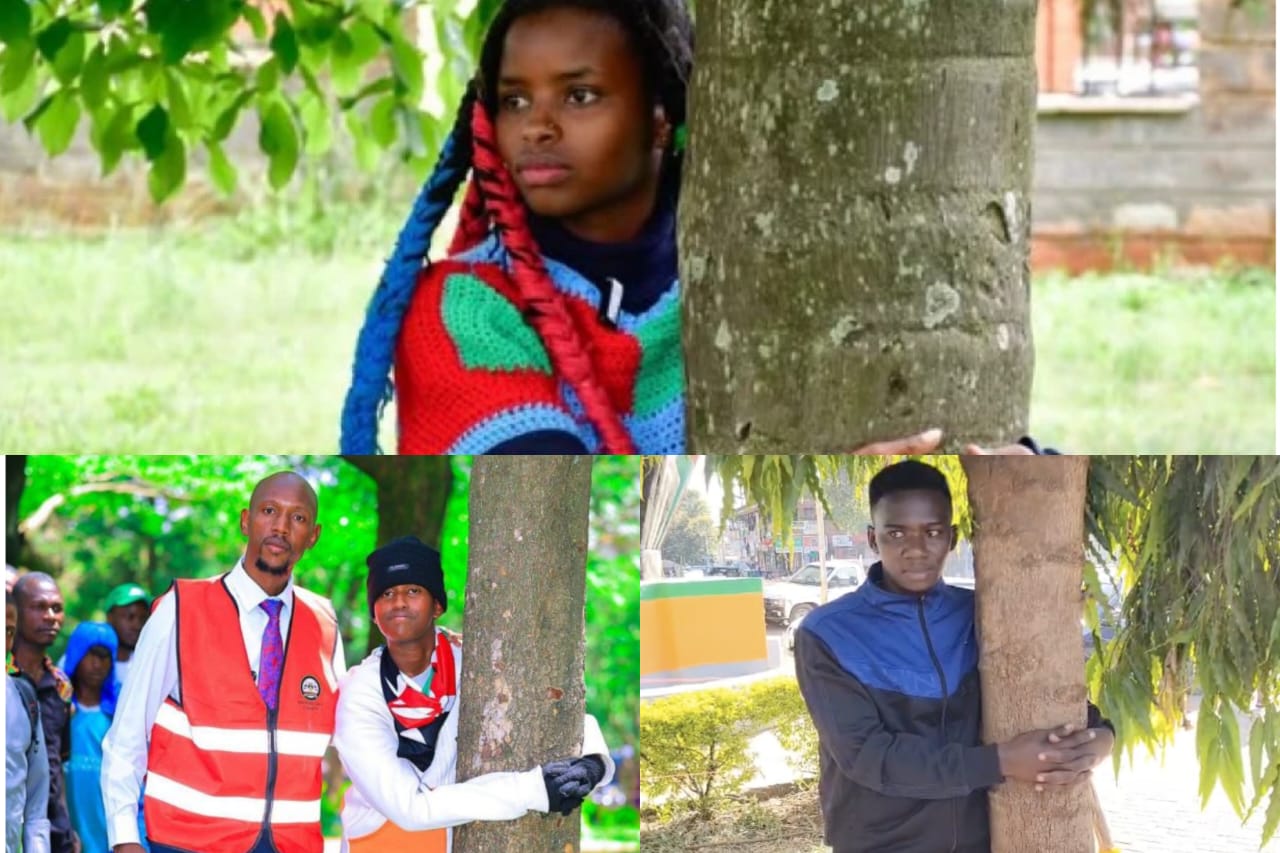
When Tree Planting Ambassador Truphena Muthoni hugged a tree for 72 hours, she ignited more than an endurance feat.
Muthoni sparked a nationwide challenge that has seen Kenyans of all ages and backgrounds attempting to emulate her endurance marathon for causes ranging from health to peace and education.
Her sustained embrace of a tree outside the Nyeri County Governor’s office in December was a striking act of environmental advocacy and personal resilience, drawing crowds, official recognition, and intense social media attention.
Her 72-hour tree hug, a feat she said was meant to highlight environmental conservation and reconnect Kenyans with nature, has become a symbol of grassroots climate activism.
The movement quickly transcended its original purpose.
In Murang’a, Pastor James (Jimmy) Irungu embarked on a grueling 80-hour tree-hugging challenge aimed at raising awareness about cancer.
Sadly, he collapsed at the 79-hour mark and was rushed to hospital with severe dehydration and developing multi-organ complications, including kidney failure, medical reports confirmed.
“I started this not for fame, but to make people see what families dealing with cancer go through,” Irungu said in the early hours of his attempt, surrounded by well-wishers who had gathered to support him.
But the physical toll proved too much.
“We underestimated the strain,” a volunteer medic later told local press.
In Nanyuki, Paul Kago, 43, also took up a prolonged tree-hugging vigil, this time for peace ahead of the 2027 general elections.
He planned to remain perched for 96 hours, but his body gave in less than a day into the challenge.
Rushed to Nanyuki Hospital with complications related to hunger and physical exhaustion, his attempt highlighted the risks of such extreme endurance stunts.
“It is for peace,” Kago said in an earlier statement as neighbors and curious onlookers gathered to watch him cling to the trunk of a tree in a public park.
“Our leaders are divided; we need unity.”
Amid these perilous episodes, others have found more positive outcomes.
In Nairobi, 14-year-old Stephen Gachanja successfully completed a 50-hour challenge at Jevanjee Gardens, raising funds for his brother’s critical medical treatment, which requires expensive surgery.
Local supporters cheered him on as he hugged the tree, completing his goal without incident.
“I did it for my brother,” Gachanja told reporters at the finish, visibly tired but triumphant.
“Thank you to everyone who donated and stood with us.”
In Kirinyaga, Josphat Ndegwa hugged a tree for 52 hours to spotlight challenges facing the boy child, while in Kerugoya Town a school-age child is currently halfway through an 81-hour hugging challenge to raise fees, drawing local attention and a mix of admiration and concern from residents and officials.
A video has also emerged online showing a girl in Carissa hugging a tree for 24 hours, urging political leaders “to return home from Nairobi” and address local issues directly.
Another photo has surfaced of John Macharia, a Kenyan living with disability, who says he will undertake the challenge today for one hour using one leg.
Macharia says the intention is to empower people living with disability and those suffering from asthma, a disease he says his mother succumbed to.
The surge in copycat tree-hugging challenges has sparked sharp debate in Kenya.
Some see it as creative activism that brings attention to important causes, environmental protection, peace, health and education, while others warn of the physical risks and possible exploitation of the movement for publicity.
Nairobi’s Citizen Engagement and Customer Service CEC Geoffrey Mosiria, urged authorities to intervene, stressing that “while environmental conservation is important, the current form of the challenge poses serious health risks to participants.”
Mosiria pointed to a growing number of individuals pushing beyond safe limits “in the name of endurance or financial gain.”
Critics in the media and social platforms have also weighed in.
Radio personality DJ Xclusive dismissed the trend as a misguided social media craze, calling it “not a career path” and urging people to pursue more substantial forms of activism.
His comments prompted debate among followers who argue that public engagement, even in symbolic forms, can jump-start conversation on pressing societal issues.
Meanwhile, Muthoni herself has remained a central figure in the unfolding narrative.
Her breakthrough act was not only widely covered in local press but also recognized by government leadership.
President William Ruto bestowed upon her a national commendation and appointment as Ambassador of the 15 Billion Tree Planting Campaign, underscoring a broader commitment to climate action.
“Before we plant a million trees, we must heal a million hurting hearts,” Muthoni said at the time, capturing the symbolic layering behind her endurance activism.
Environmental experts and some community leaders see potential in this unusual wave of challenges, not just for raising awareness but also as an entry point to deeper conversations on environmental stewardship and community engagement.
But they also caution that such acts should be grounded in safety and followed by tangible actions like tree planting, conservation education and policy advocacy.