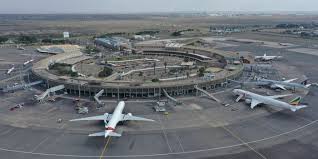
Kenya has reaffirmed its commitment to modernising Jomo Kenyatta International Airport (JKIA), signalling renewed momentum for the long-delayed expansion as regional competitors advance major airport projects.
President William Ruto recently emphasised the strategic importance of upgrading JKIA, reviving plans aimed at maintaining Kenya’s position as East and Central Africa’s aviation, business, and diplomatic hub.
Speaking during his end-of-year address at Eldoret State Lodge, he said construction of a “modern, world-class airport” at JKIA will begin in 2026 and will be financed through the Sovereign Wealth Fund.
“In 2026, we will begin the construction of a modern, world-class airport at Jomo Kenyatta International Airport to anchor our nation as the aviation capital of our region and boost our trade and tourism sectors,” Ruto said.
The statement signals that airport modernisation is back on the national agenda, amid rising regional competition from Ethiopia and Rwanda, which are pursuing new airport projects.
With policy direction now set at the highest level, attention is turning to the Kenya Airports Authority (KAA), the agency responsible for implementing the government’s vision.
Analysts say the JKIA expansion plan provides KAA with an opportunity to strengthen confidence among airlines, investors, and development partners.
Transport Cabinet Secretary Davis Chirchir confirmed the planned modernisation process.
“We want to become a hub that attracts visitors and provides a good experience upon arrival,” Chirchir said.
He also reiterated that the government plans to use Public-Private Partnerships (PPPs) to deliver the infrastructure upgrades, despite past setbacks such as the cancellation of the Adani Group’s contract.
The new plan replaces the previous concession model. Key features include an X-shaped passenger terminal with an initial capacity of 10 million passengers, expandable to 15 million.
It will feature four piers and a central processing hall separating domestic and international flows.
A long-overdue 4.8-kilometre second runway is scheduled for completion by June 2027, allowing simultaneous take-offs and landings and addressing JKIA’s single-runway limitations that have previously caused operational disruptions.
The blueprint also includes an Airport City, modelled on developments in Dubai and Istanbul, with hotels, logistics parks, and commercial districts to diversify revenue streams beyond flight fees.
Modernising JKIA is seen as essential for sustaining Kenya’s competitiveness in tourism and trade.
Efficient airports influence airline route decisions, visitor experiences, and cargo logistics—all factors directly linked to economic growth.
Tourism stakeholders have welcomed the renewed focus, noting it could attract long-haul carriers and high-value travellers.
Business leaders highlight that clarity on airport expansion strengthens Nairobi’s position as a regional corporate hub.
JKIA currently handles 8.6 million passengers annually, exceeding its design capacity of 7.5 million.
The airport continues to rely on a single runway and temporary terminals installed after the 2013 fire. Nairobi’s role as a leading conferencing and diplomatic centre also depends on JKIA’s performance.
Meanwhile, regional peers are advancing rapidly. Ethiopia has begun constructing what Prime Minister Abiy Ahmed describes as Africa’s largest airport in Bishoftu, southeast of Addis Ababa.
The Sh1.6 trillion (US$12.7 billion) facility will eventually handle 110 million passengers annually and replace Bole International Airport, with construction expected to take five years alongside a high-speed rail link and multi-lane motorway.
Rwanda is building Bugesera International Airport, a US$2 billion project backed by Qatar Airways, located 40 kilometres south of Kigali.
Scheduled for completion in 2026, it will initially handle eight million passengers annually, rising to 14 million by 2032, alongside a cargo terminal capable of processing 150,000 tonnes a year. As regional competition grows, Kenya’s renewed commitment to JKIA marks an important step.
The challenge now is translating policy intent into tangible progress. A modern, efficient JKIA is seen as central to supporting tourism growth, business competitiveness, and diplomatic influence.
With government vision now clearly restated, responsibility rests with KAA to act swiftly to ensure the country’s main gateway keeps pace with regional developments.