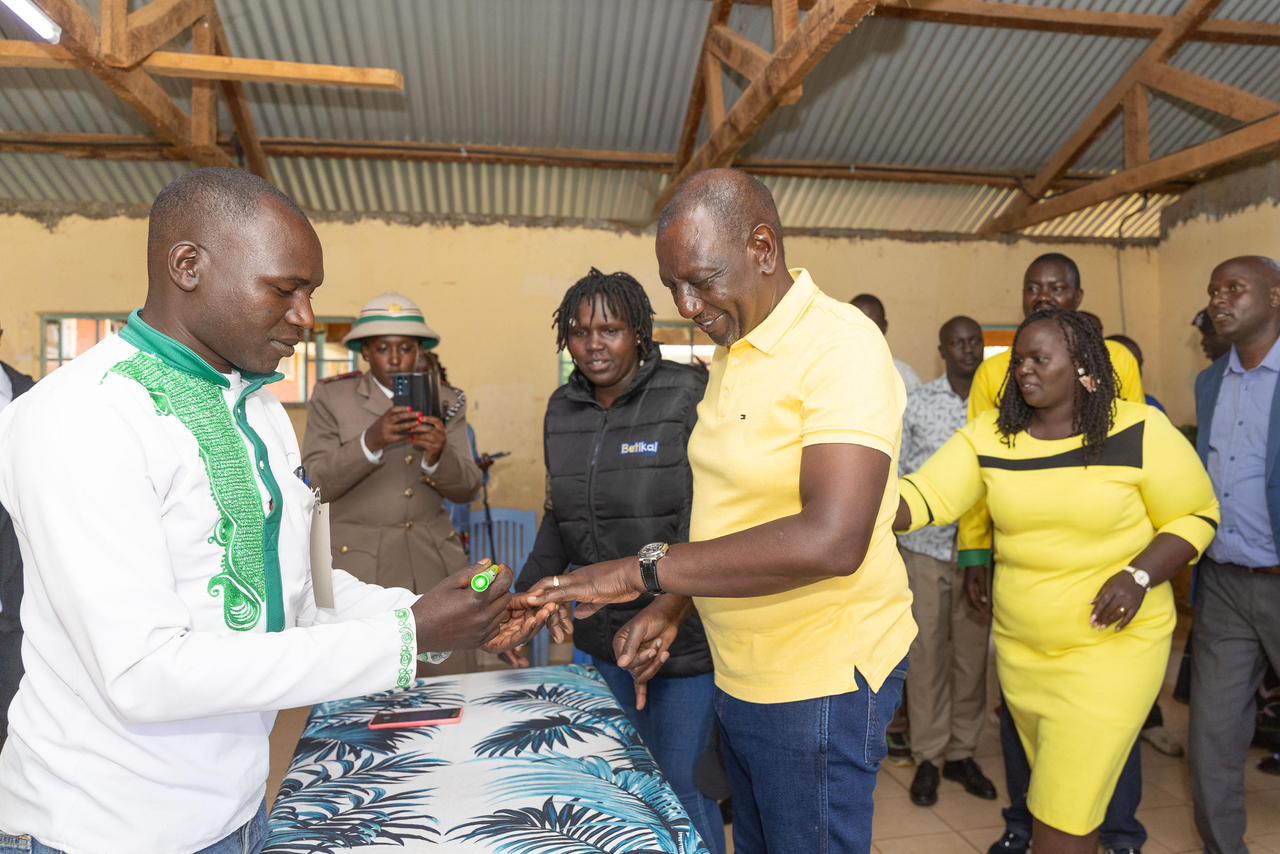
 President William Ruto gets his finger marked with indelible ink after voting in the UDA grassroots elections at Koilel Primary School in Uasin Gishu county, January 10, 2026. /PCS
The United Democratic Alliance has formally activated its internal dispute resolution mechanism ahead of the conclusion of Phase III countrywide grassroots elections and by-election nominations in two wards.
In a notice dated January 9, the UDA Electoral and Nomination Dispute Resolution Committee (ENDRC) announced it will be on standby to receive, hear and determine all disputes arising from the polls, which are being held across 20 counties and Evurore and Muminji wards in Mbeere North constituency.
“Notice is hereby given that the UDA Electoral and Nomination Dispute Resolution Committee shall be available to receive, hear and determine all disputes relating to the party grassroots elections and by-elections nominations,” the notice signed by ENDRC chairperson Adrian Kamotho reads.
The committee directed that all complaints arising from the polls must be lodged within 24 hours, upon declaration of results or nomination decision giving rise to respective disputes.
Kamotho said disputes can be submitted electronically through the committee’s official email address.
The Phase III grassroots elections are being conducted in 12,000 polling centres nationwide, translating into the election of about 240,000 party officials.
Deputy Party Leader Kithure Kindiki said on Thursday that each polling station will elect 20 officials, a structure designed to strengthen the party’s grassroots presence and administrative reach.
The elections are taking place in Bomet, Kakamega, Kirinyaga, Elgeyo Marakwet, Nandi, Kiambu, Uasin Gishu, Laikipia, Nyandarua, Kericho, Vihiga, Nyeri, Baringo, Nakuru, Murang’a, Trans Nzoia, Embu, Samburu and Meru counties.
With 310,651 candidates having registered to contest various positions across the 20 counties, the UDA exercise has drawn unprecedented participation and is shaping up to be one of the largest party electoral exercises ever conducted in the country.
Party officials estimate that about three million UDA members are taking part in the polls, averaging roughly 250 voters per polling centre.
The scale of the exercise highlights the logistical and organisational demands facing the party as it seeks to consolidate its structures.
President William Ruto, who is the UDA party leader, cast his vote at Koilel Primary School in Uasin Gishu county.
In a briefing earlier in the week, UDA National Elections Board (NEB) chairperson Anthony Mwaura said the grassroots elections are a central pillar of the party’s long-term political strategy.
He noted that the process is aimed at mobilising support, consolidating party structures and strengthening UDA’s presence and visibility across the country ahead of the 2027 General Election.
The activation of the ENDRC during the voting period is intended to provide a clear and accessible channel for addressing grievances, particularly in a contest involving hundreds of thousands of candidates and millions of voters.
Party officials say the move is meant to enhance transparency, credibility and confidence in the outcome of the elections.
The notice makes clear that the ENDRC’s mandate covers both grassroots elections and by-election nominations, signalling the party’s intention to handle all internal disputes within established institutional frameworks.
As voting continues across the selected counties, attention is likely to focus not only on turnout and results, but also on how efficiently disputes are handled in the critical hours following declarations.
For UDA, the conduct of the Phase III grassroots elections and the management of any resulting disputes will be viewed as an early test of the party’s organisational maturity as it prepares for the 2027 general elections.