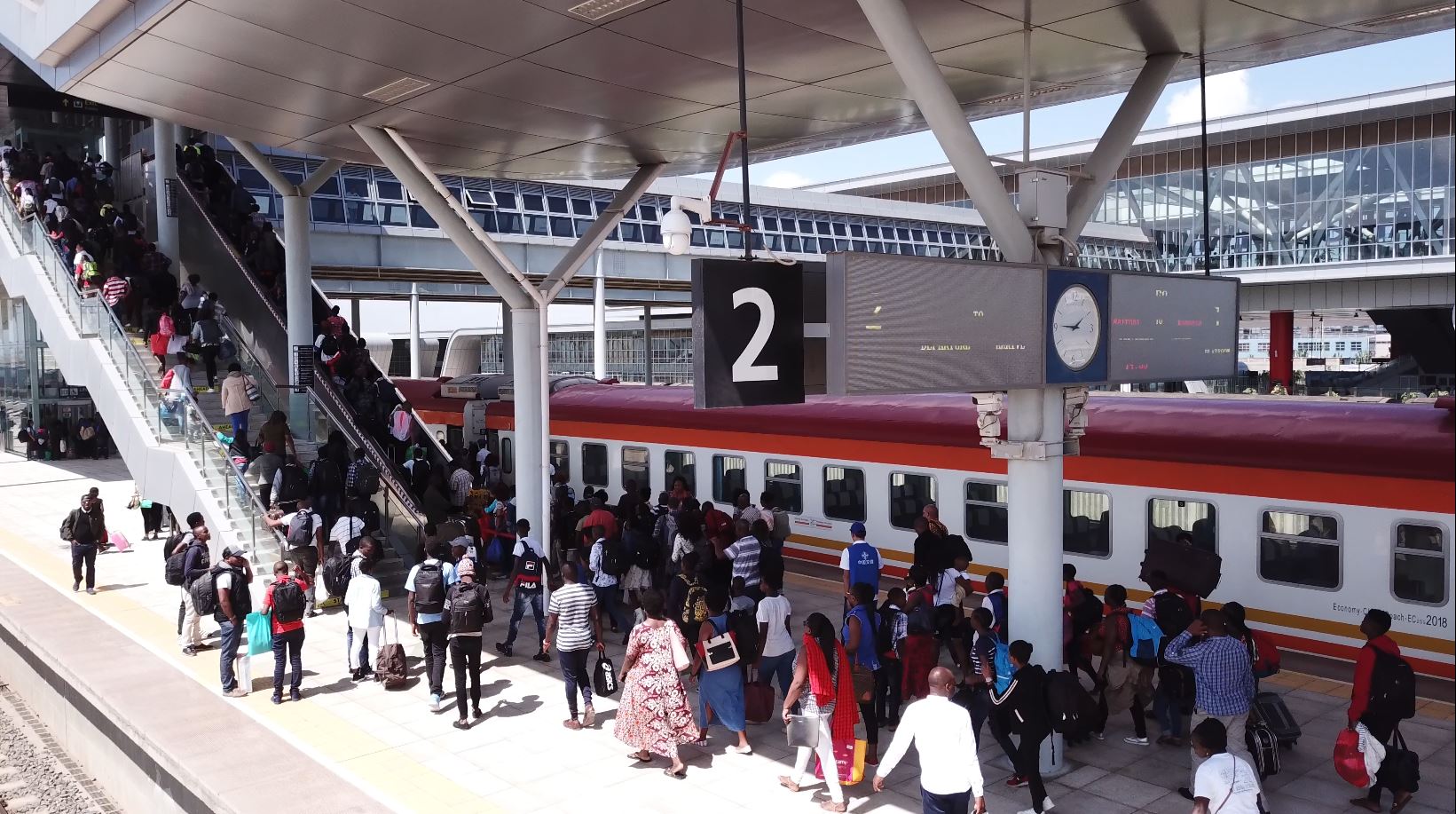
Passengers at the Nairobi SGR Terminal / X
Standard Gauge Railway cargo volumes declined marginally in the third quarter of 2025, despite the Port of Mombasa handling significantly higher volume of goods.
However the railway handled recorded strong passenger growth, pointing to shifting dynamics in the country’s transport and logistics sector.
According to the Third Quarter 2025 Gross Domestic Product (GDP) Report by the Kenya National Bureau of Statistics (KNBS), freight transported via the SGR contracted by 1.3 per cent to 1.698 million metric tonnes.
This was down from 1.720 million metric tonnes recorded in the same period of 2024.
The decline came despite an increase in overall cargo throughput at the Mombasa Port which is Kenya’s main maritime gateway.
“Performance in the railway transport sub-sector showed mixed trends.The number of passengers ferried through the Standard Gauge Railway (SGR) increased by 8.6 per cent, on the other hand, freight transported via SGR contracted marginally by 1.3 per cent,” the KNBS report shows.
During the review period, the volume of goods handled at the port rose by 12.3 per cent, climbing from 10.24 million metric tonnes in the third quarter of 2024 to 11.50 million metric tonnes in the same period of 2025.
The increase reflects stronger import demand and recovery in regional trade flows as Mombasa’s stature as a logistics hub for East and Central Africa continues to grow.
The divergence between port cargo volumes and SGR freight performance suggests that a larger share of goods is still moved via road transport.
The data shows that land transport activity remained robust during the quarter, due to stable diesel prices a key input for road freight operations.
“Consumption of light diesel, a key input for land transportation, increased by 10.5 per cent to 633.1 thousand metric tonnes in the review period. Furthermore, the average diesel price remained relatively stable, recording a marginal increase of 0.2 per cent to stand at Sh172.72 per litre,” KNBS noted.
While cargo volumes on the SGR softened slightly, passenger traffic told a markedly different story.
The number of passengers ferried by the SGR increased by 8.6 per cent, rising from 650,352 passengers in the third quarter of 2024 to 706,385 passengers in the same period of 2025.
The growth points to rising consumer uptake of rail travel, particularly on the Nairobi–Mombasa route, driven by affordability, improved reliability, and growing domestic travel demand.
The strong passenger performance aligns with broader growth in the transport and storage sector, which expanded by 5.2 per cent in the third quarter of 2025, up from 4.6 per cent in the corresponding period last year.
Growth in the sector was supported not only by rail transport, but also by increased activity in road, water and air transport.
Air transport also recorded notable gains, with visitor arrivals through Kenya’s main international airports increasing by 9.9 per cent to 578,234 passengers, reflecting a recovery in tourism and business travel during the quarter.
The rise in passenger mobility has had positive spillover effects on accommodation, food services and urban commerce.