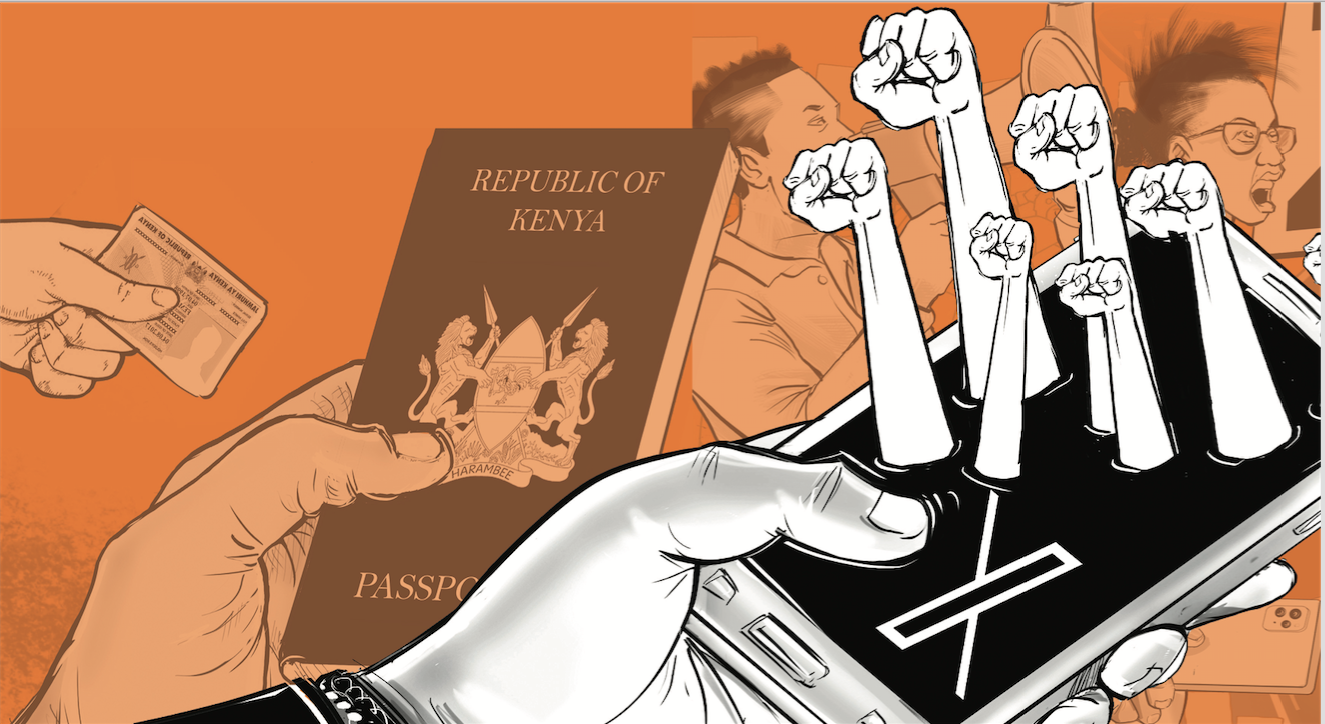
Fellow Kenyans, your passport begins with a lie. Not in its chip, not in its holograms, but in the first sentence you hand to the world: “This is to request and require in the Name of the President of the Republic of Kenya…”.
That line is a constitutional trespass. It is a colonial echo that has outlived its welcome 14 years after we, the people, rewrote the story of power in the 2010 constitution. Article 1 is plain: all sovereign power belongs to the people of Kenya. The president is not the owner of that power; he is its steward. Yet every time a Kenyan crosses a border, we are made to declare the opposite.
This is not a quibble over grammar. It is a daily betrayal of the covenant we sealed with ourselves in 2010. Symbols are the quiet teachers of authority, and this symbol teaches the wrong lesson.
The wording is a hand-me-down from the British Empire. Under monarchs, passports read: “His Britannic Majesty’s Secretary of State Requests and requires in the Name of His Majesty…” The sovereign was the King; the request was issued in his personal name. When Kenya became a republic in 1964, we simply swapped “His Majesty” for “the President”. We kept the structure, the cadence and the psychology of power flowing downward.
Modern republics have moved on. Switzerland, the United States and Germany long ago abandoned the monarchical form. Their passports speak for the people through the state they created.
In Switzerland, the inner page reads: “The Swiss Confederation requests all domestic and foreign authorities to allow the bearer of this passport to pass freely…” No president, no chancellor—just the Confederation, the legal body of the people and cantons.
In the United States: “The Secretary of State of the United States of America hereby requests all whom it may concern to permit the citizen…” No president, only law and office.
In Germany: “The Federal Republic of Germany requests all domestic and foreign authorities to allow the holder of this passport to pass freely…” The Republic—the people’s creation—makes the appeal.
These are not stylistic flourishes. They are constitutional declarations. The state is the people’s instrument. The passport, as the state’s voice abroad, must reflect that truth. The language of passports is governed by courtesy, not command.
The Vienna Convention on Consular Relations makes clear that such requests are non-binding diplomatic appeals. “Requires” is an archaic overreach; “requests” is the global norm. The phrase “without let or hindrance” is standard ICAO language, retained for continuity. The only question is who speaks.
In Kenya’s case, the speaker must be the Republic, acting on behalf of the People. Replace the current text with: “On behalf of the People of Kenya, the Republic of Kenya requests all whom it may concern to allow the bearer to pass freely without let or hindrance and to afford the bearer such assistance and protection as may be necessary.”
This is not invention. It is alignment—explicit in naming the People, accurate in using the Republic, diplomatic in tone. The fix is administrative. The Cabinet Secretary for Interior can amend Schedule 1 of the Kenya Citizenship and Immigration Regulations by Gazette notice.
New passports and renewals issued thereafter will carry the corrected text. Cost: a software update and a new inner-page design. But the initiative must come from the people.
Under Article 119, every citizen has the right to petition Parliament. Prepare a petition, gather 1,000 signatures per constituency, and deliver to your MP. Parliament must direct the Executive. The Executive must obey.
When a young Kenyan entrepreneur lands in the United States of America, or the United Kingdom, or the People’s Republic of China, she should not hand over a document that says she travels “in the name of the President”. She should present a passport that says: “I travel in the name of 54 million Kenyans who own this Republic.”
We ended the imperial presidency in 2010. Let us bury its last relic in 2026. The passport must speak for the People—because the People breathe life into it, otherwise it is just a booklet. The passport must embody the general will of the people of Kenya.
Social consciousness theorist, corporate trainer and speaker, agronomist consultant for golf courses and sportsfields, and author of 'The Gigantomachy of Samaismela' and 'The Trouble with Kenya: McKenzian Blueprint'