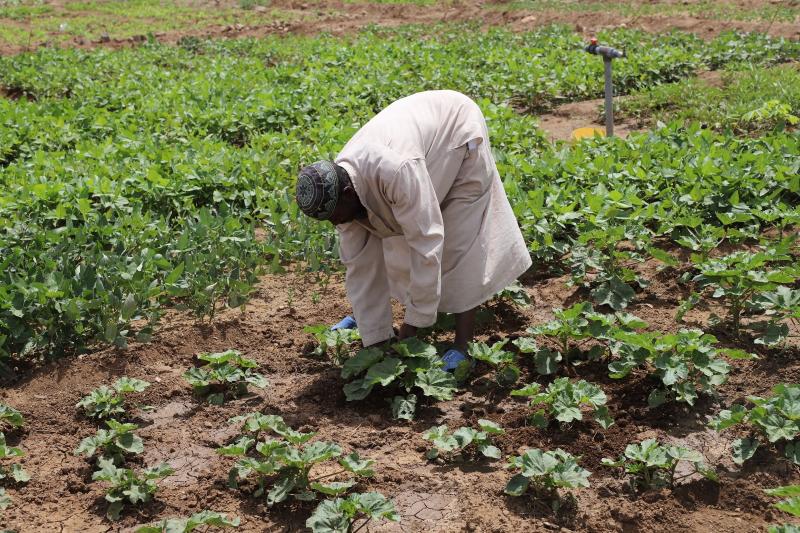
Refugees living in Kalobeyei village within Kakuma settlement are rediscovering a sense of purpose and self-reliance through farming, growing green leafy vegetables, cereals, legumes, and multi-purpose trees at Kawoi Farm in Field 9.
Organised into informal learning groups, the farmers meet regularly to share knowledge and skills.
Cheruiyot Kipngeno, an agronomist with the Food and Agriculture Organization of the United Nations (FAO), says many draw from farming traditions they practiced in their countries of origin before being displaced by conflict.
“These sessions not only support food production but also foster social integration among refugees themselves and with members of the host community,” she adds.
Kalobeyei Integrated Settlement is home to more than 80,380 refugees and asylum seekers, according to UNHCR, drawn from Somalia, Eritrea, South Sudan, Rwanda, Uganda, Burundi, the Democratic Republic of Congo, and Ethiopia.
Among the farmers is Saidi Mtokambali, a refugee from the DRC and the sole breadwinner for his family of 13.
He has been allocated a small plot at the edge of Kawoi Farm, and Mtokambali has turned it into one of the most productive farms in the area, growing okra, jute mallow (mrenda), cowpeas, and spinach.
He recalled his life before displacement, when farming was once his mainstay. “Back home in the DRC, I used to harvest maize in tonnes.
This was enough to fill a whole truck and earn good money,” he said. While his current plot is much smaller, the vegetables he harvests feed his family, with the surplus sold to earn a modest income.
The initiative also brings together refugees and host community members. James Naminyi, a local resident, said crop farming was unfamiliar to him in an area traditionally dominated by pastoralism due to harsh climatic conditions.
“This is my first time planting crops, thanks to the training,” he said. “I have planted cow peas and I’m eagerly waiting for the harvest.”
Peter Lomoi, a 28-year-old refugee from South Sudan and father of six, has planted cow peas, cassava, sweet potatos (matembele), and green grams on his plot. Lomoi supported his family through farming back home and hopes to expand his activities. “I have used the land well and would like a bigger plot to grow more food,” he said.
For Emmanuel Nijimbere from Burundi, farming is a completely new experience. At 54 and a father of four, he says the training has opened new possibilities. “This is my first time farming, and I am grateful for the support. I also hope the farm sizes will increase,” he said.
According to Kipngeno from FAO, both refugees and host community members have shown remarkable enthusiasm and adaptability.
“They are growing vegetables familiar from their countries of origin, while also adopting new crops that are better suited to the local climate,” she explained.
Kipng'eno envisions a future where more people join the initiative and the full 6.4-hectare Kawoi Farm is utilised to strengthen food security, build resilience, commercialise production, and reduce dependence on humanitarian assistance.
The initiative is part of the Building Opportunities for Refugees and Host Communities’ Self-Reliance Project funded by the European Union and implemented by FAO alongside other UN agencies.
The project supports refugees and host communities to diversify income sources within the agricultural sector.
Under the project, farmers cultivate small plots measuring about 400 by 400 metres. With favourable weather and good agronomic practices, the farms produce enough vegetables to supplement food rations, with the surplus sold for income.
“Farmers who follow recommended agroecological practices can earn approximately $34 to 37 per week (Sh4,386 to Sh4,773),” Kipng'eno said.
She added that farming in Turkana has historically been limited by arid conditions. However, at Kawoi Farm, the establishment of a water pan and an irrigation system set up by FAO with funding from the IKEA Foundation has enabled 160 farmers to take up vegetable production.
“Additional support includes access to a two-wheel tractor for ploughing and continuous agricultural extension services provided by trained Community-Based Extension Service Providers (CBESPs). Each extension agent supports about 40 farmers,” Kipngeno said.
Ambrose Metet, one of the extension agents attached to Kawoi Farm, said the farmers’ dedication is inspiring. “They are passionate and hardworking. Their commitment is visible in the way they manage their crops,” he said.
For Tenge Tenge, a refugee from Rwanda, farming has become an essential part of daily life. “We like farming because it keeps us busy and puts food on our plates. These farms are very important to us,” he said, gesturing toward the lush vegetable beds.
The Building Opportunities for Refugees and Host Communities’ Self-Reliance Project is being implemented in both Kakuma and Kalobeyei, where relative peace has enabled sustained humanitarian and development interventions.
“In Kakuma and Kalobeyei, peaceful coexistence between refugees and host communities has created a stable environment for long-term development,” Kipngeno noted.
The initiative aligns with the Kalobeyei Integrated Socio-Economic Development Plan (KISEDP), the main framework guiding refugee and host community responses in Turkana County. Phase I of KISEDP concluded in 2022, while KISEDP II was launched in March 2023.
Led by the Government of Kenya, KISEDP is a multi-year, multi-sectoral strategy aligned with the Global Compact on Refugees, the Sustainable Development Goals, and regional frameworks such as IGAD and the East African Community. It also supports national and county development priorities, including Turkana County’s third-generation County Integrated Development Plan.