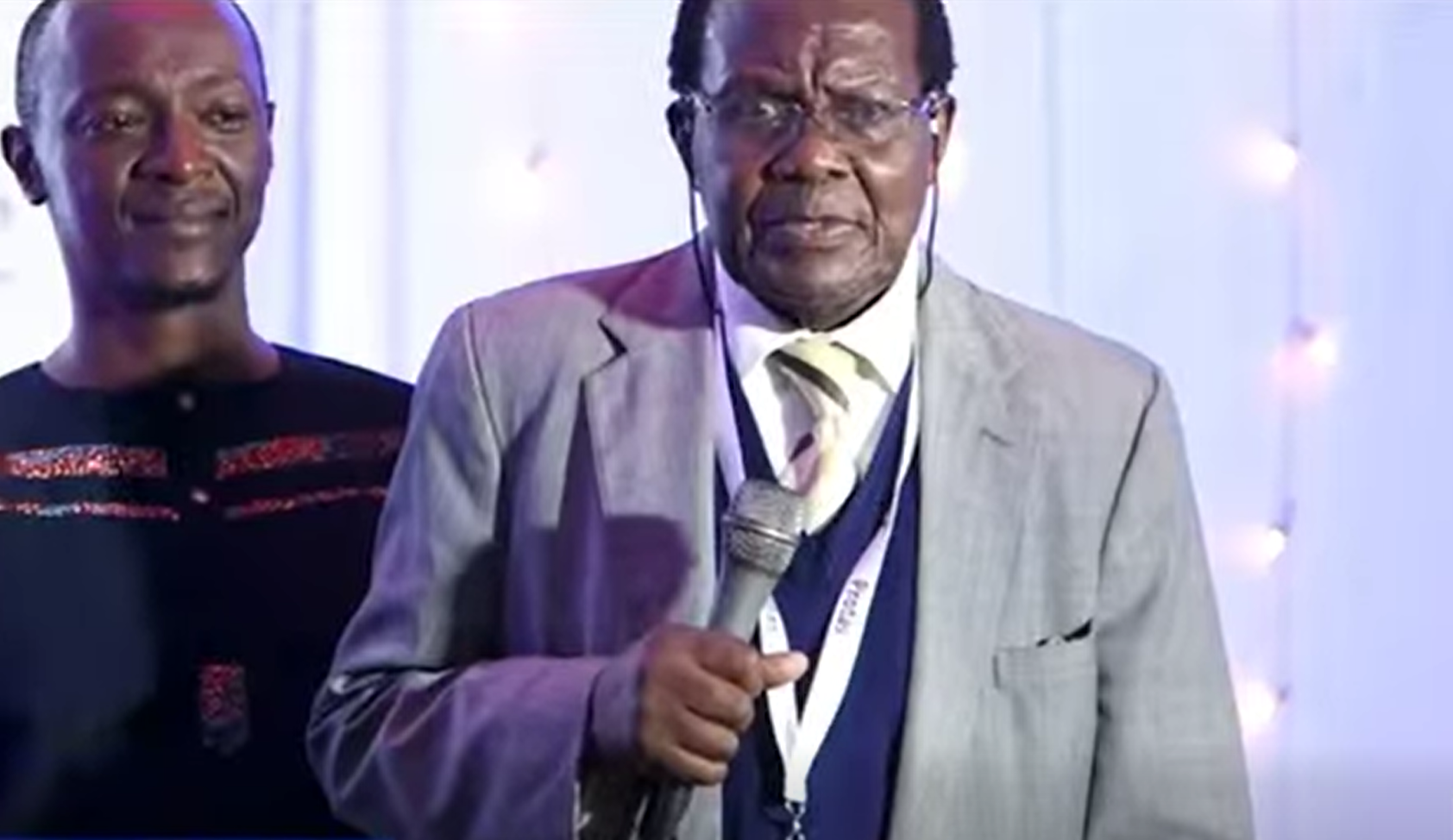
 Prof William Lore speaks during the 50th Kenya Medical Association Scientific Conference in May 2023, in Mombasa. The meeting also celebrated the 100th anniversary of the East African Medical Journal (EAMJ). Next to him is KMA President Dr Simon Kigondu.
Prof William Lore died on December 23, 2025. He was a professor of medicine and a long-serving editor-in-chief of the East African Medical Journal. He also served as the chair of the Kenya Medical Association.
Medicine is divided into four major disciplines: paediatrics – diseases of children; obstetrics/gynaecology – diseases and conditions of women; surgery – where there is a need to cut someone up; and internal medicine – which covers diseases and conditions of everyone.
Medicine is practised from two perspectives, clinical and public health. Clinical medicine is about the individual and the disease that affects them as a person. Public health is about the community, how it contributes to and is affected by individual illness.
Prof Lore was an internal medicine specialist in cardiology, diseases of the heart. He taught first at the University of Nairobi from 1977 to 1989. He was part of the professors who established the medical school at Moi University from 1989 onwards.
Many of the currently practising cardiologists and hundreds of doctors passed through his hands. Many of his students will remember his gentle nature when teaching, especially bedside ward teaching with patients. Learning in the wards, with the patient present and other students, was often an intimidating experience.
Prof Lore was a gentle teacher, guiding students to think and logically learn their medicine without distressing the patient. He taught many how to use the stethoscope, that proud symbol of a doctor, properly.
But perhaps his greatest contribution to the foundations of medical practice in independent Kenya was not in the wards but as Editor-in-Chief of the East African Medical Journal.
The practice of medicine is dynamic, and doctors need to keep up with the latest knowledge. That knowledge has to be local; the mosquito in Italy does not do the same thing as in Kenya. Cajoling and collating Practioners to write is a tough business.
Today, the advent of the pin has made even the signature, a bit of writing that does not need to be legible, irrelevant. But even in the past, Africans were not known for writing a lot. As editor in chief, Prof Lore had to find, encourage and motivate Practioners to become researchers, to write.
Today, many imagine motivation means money despite the scientific evidence to the contrary. For the editor of the EAMJ, getting people to write was about true motivation, getting people to develop a passion. He did it for many years, almost single-handedly carrying the journal.
I would occasionally visit his office. He was always impeccably dressed. A suit, trousers held by suspenders. He favoured a white collar, broad, vertical striped shirts with a bow tie. He would be at his desk, swamped with manuscripts and paper in neat bundles all over the place. Pen in hand, meticulously editing a particular manuscript, preparing it for print. It was all manual until personal computers became common.
Dr Lore was also the chair of the Kenya Medical Association. What KMA is today, with thousands of medical doctors as members, has grown from an early foundation when just a few hundred doctors were practising in Kenya. The medical fraternity in Kenya has lost a number of its foundational members who contributed greatly to establishing medical teaching and practice.



![Africa CDC Director General Dr Jean Kaseya at a past event. [Photo: Arthur Mbuguah, WHM]](https://cdn.radioafrica.digital/image/2026/10/8ced213c-affb-4dff-97ca-1b6bac1f958e.webp)