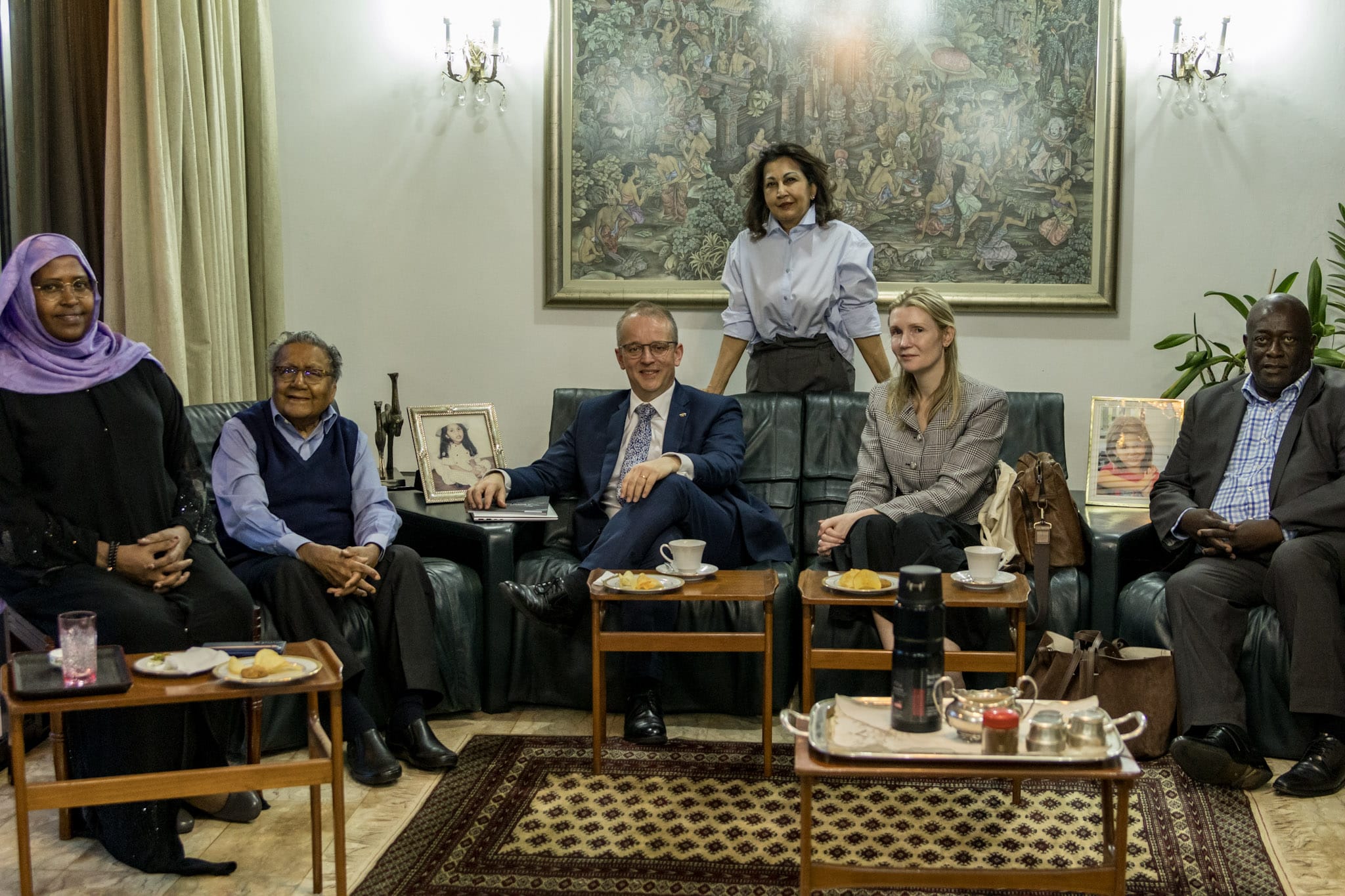
 KUTRRH CEO Dr Zeinab Gura, Dr Manu Chandaria, Prof Keith Brennan, Priti Chandaria, Helen Hawthorne, and Amb. Prof. Manoah Esipisu. Photo/Richard Kanguru.
The collaboration, launched on September 30, 2022, with funding from the National Institute for Health and Care Research (NIHR), was designed to improve early detection, diagnosis and treatment of oesophageal cancer — one of the most common and deadliest cancers in parts of Kenya.
The programme has been piloted in Kiambu, Nyeri, Ikuru, Kisii and Meru counties, bringing screening services and improved diagnostics closer to communities where patients often present late with advanced disease.
Prof Keith Brennan, Vice Dean for Internationalisation at the University of Manchester and lead of the strategic partnership, said one of the project’s most important gains has been diagnosing the disease earlier.
“Previously, oesophageal cancer was only seen at stage 3-4. We are now seeing it at stage 1-2, when it's curative; there are curative options. Stage 3-4, it's not. It's palliative, and it's end-of-life. Whereas at stage 1-2, there are curative options. So, that is a success,” he said.
In Kenya, late diagnosis has long undermined cancer outcomes, with many patients seeking care only when symptoms become severe. By introducing structured screening and strengthening community awareness, the partnership is beginning to reverse this trend.
Capacity building has been central to the intervention. Thousands of frontline health workers have been equipped with skills to identify symptoms early and refer patients promptly.
“We have trained 14 surgeons in endoscopy so that they can look for the cancer. We've trained two pathologists who can then screen the samples and actually understand whether there's a cancer present or not,” Prof. Brennan said.
In addition, about 15,000 Community Health Promoters have been trained to recognise early warning signs and guide patients into the health system — a move expected to significantly shorten the time between symptom onset and diagnosis.
The partnership has also enabled a two-way exchange of expertise between Kenya and the United Kingdom. Kenyan clinicians have travelled to Manchester for specialised training at The Christie Hospital, while UK experts have supported local teams through on-site mentorship and the rollout of screening and treatment protocols.
Beyond individual skills, the initiative has helped strengthen institutions — particularly KUTRRH, which has rapidly grown into a major referral and research centre.
“So, when I first came here, that hospital was just starting to open; they might have had a handful of patients, if that. Now, it's a successful, thriving hospital that teaches medical students, does research and is clearly a referral centre for the nation,” Prof. Brennan said.
KUTRRH is now playing a central role in cancer care, research and training, with the oesophageal cancer project embedding new technologies, clinical practices and research capacity within the facility.
The origins of the collaboration trace back to a request by former President Uhuru Kenyatta to explore partnerships in oncology. While cancer care was the broad focus, the decision to prioritise oesophageal cancer came from Kenyan partners.
“When it came to thinking about the particular cancer type, that came as a question from KUTRRH. It came because it's the fourth most common cancer in Kenya, and at the time, it was causing the most deaths from cancer. For us, it was a huge learning experience, listening to what your partner sees as important,” he explained.
Implementation has not been without challenges. Kenya’s devolved health system meant the programme had to negotiate agreements separately with county governments during the pilot phase. While this required more time and coordination, it also helped build ownership at the local level.
With the pilot phase nearing completion and early results showing promise, attention is now shifting to national expansion. Discussions are expected with the Ministry of Health on scaling up the programme to all 47 counties.
The long-term goal, according to Prof. Brennan, is to ensure that the expertise developed through the partnership becomes embedded within Kenya’s health system, rather than remaining a time-limited intervention.
Looking ahead, researchers are also turning to genomics to better understand why the disease is more common in certain regions of the country.
“There are more cases of oesophageal cancer as you go across the Rift Valley and Western Kenya than there are in Eastern Kenya. This tells you it might be something present in the environment, or it might be something missing from the environment. But the genomics might tell us what it is in the environment that we want to get rid of or it will tell us what's missing from the environment we need to add. This will be a good preventive measure,” he said.
Genomic studies could also help tailor treatment by identifying the specific genetic mutations driving the disease.
“The issue is that a lot of those targeted, very precise therapies are very expensive. So you need the evidence to explain why you actually need that drug. So the genomics will give that evidence too. So that will make the treatment of patients much better,” he said.

![Africa CDC Director General Dr Jean Kaseya at a past event. [Photo: Arthur Mbuguah, WHM]](https://cdn.radioafrica.digital/image/2026/10/8ced213c-affb-4dff-97ca-1b6bac1f958e.webp)