

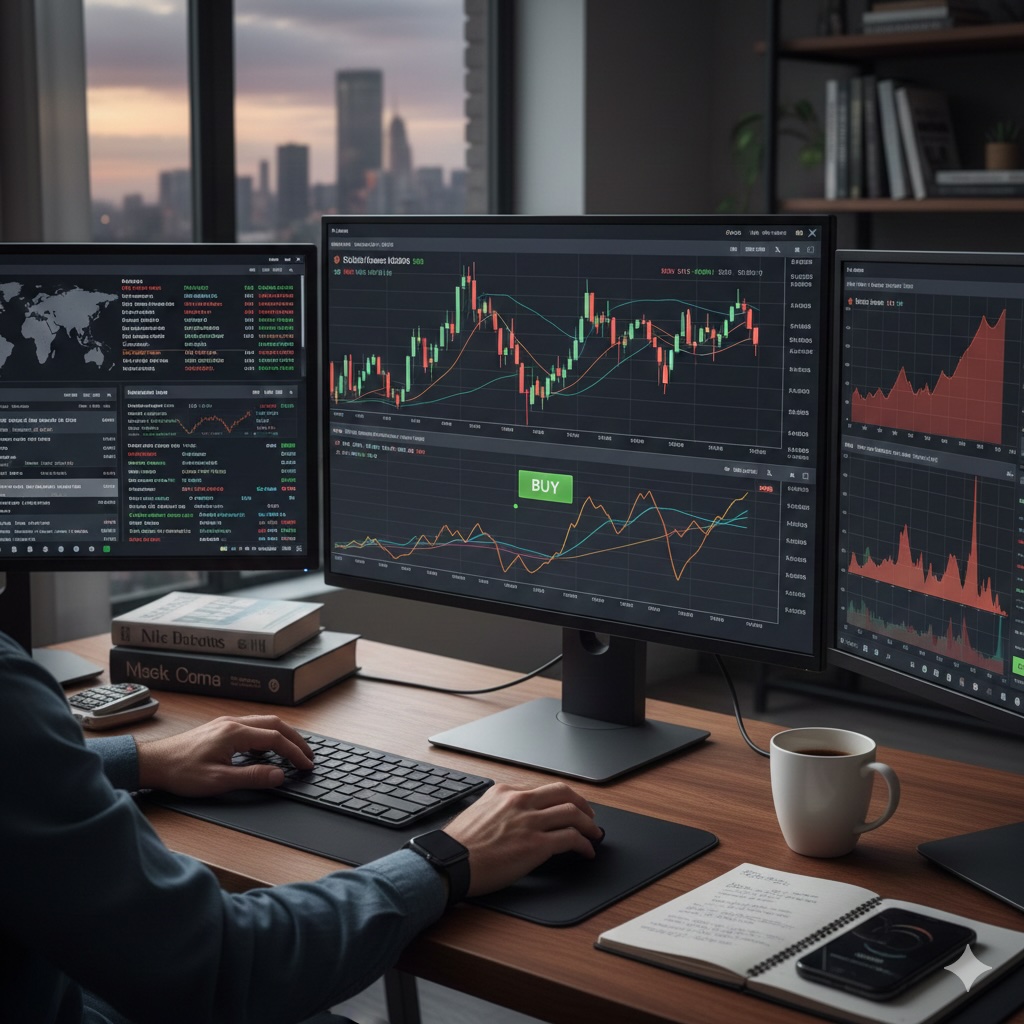
As of 2025, the Foreign Exchange (Forex) market is still the world’s biggest and most liquid marketplace with average trading volumes in excess of $7 trillion every day. While the stock exchange closes at the end of a trading day, Forex trades and continues 24 hours a day and five days a week.
Financial hubs around the world are connected through Forex every day of the week in Sydney, Tokyo, London, and New York.
A market that never sleeps
The 24-hour aspect of Forex trading simply acknowledges the fact that the global economy is an interconnected one. While a major market may be closed, it soon opens in a matter of hours.
This means, for instance, that the Tokyo market opens as the market in Sydney continues overnight, and this continues into the European market, where it simultaneously operates as the Asian market, and finally the U.S. market.
This is an advantage to traders who seek flexibility.
There has been a tremendous uptake of participation by retail traders; currently, millions of people across the globe are trading Forex through smartphones and laptops. Some 60% of retail Forex traders are now using mobile trading platforms to make trades and track positions.
Effects of global events on price action
Price changes in the foreign currency market are extremely time-sensitive in the 24-hour environment.
News related to changes in interest rates at the Fed, European Central Bank, and the Bank of Japan could create volatility in currency pairs such as EUR/USD and USD/JPY. Sometimes natural calamities and political issues also contribute toward changes in currency values.
Economic calendars and news feeds are now common features of most trading platforms available today. As such, the trader can anticipate major events and develop strategies ahead of time. Such immediacy promotes a dynamic risk and position approach since there can be spikes in markets during major announcements.
Volatility and liquidity throughout the day
Liquidity, or ease of buying or selling of assets without changing market price, is not equal throughout a trading day. It reaches the peak during times when markets overlap globally, for instance, during London-New York overlap. When markets overlap, bid-offer spreads tighten, and execution quality enhances, and big traders find it easier to exit and entry positions.
Fewer active hours, on the other hand, can somewhat create their own set of opportunities.
The Asian market, for instance, tends to experience low volume activity but can contain forming market trends that are created as a result of the start of other market sessions, either in Europe or America.
Risk management within a continual market
A 24-hour market calls for special measures for effective risk management. A market that “closes,” as is the case with other markets, is not the same with Forex since the market is open on weekends and overnight. Effective risk management requires sophisticated tools such as stop loss orders and profit-taking levels.
Algorithmic trading and automated notifications are also at play. Traders find it useful to create scripts that allow them to monitor price levels so that trades are executed based on pre-programmed conditions, enabling them to manage risk even when they are not present.
Accessibility and education
The contemporary Forex trading community has, in fact, unprecedented educational resources at its disposal. Online tutorials, webinars, and dynamic analyses by brokers and unbiased educators are linked to current market conditions.
Alongside the availability of free demo trading accounts, beginners can learn about price movements, leverage, and strategies risk-free.
This democratization has driven the popularity of Forex all over the world. People from all over, including Africa, Latin America, and Southeast Asia, take part in trade markets, previously controlled by institutions.
The role of technology
Technology is the backbone of the 24-hour Forex market. With advanced internet connectivity, cloud-based graphing, and mobile connectivity, there is immediate response to market changes.
Artificial intelligence and machine learning tools are being developed to analyze market patterns to produce predictions.
With such technology, both amateurs and experts in the trade are better equipped to deal with the continuous cycle of international finance.
Conclusion
The 24-hour Forex market reflects our interlinked financial world—teeming with opportunity, full of intricacies, and always in flux.
It presents many challenges for Forex traders, from having to think globally, taking appropriate measures for risk management, and adapting their strategies through real-time data.
For those who are keen on learning and adapting, it provides unparalleled access to what could very well be the world’s most dynamic market.







