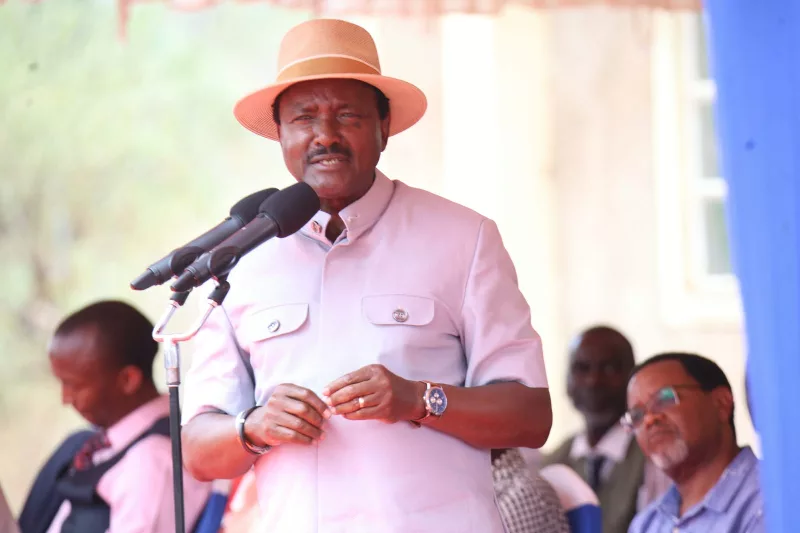
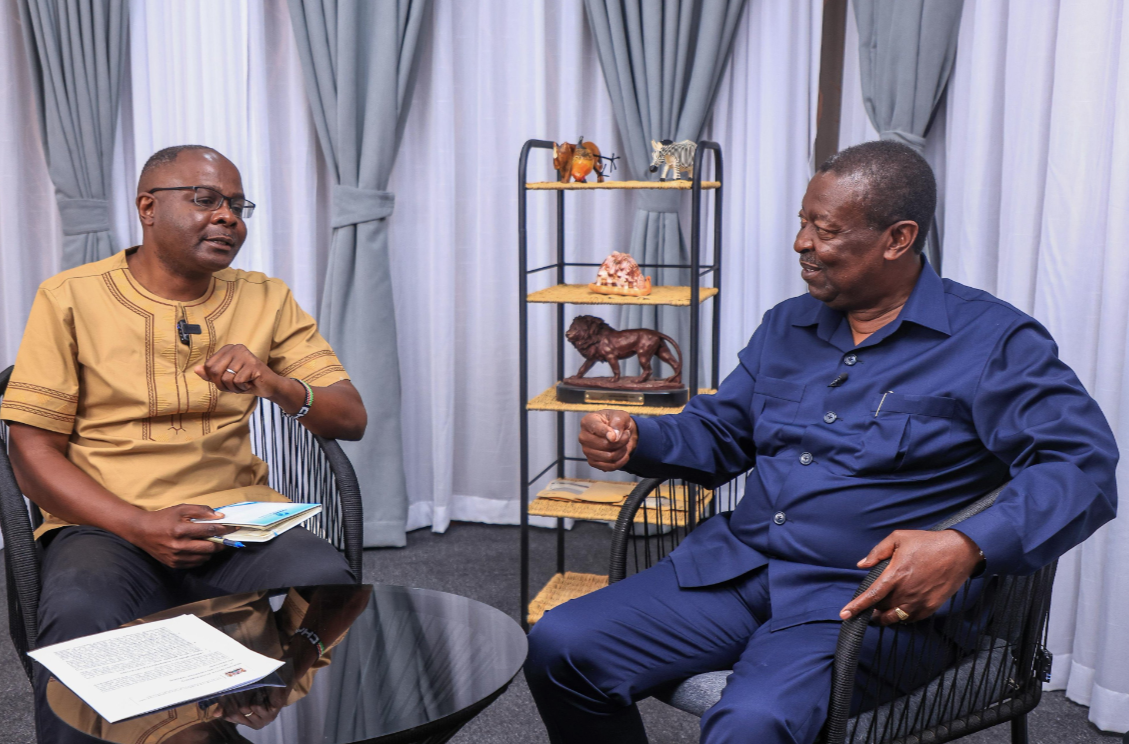
 CHAMS MEDIA CEO and veteran journalist Alex Chamwada and Prime Cabinet Secretary Musalia Mudavadi during an end year media interview in Nairobi/OPCS
Prime Cabinet Secretary Musalia Mudavadi has floated the idea of holding the 2027 General Election alongside a constitutional referendum.
He argued that the move could offer Kenyans an opportunity to resolve long-standing constitutional questions that have remained contentious for years.
Mudavadi said some of the issues that have proven difficult to settle through Parliament or the courts could be consolidated into well-crafted referendum questions and subjected directly to a popular vote.
According to him, such an approach would not only be practical but also progressive if properly structured and managed by the Independent Electoral and Boundaries Commission (IEBC).
“We can use the 2027 election as the first example to have those issues that have never been resolved crafted well into sensible referendum questions that will help amend our 2010 Constitution,” Mudavadi said.
“Kenyans should buy into this idea and we begin this discussion in 2026 ahead of the 2027 General Election.”
The Prime Cabinet Secretary argued that Kenyans have demonstrated sufficient democratic maturity to handle multiple voting items on the same day.
Drawing comparisons with the current ballot structure, he said adding a few referendum questions would not be overly complicated.
“If you can vote for six people on one ballot paper, I think we are now mature enough to include maybe two or three constitutional questions that can be dealt with so that we move forward,” he added.
He was speaking during an end year media interview at CHAMS Media in Nairobi.
Mudavadi, who also serves as Cabinet Secretary for Foreign and Diaspora Affairs, said successfully conducting a general election alongside a constitutional referendum would place Kenya on the global map as a democratic trailblazer.
He cited past milestones, including the Supreme Court’s nullification of a presidential election, as examples of Kenya setting precedents that attracted international attention.
“Just like earlier examples, including the nullification of a presidential election by Kenya’s Supreme Court, this will not only set precedence in Africa, but a successful process will attract global recognition,” he said.
He explained that he had deliberately chosen to introduce the debate to the public early to avoid endless disputes over issues that institutions may struggle to resolve on their own.
According to Mudavadi, some constitutional matters have generated prolonged arguments because Parliament may lack the political will to act decisively, while the courts are limited in how far they can go in resolving such questions.
“The reason I am putting this debate in the public is because we don’t want to have arguments constantly on some issues that we know Parliament may not want or manage to resolve. Same to the courts, and thus the voice of Kenyans must prevail,” the Prime CS noted.
Mudavadi said the implementation of the National Dialogue Committee (NADCO) report could form a central pillar of the proposed referendum debate.
He observed that despite Parliament being tasked with addressing issues raised in the report, progress has been slow and marked by political back-and-forth.
“For instance, the NADCO report. We are not hearing much about it but Parliament was tasked to resolve the issues in there. Now that there is too much back and forth, why can’t we take this to IEBC and they craft a question or two to be subjected to a constitutional referendum?” he posed.
Among the issues that could be put to a vote, Mudavadi cited concerns around inclusivity in governance and the question of whether Kenya should introduce the position of a substantive Prime Minister, proposals that featured prominently in the NADCO discussions.