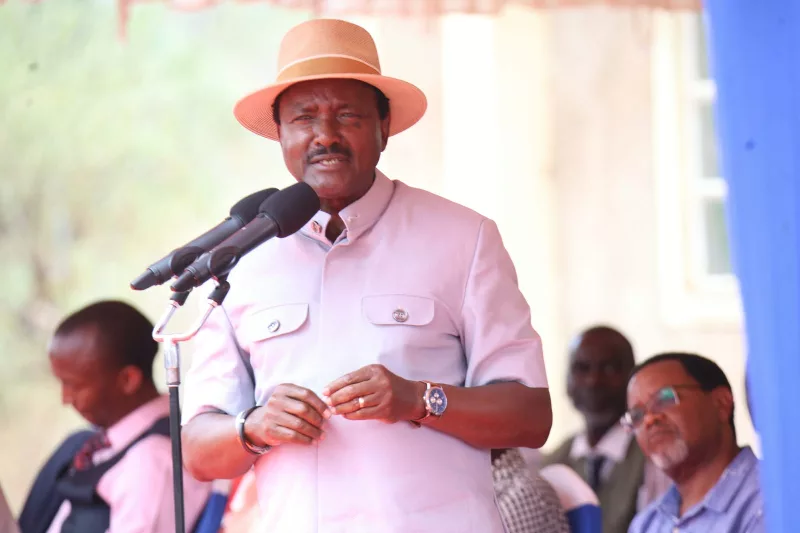
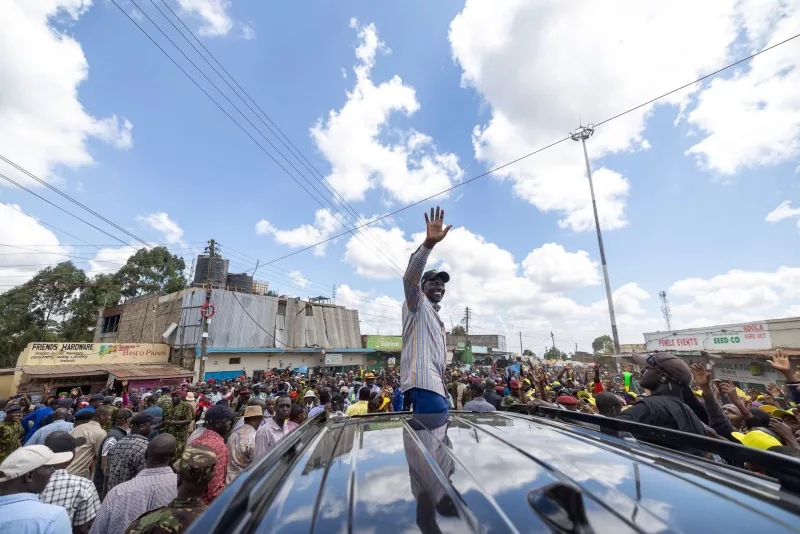
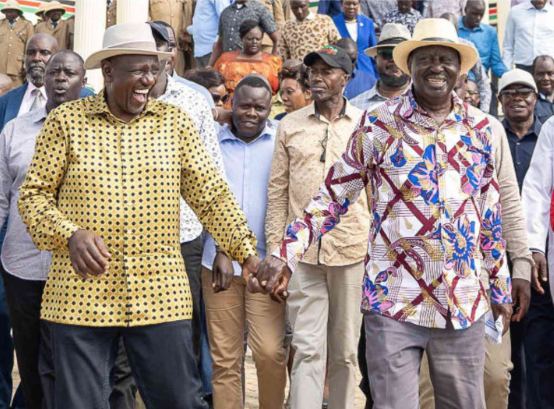
 President William Ruto and the late former Prime Minister Raila Odinga/FILE
Most Kenyans believe former Prime Minister Raila Odinga’s death makes President William Ruto’s chances of being re-elected more difficult, a survey by Tifa Research shows.
According to the survey results, 41 per cent of respondents said they believe Ruto’s chances of re-election would become more difficult in a post-Raila scenario.
In contrast, 30 per cent felt the President would find it easier to secure a second term, while 18 per cent said Raila’s absence would make no difference.
A further 10 per cent of respondents said they were not sure, highlighting widespread uncertainty over how the political landscape would realign.
The survey’s primary focus is the political aftermath of such a scenario, particularly in relation to partisan alignment and public attitudes towards the so-called Broad-Based Government (BBG) arrangement between Ruto and Raila.
While the BBG has been credited with easing political tensions, the report notes that it has also created discomfort within the core support bases of both leaders.
The report suggests that Raila’s absence could expose internal fractures and complicate efforts to maintain cohesion among his supporters, potentially reshaping opposition politics.
Among respondents who support the Broad-Based Government, its perceived promotion of national unity emerged as the strongest reason for approval.
About 72 per cent of BBG supporters cited reduced ethnic tension and greater political stability as key benefits of the arrangement, a narrative frequently advanced by the President and other leaders allied to the government.
However, TIFA found a clear correlation between attitudes towards the BBG and expectations about President Ruto’s electoral fortunes in this scenario.
Nearly twice as many BBG supporters as opponents believe Ruto’s chances would improve without Raila’s presence, at 40 per cent compared to 23 per cent.
Conversely, a majority of BBG opponents—54 per cent—said Ruto’s re-election bid would become more difficult, compared to 31 per cent among BBG supporters.
Among respondents who expressed no opinion about the BBG, uncertainty dominated, with 35 per cent saying they were unsure what impact Raila’s absence would have on the President’s prospects.
Overall, the survey underscored the complexity of Kenya’s political dynamics and suggests that even in post-Raila era, electoral outcomes would remain highly contingent on governance performance, political realignments, and the ability of leaders to manage shifting public expectations.
The report is based on a TIFA national survey conducted during November 10-17, 2025.
A total of 2,053 randomly selected Kenyan adults (aged 18 and above) across all 47 counties were interviewed at their residences.
Data collection was done face-to-face (household-based interviews). interviews were conducted in Swahili(mainly) and English and the margin of error was +/- 2.16 per cent.