

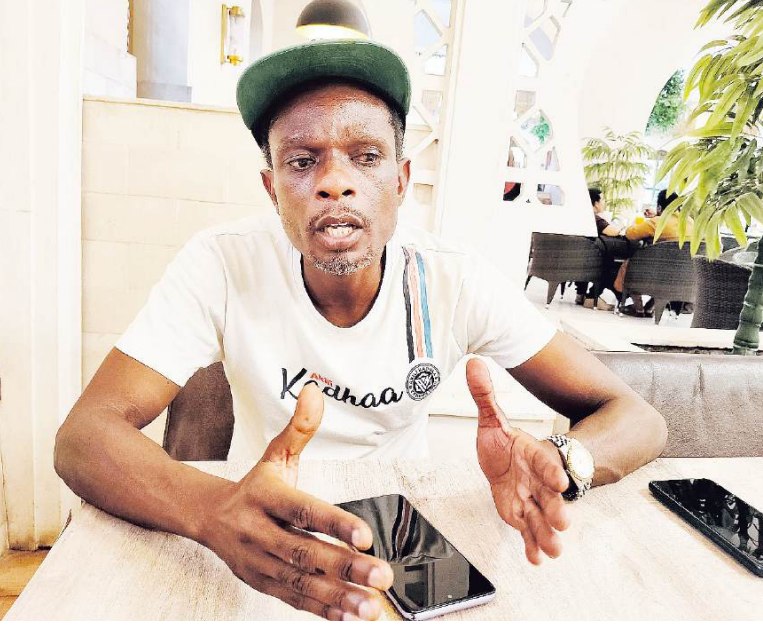
 Juma Mashuhuri during the interview./BRIAN OTIENO
Juma Mashuhuri says out of about 30 friends he grew up with, only about seven remain alive today.
Others have either been gunned down by police, underwent mob justice or killed by drugs or drugs-related complications.
Such was the environment he grew up in, but he thanks God he was not influenced by peer pressure into such vices.
“Today, when I sit down and reflect, I almost cry because I wish I had the presence of mind to help my friends first before they got lost into the world of crime, drugs and thuggery,” he says.
Born in Barsheba’s Soko Mjinga in Kisauni constituency, Mombasa, Mashuhuri, 45, is today a shining light of hope in the most vast and populous constituency in Mombasa, helping young people turn their lives around for those that had gone astray and walk the straight and narrow path for those that have not been negatively influenced.
Mashuhuriwent to Kisauni Primary completing his Class 8 in 1996, but not before his fair share of naughtiness, which saw him play truancy in Class 7 and Class 8.
He used to sneak out of school to go for reggae jam sessions in different clubs in Mombasa central business district.
He took his naughtiness to Mazeras High School in 1997, where he only did two years before being transferred to Tudor Day Secondary, closer home, where his father could monitor him.
“While in Mazeras High, I used to sneak out of school on Fridays, sometimes travelling to Voi for deejaying gigs before returning on Sunday evening or Monday morning. I was so into music I wanted to be a disk jockey,” Mashuhuri says.
His grades took a hit because of that, hence his father’s decision to transfer him.
“I used to sneak out with a friend of mine, who followed his dream of becoming a DJ and is now a full time DJ. He is called DJ Hamid,” Mashuhuri says.
After completing high school, he opened the first video library business in Mshomoronito keep himself busy.
In 2005, he enrolled for a certificate in tourism course at Kenways Institute, a college that was eventually shut down in 2010.
In 2009, he was employed as a driver in a tour company up to 2019, when he quit.
“What hit me hard is the fact that my friends who I grew up with were being felled because of crime. They had given up hope in life,” Mashuhuri says.
The saddest part, he adds, is that almost all those killed had some talent.
“Some were good in boxing, others were skilled in football, while others had some extraordinary swimming or acting skills.”
Mashuhuri says this bothered him and he promised to do something to help the next generation of children.
“We used to swim across the ocean from Bahari Club near the Nyali Bridge to the other side, Madhuba beach and back. But none of us would be seen in any swimming competition,” he adds.
He says he saw a lot of sporting talent in the streets but parents were pushing their children towards academics even when clearly the children could not succeed.
“It is true that education is the key to success, but not all of us can be good academically. Some are good in arts and sports,” he says.
He says even after failing in KCPE or KCSE, parents used to push their children to colleges for technical courses like plumbing, carpentry and electrical engineering.
“This was still pushing children to places where clearly they could not fit. They then become frustrated and rebelled, becoming dangerous criminals in the long run,” Mashuhuri says.
That is why he decided to call a few people in his circle to brainstorm on what they can do salvage the situation.
“That is how we formed Akili Kadhaa CBO (community-based organisation). We wanted to bring several of our brains together to come up with something that could help our fellow youth,” Mashuhuri says.
He says the killing of the youth did not address the root cause of the issues that drove them to crime.
In fact, he says, it only seemed to anger their peers who argued that they joining gangs out of frustration or as a message to the authorities.
“The names of the gangs were a cry for help in a way. There were gangs like ‘Watengwa’ meaning they felt rejected or discriminated against, ‘Mashahidi’ meaning they had witnessed their peers gunned down, and ‘Lipiza Gang’ meaning they were out to avenge their fallen friends.”
The first project that Mashuhuri and his friends, through the Akili Kadhaa CBO, came up with to try was boxing.
They formed a boxing club where people used to train and it gained so much popularity that it started getting recognition.
There were amateur bouts at Kadongo ground and out of these bouts some youths like Said Pandu and Hamza Rama were scouted and now they are professional boxers in Kenya.
In the process, Akili Kadhaa gained traction.
“They liked the name so much so that people offered to print branded t-shirts for me. Some offered to buy the t-shirts and I saw a business opportunity there, I printed t-shirts and sold them,” Mashuhuri says.
From the success of the boxing, which also attracted corporate sponsorship, he went on to initiate other sporting projects in football and swimming, replicating the success that boxing had.
“Kisauni ishouse of talent but these people lack exposure. Kisauni is known only for the bad things, but there are also good things that need to be highlighted,” Mashuhuri says.
After seeing corporates like the Kenya Maritime Authority and individuals like lawyer Amriya Boy and artist-turned-politician Charles Kanyi alias Jaguar take interest in his activities, helping sponsor some of the events, Mashuhuri came up with an environmental project to help restore a beach in Junda ward.
“Many of the sports people who had joined my initiatives were training at a beach in Junda that was in such a bad state that it attracted a bad name. It was called Mavi Mavi beach because people used to go for a long call there.”
Members of the Junda beach management unit and fishermen used to complain of the dwindling fish catch because of the pollution of the ocean and the beach.
Mangrove trees used to be cut and used as building materials.
Through sensitisation campaigns, Mashuhuri, through Akili Kadhaa, helped the community understand the importance of conserving the environment and keeping it clean.
The Mavi Mavi beach has now been transformed into a clean beach with Junda BMU members reporting improved fish catch.
Akili Kadhaa has helped plant more than 15,000 mangrove trees in the area.
“People from three wards including Magogoni, Junda and Mjambere eat fish from the now renamed Junda beach. In the past there were a lot of plastics in the water meaning people were eating micro-plastics. Now the fish are much safer to eat,” Mashuhuri says.
Today, different groups are involved in the care of the Junda beach, including a women group that has set up a 500,000-seedling nursery from where groups buy seedlings to plant trees in environmental conservation efforts.







