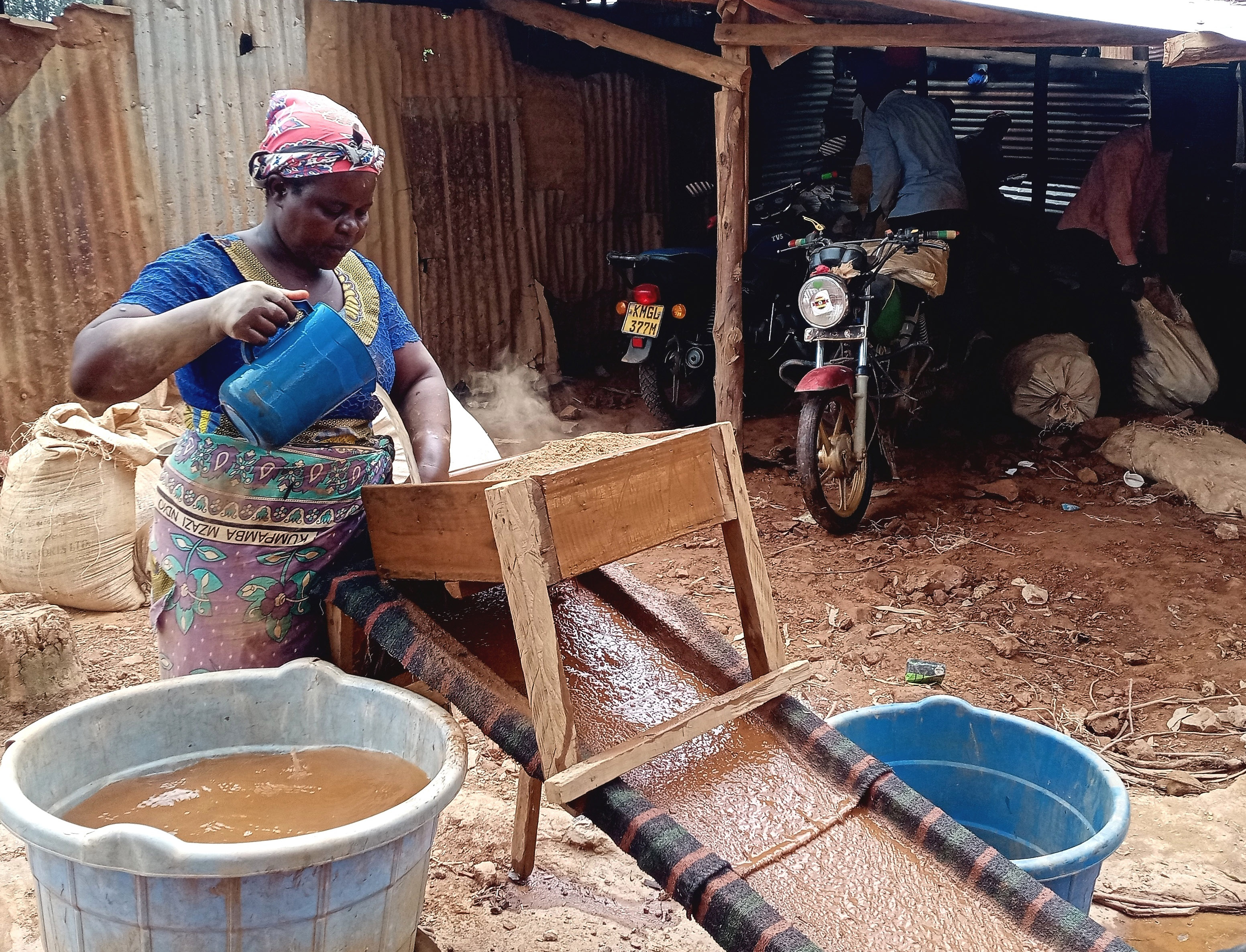
 A woman working at an artisanal mining cite in Bushangala village in Ikolomani subcounty/IMAGE /HILTON OTENYO
Gold mining in Kakamega poses as a subject of intense public debate after community members opposing large-scale mining on the mythical grounds that the resource is an ancestral gift that should not be accessed by external investors.
While cultural interpretations of land are crucial to social discourse, consequential decisions concerning mineral development must ultimately be guided by geology, engineering, economics and public safety. From my perspective as an expert of mining systems, the question is not whether Kakamega’s gold should be mined, but how informal, high-risk extraction can be transformed into sustainable production with traceable value, enforceable safety and durable socioeconomic returns.
Gold mining in Kakamega was formed due to hydrothermal mineralisation, a geological process in which gold-bearing fluids were deposited along structural weaknesses under high temperature and pressure conditions, over millions of years ago. These processes predate human settlement and are independent of ancestry. In mining engineering, we classify such deposits as finite natural capital whose economic value entirely depends on extraction efficiency, processing accuracy, occupational safety and governance. Without these key factors, the resources exist but benefits are systematically lost.
Today, most gold mining in Kakamega is extracted through artisanal and small-scale mining (ASM) characterised by rudimentary ground control, improper ventilation designs, poor blasting operations, irresponsible usage of mercury, and uncontrolled hazard exposure to natural occurring radioactive material (NORM), heat and dust. The consequences are well known including mine collapse, respiratory ailments, suffocation and neurological damages amongst other fatalities. As an expert in mining hazard management, I emphasize that these risks are neither inevitable nor uncontrollable. With the integration of modern technologies, including advanced sensors, predictive analytics and artificial intelligence, such hazards can be systematically identified, monitored, and mitigated. Formalised and well-regulated mining operations provide the framework to enforce rigorous safety standards, optimise ventilation design, ensure responsible chemical handling, and apply real-time hazard detection systems.
From mineral economic standpoint, ASM is even more damaging. Informal miners are typically exploited by intermediaries receiving far less than the actual worth of gold in global commodity markets. In other words, the miners who assume greatest health and safety risks obtain the least share of the value chain despite their everlasting health consequences. Drawing on my experience as a mining engineering consultant having worked with ASMs from Kuranze in Kwale, Kishushe in Taita, and Ganze in Kilifi, I have consistently observed that artisanal miners are not opposed to modernisation.
On the contrary, most of them actively seek modern technology, mechanised equipment, and professional support to enhance safety and productivity. However, their major barrier has been persistent misinformation propagated by same intermediaries who discourage artisanal miners from welcoming large-scale investors, framing it as resource theft. The case of Kakamega cannot be exceptional.
For Kakamega community to fully enjoy economic prosperity from their gold, they should embrace a well regulated and engineered large-scale mining operation. To start-off, landowners will be compensated for giving access to the mining investors to mine. Speculative digging will be eliminated by employing geostatistical resource modelling which will clearly define minerals of economic benefits from waste. Unsecured underground structures will be replaced with well designed and optimised underground mine structures that will ensure ground stability, ample airflow and accurate monitoring of hazards. Additionally, the mined-out gold will be efficiently processed and refined to attract highest price in the global mineral market.
The Kakamega community will be formally trained and employed to work in the mine as per the Community Development Agreement embedded in the Kenyan Mining Act, 2016. What is often portrayed as a future possibility is already an established reality in Kenya: the Kwale–Magarini community through Base Titanium Limited has benefited from structured employment, community development, environmental safeguards, and revenue sharing under a regulated large-scale mining framework. This is not conjecture, but a proven precedent in Kenya that demonstrated how responsible, well-governed mining can translate natural resources into tangible community benefits.
The benefits of transitioning from informal to well regulated large-scale gold mining is well documented across Africa and the world at large. In Geita, Tanzania, transitioning from small scale to large scale gold mining increased efficiency from 30 per cent to 85 per cent, eliminated broker-driven price discounts and transformed the region into a hub of skilled employment, infrastructure investment and local procurement networks.
In Red Lake, Canada, small scale gold mining evolved into one of the world’s most technologically advanced underground mining districts through systematic geological modeling, automation and continuous safety research. In all these golds endowed regions, communities did not lose control of their resources, but continue to enjoy financial prosperity, technical capacity, institutional strength, and durable economic diversification.
By denying land access for mining, Kakamega faces vast, unquantifiable opportunity costs, including the loss of employment prospects, infrastructure expansion, revenue streams and technological advancement. Without formal large-scale operations, unsafe and inefficient operations will continue, coupled with exploitation by middlemen. From a national development perspective, this represents lost economic multipliers and persistent safety externalities. Informality does not preserve wealth; it fragments and exports it. The choice before Kakamega is therefore not between preservation and exploitation, but between informal loss and engineered value creation, a choice with consequences that extend well beyond the region to Kenya’s broader economic and technological future.
(Doctoral candidate, Energy and Mineral Engineering, Pennsylvania State University)