 Information,
Communication
and the Digital
Economy
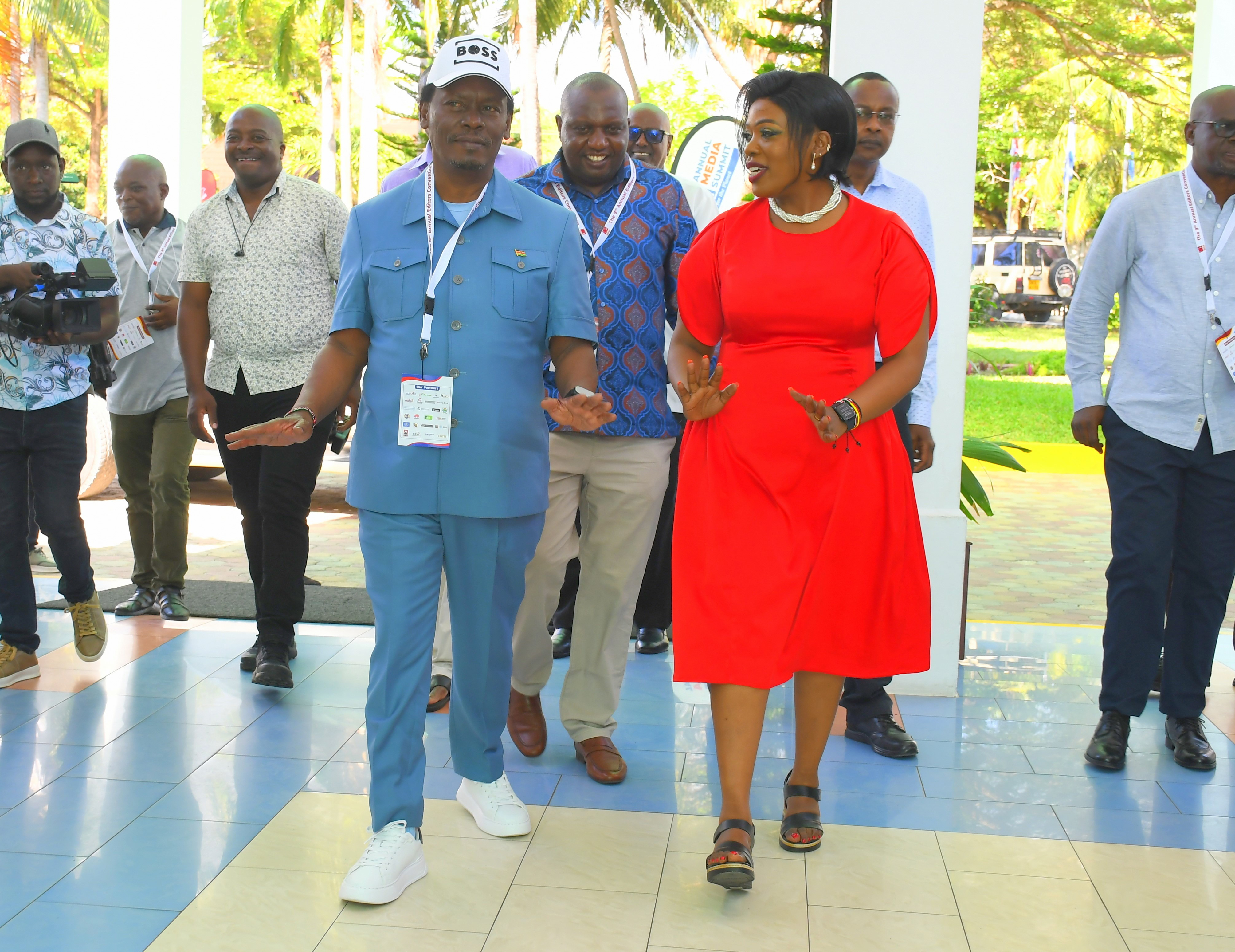
CS William
Kabogo (left) is
welcomed by
the President
of the Kenya
Editors Guild
Zubeidah
Kananu during
the 8th Annual
Editor’s
Convention on
November 28
/FILE
Information,
Communication
and the Digital
Economy
CS William
Kabogo (left) is
welcomed by
the President
of the Kenya
Editors Guild
Zubeidah
Kananu during
the 8th Annual
Editor’s
Convention on
November 28
/FILE
“For government advertising to be spread, that is a fair ask. But if you are a commercial entity and your job is to continuously hit the government, then it will be difficult for the government to put money in your basket,” Kabogo told the Kenya Editors Guild convention in Kilifi on November 28.
Exactly a year ago at a similar event in Nakuru, Deputy President Prof Kithure Kindiki delivered what sounds like the opposite of CS Kabogo’s decree. “The government appreciates the role of the media as a watchdog in society and will continue to support the sector to effectively perform its role of shaping public discourse,” he said. Kindiki said the government would clear debts owed to media houses and relook into its advertising plans to ensure more equity.
That position seems to have shifted. Media houses that “continuously hit the government” must stop or lose. What does this mean in practice? That journalists should ask themselves not whether what they publish is true but rather whether the government would be happy with it or not. That is called self-censorship.
CS Kabogo’s decree is problematic for media freedom and independence guaranteed in Articles 34 and 35 of the constitution. “The State shall not - (a) exercise control over or interfere with any person engaged in broadcasting, the production or circulation of any publication or the dissemination of information by any medium; or (b) penalise any person for any opinion or view or the content of any broadcast, publication or dissemination.”
The Code of Conduct for Media Practice, 2025, binds journalists to independence by outlining what constitutes editorial integrity and avoidance of undue influence. Journalists shall: “(a) maintain editorial independence in all production and publication of editorial content; (b) ensure that editorial content remains free from undue influence by advertisers, media owners, sources, subjects, powerful individuals, government, or special interest groups” (Section 8).
Newsmen and women shall “(c) present editorial content with integrity and common decency, and avoid real or perceived conflicts of interest; (d) declare and manage all conflicts of interest, including those arising from gifts, funding, advertising, discounts, or sponsored travel or services; (e) refrain from political or other external activities that may compromise journalistic integrity or public confidence in impartiality of reporting...”
How can the media heed Kabogo’s decree while remaining independent, free and ethical? Are media houses being asked to choose survival over professionalism? The media does not publish critical reports of government because it hates the Kenya Kwanza administration or President William Ruto. The media is simply fulfilling its watchdog mandate. It would do the same if the government were headed by Senator Okiya Omatatah or journalist Gateete Njoroge. What the media owes the government and Kenyans is fidelity to the truth. When it fails, there are competent mechanisms to hold it accountable.
The media is a messenger of the people, sent to speak truth to power. To threaten to starve media houses of government advertising because of saying things the government doesn’t like is to attempt to kill the messenger. A key requirement of good leadership is big ears. As servants of the people, wise leaders listen long and genuinely. Not because they have all the answers – no one has – but because that is their primary task in a democracy. The will of the people is expressed not just at the ballot every five years but also in their voices, which the media carries every day.
Now, let’s talk money. Government funds belong to the people of Kenya as taxes, income from public assets or loans and grants acquired on behalf of the citizens. It will be unacceptable for the government to wield public funds as a stick to hit its critics. Critical reporting cannot justify arbitrary exclusion from enjoying public goods or being subjected to punitive directives.
Kenyans want a free, independent, vibrant and responsible media. The government has a duty to support the media to thrive and effectively perform its roles —or the guarantees in the constitution would just be words on paper. Kabogo’s threat to use advertising as a weapon threatens media.