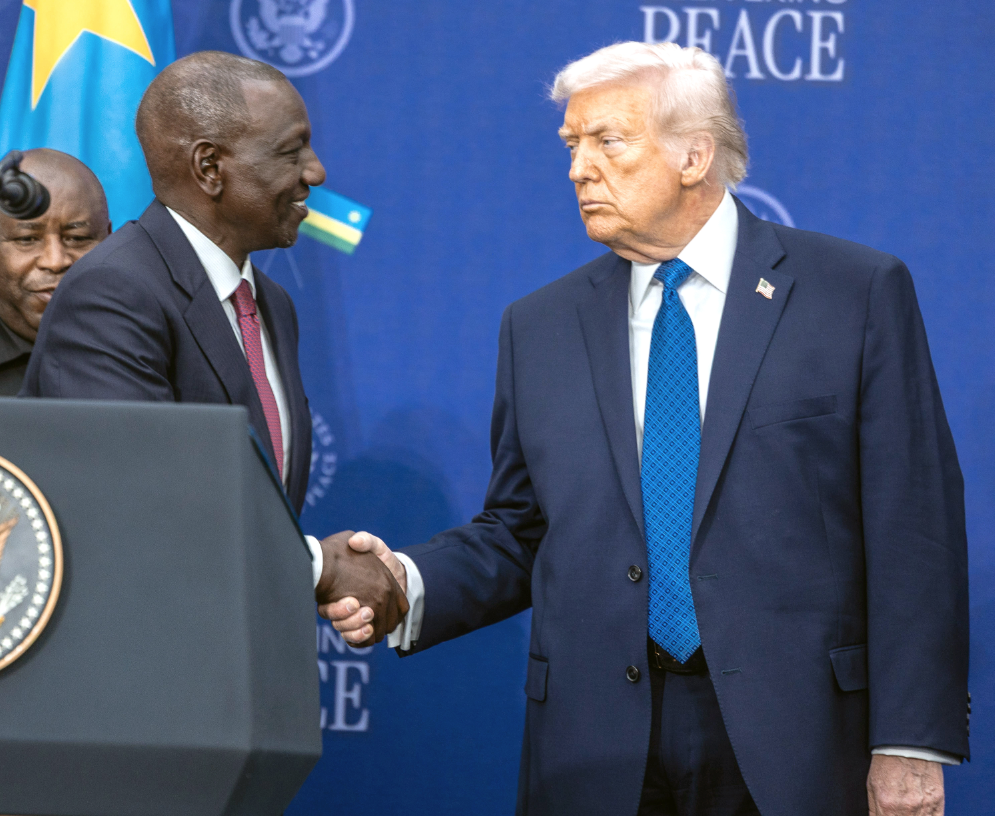
 President William Ruto with the US President Donald Trump after witnessing the historic signing of a peace deal between Trump, President Félix Tshisekedi of the DRC and President Paul Kagame of Rwanda at the Donald J. Trump United States Institute of Peace in Washington, D.C., the United States /FILE
When a government says it wants “mutually beneficial” relations but builds higher walls against the very partners it claims to court, the contradiction is not subtle. It is structural. Since Donald Trump’s return to the White House on January 20, 2025, there has been a string of policy reversals — including cuts to development assistance, uncertainty around trade frameworks such as AGOA and renewed travel restrictions disproportionately affecting African countries. These reversals have exposed a deep inconsistency at the heart of Washington’s Africa policy.
The administration’s rhetoric insists that Africa matters as a market, as a strategic partner and as a counterweight in a rapidly shifting global economy. Yet policy choices tell a different story. Travel bans and restrictive visa regimes aimed largely at African states send an unmistakable message: African governments may be welcome at the negotiating table, but African people are not welcome at the border. In an era where diplomacy, trade, education and innovation are inseparable from mobility, this posture undermines the very partnerships the administration claims to pursue.
Trade does not happen in the abstract. It is built by businesspeople who travel to pitch ideas, engineers who instal equipment, students who form networks and officials who negotiate details face to face. By limiting travel from African countries while simultaneously calling for bilateral trade deals, Washington is effectively trying to clap with one hand. You cannot expand exports, attract investment or deepen commercial ties while treating movement as a security threat rather than an economic enabler.
The uncertainty surrounding the renewal of the African Growth and Opportunity Act (AGOA) compounds the problem. For more than two decades, AGOA has symbolised US engagement with Africa based on trade rather than aid. Delays and mixed signals around its future weaken investor confidence across the continent, from textile producers in Kenya to manufacturers in Ethiopia and agribusiness exporters in Ghana. When these doubts are paired with travel restrictions, the message becomes clearer still: Africa is expected to open its markets while America closes its doors.
Cuts and reversals linked to USAID and other development instruments further strain credibility. Development cooperation has never been charity; it has been a strategic investment in stability, health and growth that ultimately benefits US interests as well. Rolling back such engagement while proclaiming a desire for stronger partnerships suggests a transactional worldview that values short-term optics over long-term relationships. Africa is not a line item to be switched on and off depending on domestic political moods in Washington.
For East Africa, the consequences are especially tangible. Kenya, often described as a regional hub for technology, logistics and finance, relies heavily on international mobility. Entrepreneurs need visas to attend trade fairs in the United States. Researchers need access to conferences and partnerships.
Students — many of whom later become bridges between economies — need predictable pathways for study. When these channels narrow, the loss is not only Africa’s; American universities, companies and consumers also lose out.
The hypocrisy becomes starker when contrasted with how the United States frames global competition. Washington frequently warns African countries about overreliance on other partners and urges them to diversify relationships. Yet credibility matters in competition. Countries choose partners not only on promises, but on consistency. A partner that restricts travel, delays trade frameworks and withdraws development support while speaking the language of cooperation appears unreliable. Influence is not asserted by exclusion; it is earned through engagement.
Defenders of the administration argue that travel restrictions are about security, not geography. But when the overwhelming share of affected countries are African, perception becomes reality. Diplomacy is as much about signals as it is about statutes. The signal being sent is one of suspicion, not partnership. That perception will linger long after any individual policy is revised.
If the United States genuinely wants a beneficial relationship with Africa, it must align its policies with its words. That means predictable trade frameworks, sustained development engagement and visa regimes that recognise Africans as partners in growth, not risks to be managed. Bilateral deals cannot flourish in an environment of unilateral barriers.
Africa is changing — demographically, economically and politically. It is a continent of opportunity, not a problem to be contained. Any US administration that fails to grasp this, while claiming the opposite, risks turning hypocrisy into policy. And in global politics, hypocrisy is not just a moral flaw; it is a strategic mistake.
Onyango K’Onyangois a journalist and communication consultant