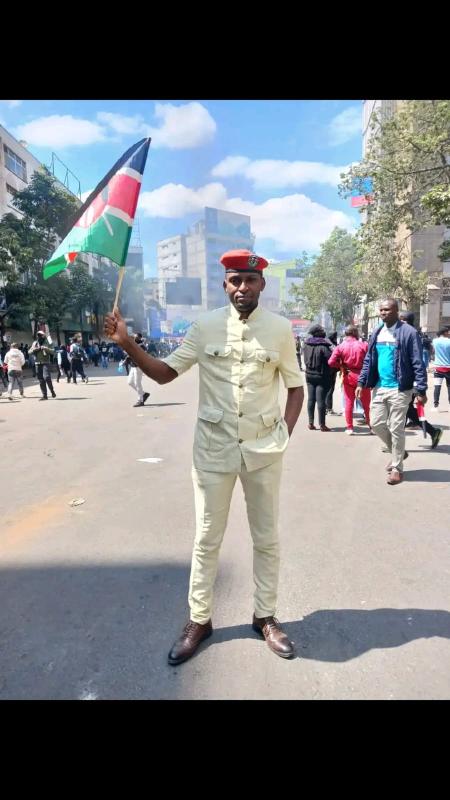
Felix Wambua during the Gen Z protests
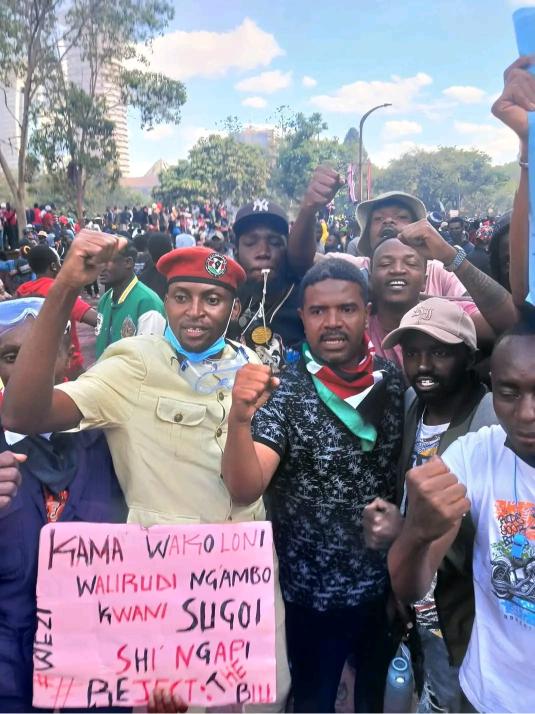 Activists Felix Wambua (in cream) joins other human rights activists during the Gen Z protests in June 2025 /
At age 37, Felix Wambua has learnt to live with the risk he says comes with the territory of speaking up, speaking out and speaking truth to power in a country where opposition often attracts suspicion, intimidation, sometimes brute force - and worse.
Soft-spoken but adamant, Wambua is the national coordinator of the Free Kenya Movement, a civic political organisation at the centre of Kenya’s ongoing struggle over constitutional reforms, economic justice and the shrinking democratic space.
Wambua said nobody is born an activist, a challenger of the system, but activism arises from the need to speak out against injustices in the society.
His moment of illumination, his dawn and turning point came when he realised life in Kenya revolves around politics, and the political space is not as democratic, as people are told.
Wambua’s activism did not begin in conference halls or donor-funded workshops. It was shaped by watching how power operates, who benefits from power and who is pushed to the margins by power.
“Over time, that awareness hardened into resolve, and I felt I needed to challenge what I describe as a system that silences dissent and normalises inequality,” he told the Star about being named a Person of the Year for 2025.
His activism is grounded in the belief that human rights and democracy are inseparable.
“When you advocate for change, a lot of force is used by the state to silence dissenting voices. That is why human rights must always be part of the conversation,” he said.
While much civic activism in Kenya is concentrated in urban centres - with easy access to lawyers, hospitals for injured protesters and media ¾ Wambua has focused on rural communities.
“In towns, young people can at least access legal representation or medical support from organisations like the Kenya Human Rights Commission or Amnesty, but deep in the villages, people are completely neglected,” Wambua said.
One case still weighs heavily on him: a young man named Brian Mutisia was shot by police in Makueni county. Wambua helped the family record statements and push for the case to be formally documented.
“Without that intervention, the story would have ended in silence,” he said.
That experience shaped the direction of the Free Kenya Movement’s work of documenting victims of state violence, especially in informal settlements and rural areas, and ensuring their cases reach human rights organisations that can provide support.
The Free Kenya Movement was formed in 2018, out of frustration with rising taxes, economic hardship and what members saw as a disconnect between government priorities and citizens’ lived realities.
“From the beginning, we were agitating for tax exemptions on basic commodities,” Wambua said.
“Even today, we are collecting signatures to amend Constitution Article 43, which talks about basic rights like health, education and food. We want it implemented in a way that actually makes life affordable.”
Among the group’s key demands are the removal of taxes on essential goods such as food, infant nutrition and hygiene products, particularly pads used by women.
“Government talks about affordable housing but what we want is an affordable and dignified life. Dignity goes beyond policy slogans. A decent life means you can eat, access healthcare, educate your children and live without constant fear,” he said.
As national coordinator, Wambua’s biggest challenge has been mobilising citizens in a context where activism is often viewed through a transactional lens.
“People assume we are funded. They expect allowances, food, hotel meetings, and yet we cannot afford that,” the rights defender-reformer said.
Wambua said that the expectation of material benefits, such as allowances, has shaped the movement’s methods and so its events are often held in public spaces, sometimes on the streets.
“We believe in people and believe what we are doing is for the good of the country, for the people’s own good,” he added. “When you mobilise, you become a threat to the state.”
Wambua recalled being attacked and beaten while campaigning for the release of human rights activists Bob Njagi and Nick Oyoo from the Free Kenya Movement.
They were seized in October this year in Kampala, Uganda, by masked uniformed men and detained for 38 days. The two finally were released after public pressure and diplomatic negotiations.
“I addressed the press with swollen lips and a swollen face. That is the price of speaking out.”
Many would say that he got off easy with bad bruises, his injuries could have been far worse.
He remains defiant.
“They [authorities, the powers that be] think we do this because we like violence or because we don’t love our country, but we are here because we want a country that works for all,” Wambua said.
The Free Kenya Movement has been vocal about the high cost of living. Wambua acknowledged that taxes are essential for running government, but argued that Kenya’s tax regime disproportionately burdens ordinary citizens.
“Food and other basic commodities should not be taxed. The tax system takes a huge fraction of people’s income,” he emphasised.
He believes reducing the cost of electricity and fuel would lower production costs and, in turn, the price of goods.
“If fuel levies were reduced and corruption dealt with seriously, government would still have enough money. The real problem is corruption and poor prioritisation,” he added. “Too much money goes to waste.”
Beyond economic issues, the movement is also pushing for constitutional amendments aimed at restructuring government and reforming elections. Wambua said Kenya has too many unnecessary offices.
“We have close to 25 ministries. If we reduced them to 15 or 17, there would be more money for education and other essentials,” he said.
He is particularly critical of proposals to expand the Executive through offices such as a Prime Minister and an Office of the Opposition.
“Those are meant to appease the political class,” he said. “What we are proposing is for the people.”
On elections, Wambua asserted that the Independent Electoral and Boundaries Commission’s system has not been fair and that elections must be verifiable and quantifiable.
“I believe electronic voting is the solution. You cannot verify 10 million votes in 21 days using paper,” he said.
Electronic voting, he said, would reduce rigging, cut down on court petitions and allow citizens to vote anywhere in the country, including security officers deployed away from home. He cited countries such as Brazil and India as examples, saying India has more than 500 million voters and announces results in days.
Wambua sees young people as central to Kenya’s democratic future. “The youth are everywhere, on the streets and online” as social media has transformed mobilisation.
“Young people want freedom. We are entering a technology-driven society, and our systems must reflect that,” he said.
Wambua said civic space is contracting, not expanding and Kenya’s human rights situation has deteriorated sharply since 2013.
“Last year alone, more than 100 people died during protests. Over 500 were arrested and charged with serious offences like terrorism and treason,” he said.
“These are trumped-up charges meant to instil fear. Being outspoken makes you an enemy of the state.”
Rights guaranteed on paper mean little if they are not exercised.
“If we stop speaking, those rights will remain in the constitution but not in real life,” Wambua said.
Governments are coordinating to silence dissent” [in the region]. That is why I believe activists across East Africa must work together. Human rights have no boundaries.”
Highlighting rights abuses in Uganda and Tanzania, he said, will build pressure for accountability. “As dictators work together, we must also unite.”
Wambua defines success as a situation in which every Kenyan understands their rights. He believes constitutional literacy should be taught as a basic subject in schools and citizens must come to see themselves as the employers of politicians. That means the power elite should be genuine servant-leaders.
“People power is the highest power,” the dissenter said. He envisions village-level ‘people’s parliaments’ that oversee development projects and reduce corruption.
“Young people make up over 70 per cent of the population. They should also dominate parliament, county assemblies and leadership positions,” Wambua said.
He urged Kenyans to support activists who work on their behalf, saying many of them struggle with stress and mental health challenges due to harassment, anxiety and danger.
“Show them love and speak out against any injustice, whether violations of human rights, destruction of the environment or corruption,” the activist Person of the Year said.
“When they [the state, authorities] come for others and you remain silent, one day there will be no one left to speak for you.”