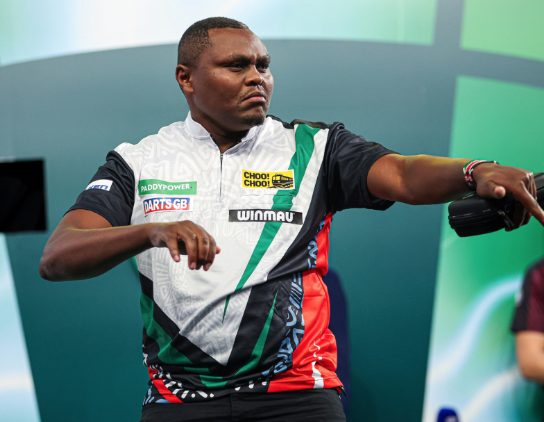
 David Munyua provided one of the biggest shocks in World Darts Championship history after beating Mike De Decker/SCREENGRAB
David Munyua on Thursday night etched his name into the history books by becoming the first Kenyan to register a win at the prestigious Paddy Power World Darts Championship.
He produced a stunning comeback to defeat former World Grand Prix champion Mike De Decker 3–2 at Alexandra Palace in London.
The landmark victory not only marked a personal triumph for the 30-year-old but also signalled a breakthrough moment for Kenyan and African darts on the global stage.
Munyua had already made history simply by stepping onto the iconic Ally Pally stage as the first representative from Kenya at the tournament.
However, few could have predicted the drama that would follow against De Decker, one of Belgium’s top-ranked players and an established name in world darts. Trailing 2–0 in sets, Munyua appeared on the brink of elimination, staring down three match darts in the fourth set.
Yet, with remarkable composure and belief, he survived the onslaught, held his nerve, and clawed his way back to level the match at 2–2.
The decisive final set delivered the moment that will be replayed for years in Kenyan sporting circles.
Munyua produced a clutch 135 checkout, finishing on the bullseye under immense pressure, before reeling off two more legs to seal a famous victory.
The Ally Pally crowd, renowned for its appreciation of big moments regardless of nationality, responded with thunderous applause as the underdog completed one of the tournament’s early shocks.
As news of the triumph filtered back home, celebrations erupted across Kenya. Political leaders, sports administrators and prominent public figures took to social media to congratulate Munyua, hailing his achievement as a source of national pride.
For many Kenyans, it was their first exposure to competitive darts at the highest level, sparking widespread curiosity about the sport, how it is played and the significance of the tournament Munyua had conquered.
“This is a really big moment for the sport itself and for Africa,” Munyua said after the match. “Everyone back in my country is going crazy about it. It is a special feeling for me and for players back in my country.”
Nicknamed “Whynot,” Munyua had promised before the tournament to showcase the best of African darts, and his performance emphatically delivered on that pledge.
Munyua earned his place at the World Darts Championship by qualifying through the African Darts Group Qualifier, a pathway that highlights the sport’s growing reach beyond its traditional European strongholds.
His success has now raised hopes that more Kenyan and African players could follow in his footsteps, inspired by the visibility and possibility his victory has created.
The Paddy Power World Darts Championship, organised by the Professional Darts Corporation (PDC), is the sport’s premier annual event. Held every year from December to January, the tournament has been staged at Alexandra Palace since 2008 and has become synonymous with the festive season.
With its colourful crowds, electric atmosphere and global television audience, the championship is widely regarded as the pinnacle of professional darts.
Prize money at the tournament is the richest in the sport, underlining its stature and importance.
Winning the title brings not only a life-changing financial reward but also instant immortality in darts history, with champions joining an elite list of legends whose careers are defined by success on the Ally Pally stage.
Even a single match win, as Munyua has shown, can be career-defining.
For many Kenyans newly introduced to the sport, darts may appear deceptively simple, yet it is governed by strict rules and demands intense concentration and strategic thinking.
The game is played using three small, pointed missiles thrown by hand at a circular dartboard divided into numbered sections from 1 to 20. These numbers are arranged non-sequentially to reward accuracy and punish mistakes.
Thin outer and inner rings double or triple the value of each segment, while the bullseye at the centre is split into an outer bull worth 25 points and an inner bull worth 50.
Most professional matches, including those at the World Championship, are played starting from a score of 501 points.
Players take turns throwing three darts per visit, subtracting their total from the remaining score.
The objective is to reach exactly zero, but the final dart must land on a double or the inner bullseye, a rule known as “double out.” Failing to do so results in a “bust,” with the score reverting to its previous total.
Matches are structured into legs and sets. A leg is a single race from the starting score down to zero, while a set consists of a fixed number of legs.
To win a match, a player must win a predetermined number of sets, with later rounds requiring more sets and placing greater emphasis on stamina, consistency and mental strength.
Beyond the technicalities, the World Darts Championship is celebrated for its unique spectacle.
Fans are central to the experience, generating noise, colour and drama that have helped propel darts into mainstream global sport.
Extensive television coverage ensures millions around the world tune in, making it the most-watched darts event of the year.