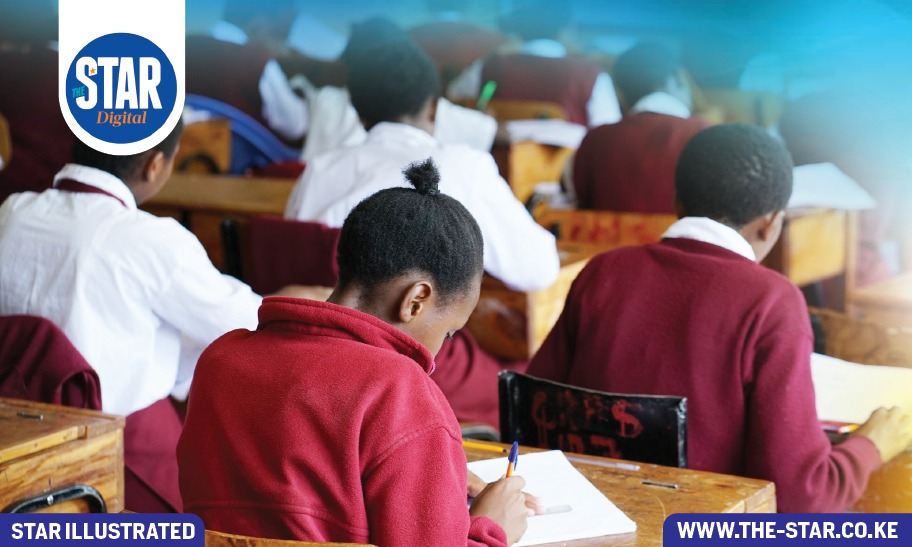
 Classroom- The Star illustrated
Kenya’s education sector entered 2025 amid one of its most far-reaching transformations since independence — a sweeping overhaul that touches everything from early learning classrooms to university financing.
At the centre of the reforms is the transition from the long-running 8-4-4 system to a skills-oriented framework under Competency-Based Education and Training (CBET), supported by expanded teacher recruitment, classroom construction, curriculum redesign, and changes to higher-education funding.
President William Ruto, speaking during the 62nd Madaraka Day celebrations in Homa Bay in June, described the reforms as the most consequential shift in Kenya’s education system since 1963.
According to the President, 76,000 teachers have been recruited over the past two years, with a further 24,000 expected by January 2026 — a scale of hiring that government officials say represents the largest teacher recruitment drive in the country’s history.
More than 23,000 classrooms have also been constructed nationwide to address congestion and support the phased rollout of the Competency-Based Education (CBE) framework.
“As we build the nation, we are preparing Kenyan learners to thrive in a complex and competitive world,” Ruto said, underscoring the shift toward practical skills and learner-centred education.
From 8-4-4 to CBET: A New Education Framework
The year 2025 marked a decisive phase in the gradual retirement of the 8-4-4 system and the consolidation of the new competency-based structure.
Government Spokesperson Isaac Mwaura noted that the first cohort of learners under the Competency-Based Curriculum (CBC) officially transitioned to Grade 9 on January 6, 2025 — a milestone in the reform journey.
Under the 8-4-4 system, students followed a largely fixed academic route: eight years of primary education culminating in the Kenya Certificate of Primary Education (KCPE), followed by four years of secondary education and the Kenya Certificate of Secondary Education (KCSE), before progressing to tertiary institutions.
CBET, by contrast, introduces a more flexible, learner-focused pathway that emphasises skills development alongside academic learning.
Education Cabinet Secretary Julius Ogamba announced in April that all national senior schools will be required to offer three career pathways when senior secondary begins in 2026.
Under the new structure, learners will choose between Science, Technology, Engineering and Mathematics (STEM); Arts and Social Sciences; and Sports Science pathways at the end of Grade 9.
“The State has already developed guidelines for the transition and placement of students to Grade 10 in January 2026,” Ogamba said, adding that the categorisation of schools as national, extra-county, county or sub-county will be abolished under the new system.
The ministry, he said, is expanding infrastructure and teacher capacity to ensure schools can offer the required pathways.
The reforms shift key academic and career decisions to an earlier stage of schooling, giving learners more time to develop strengths aligned to their interests and abilities.
Infrastructure, Teachers and Learning Resources
To support CBET, the government embarked on a large-scale infrastructure and staffing programme.
Deputy President Kithure Kindiki said the education reforms underway are “irreversible,” citing investments made since 2022.
He said 23,000 new classrooms have been built — 16,000 by the Ministry of Education and 7,000 through the National Government Constituencies Development Fund (NG-CDF).
In addition, the government plans to construct 1,600 new science laboratories, particularly in underserved regions and schools offering STEM pathways.
Teacher recruitment has been another cornerstone of the reforms. Since 2022, the government has hired 76,000 teachers, compared with an average of about 5,000 annually in previous years.
An additional 24,000 teachers are expected to be recruited by the end of 2025, bringing the total to 100,000 new hires within three years.
Kindiki said the number represents nearly a third of all teachers employed in Kenya between independence and 2022.
To support learning materials, Education Principal Secretary Belio Kipsang announced that more than 9.9 million textbooks were procured and distributed to Grade 9 learners at the start of the year.
“These efforts ensure the curriculum reform is matched with real resources in classrooms,” he said.
Expansion of TVET and Skills Training
Technical and Vocational Education and Training (TVET) has emerged as a key pillar of the CBET framework.
Enrollment in TVET institutions has more than doubled, from about 297,000 learners in 2022 to over 700,000 in 2025, according to government figures.
Officials attribute the growth to increased funding, modern equipment, recruitment of tutors, adoption of modular curricula, and the rollout of the Dual Training Policy and Recognition of Prior Learning (RPL).
The Dual Training Policy requires students to undergo structured industry exposure before graduation, while RPL certifies skills acquired through work experience.
Education CS Ogamba, speaking during the 20th graduation ceremony at Eldoret National Polytechnic in December, said the government plans to grow TVET enrollment to two million learners by the end of 2026.
He said the sector received Sh29 billion in the current financial year, with an additional Sh2 billion disbursed to support training programmes.
Kenya has also signed a partnership agreement with China to expand 70 new TVET institutions.
Staffing shortages, previously cited as a challenge, have been addressed through the deployment of 2,000 newly trained tutors across 242 colleges.
“Dual training brings classrooms and industry together,” Ogamba said. “Our youth graduate ready for employment or entrepreneurship.”
University Funding Reforms and Legal Scrutiny
Reforms in higher education have been among the most debated aspects of the 2025 education agenda.
The government rolled out a new student-centred funding model for universities and technical institutions, aimed at aligning financial support with students’ economic circumstances.
According to the Ministry of Education, more than Sh41 billion has been disbursed in scholarships and loans since 2023.
President Ruto has defended the model, saying it is intended to make higher education more accessible while improving the financial sustainability of institutions.
However, the model has attracted scrutiny.
In a 2025 report, Auditor-General Nancy Gathungu raised concerns about operational challenges affecting implementation of the funding framework.
The report cited issues such as inaccurate data submitted by applicants, limited public awareness of the model, and delays in loan and scholarship disbursements, which affected students’ ability to meet tuition and living costs.
The Auditor-General also noted challenges related to inclusivity, particularly for students with disabilities and those from marginalised areas.
Separately, the funding model has been the subject of legal proceedings. In 2024, the High Court declared aspects of the framework unconstitutional, a decision that prompted the government to initiate a review process.
Education officials have since said the model remains under refinement, with adjustments aimed at addressing both legal concerns and operational gaps.
Teacher Unrest and Funding Pressures
Despite progress, the reforms have faced resistance and pressure points.
In July 2025, the Kenya National Union of Teachers (KNUT) issued a strike notice, citing delays in implementing salary adjustments under a new Collective Bargaining Agreement (CBA).
Teachers said rising living costs had eroded wages, while unions argued that earlier commitments had not been fully honoured.
The dispute was resolved on July 19, when the Teachers Service Commission (TSC) and unions — including KNUT, KUPPET and KUSNET — signed a Sh33.7 billion CBA covering the 2025–2029 period.
TSC said the agreement was intended to safeguard teacher welfare and ensure industrial harmony.
However, prolonged industrial action by university lecturers over separate CBA disputes highlighted ongoing tensions in the sector.
Budget documents from the National Treasury show that while funding has been allocated for classrooms, sanitation facilities and TVET expansion, sustained investment will be required to maintain momentum.
A System in Transition
By the end of 2025, Kenya’s education system had undergone changes that would have seemed ambitious just a decade earlier.
New classrooms, thousands of teachers, redesigned curricula, expanded TVET programmes and a reworked university funding model now form the foundation of CBET.
Yet, as policymakers acknowledge, implementation challenges remain.
The success of the reforms will depend on continued funding, legal clarity, teacher support, and public understanding.
For now, the transformation is underway — and for many learners, teachers and families, it represents both uncertainty and opportunity.