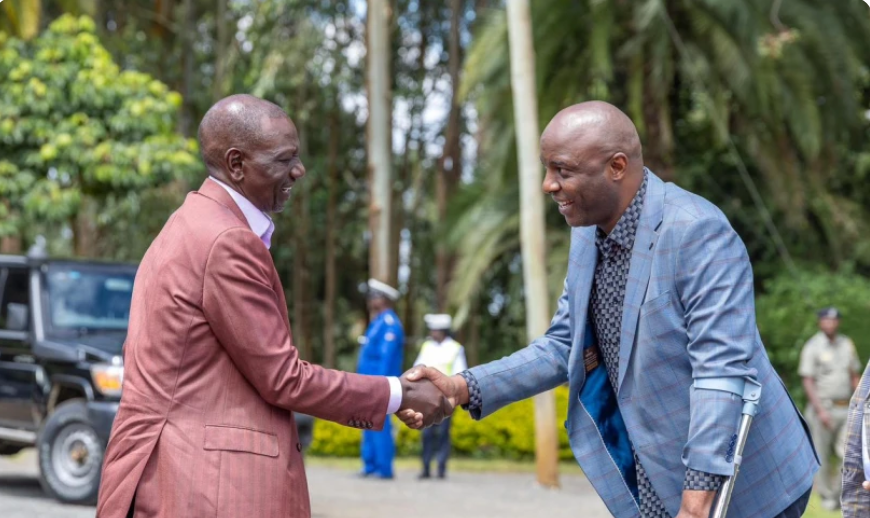
 Murang'a Governor Irungu Kang'ata and President William Ruto in Kandara Constituency on May 3, 2026./FILE
Murang’a Governor Irungu Kang’ata’s decision to abandon President William Ruto’s UDA has lifted the lid on the growing troubles facing the head of state in Mt Kenya ahead of the polls.
In a surprise announcement on Sunday, Kang’ata declared he would not defend his seat on a UDA ticket in next year's general election.
He cited what he described as deep-rooted problems within the party in the region as the reason for his decision to decamp.
Kang’ata did not disclose the political vehicle he would use, but sources indicate he could use Rigathi Gachagua’s DCP, whose popularity has been growing in the region.
The county chief also pointed to declining popularity and “strategic errors” by the party leadership as key reasons behind his decision.
“There is a problem with UDA in my region. That is the truth,” Kang’ata said during a press briefing, in remarks that have since triggered intense political debate.
Anti-Ruto forces and political observers now warn that his departure could mark the beginning of high-profile defections by influential leaders from Mt Kenya, a region widely credited with delivering the presidency to Ruto.
Kirinyaga Senator James Murango has publicly declared that the political direction of Mt Kenya is already settled.
“By now, we know who is in charge of Mt Kenya politics. It is not a secret anymore. It is up to them to decide,” Murango said.
National Assembly Majority leader Kimani Ichung’wah and other pro-government legislators have, however, downplayed Gachagua’s influence, accusing him of attempting to destabilise the region’s political unity.
Analysts argue that Kang’ata’s move reflects simmering discontent that has been building beneath the surface since the impeachment of Gachagua as Deputy President.
Political commentator Martin Andati described the governor’s decision as a significant political signal.
“Kang’ata’s move is a clear indication that the mountain is no longer solidly behind Ruto. This shift has been gradual, but the latest development makes it harder to ignore,” he said.
The development came amid sustained criticism of the President by Gachagua, who has emerged as one of Ruto’s fiercest critics following their political fallout.
Gachagua has intensified his attacks on the President, vowing to make him a one-term leader, while simultaneously gaining traction and sympathy across parts of the Mt Kenya region.
Gachagua has vowed to send home all elected leaders supporting the President.
“They say yes to everything William Ruto says,” he said.
“Na nyinyi muendelee tu, mtakutana na hawa wananchi (Just continue, you will meet these citizens),” he said recently.
Sources familiar with political dynamics in the region say the ground has shifted considerably, with voters increasingly expressing dissatisfaction over economic concerns and political decisions made by the current administration.
While a section of elected leaders remains aligned with the President, cracks are beginning to show.
Kang’ata’s exit is therefore being interpreted as more than an isolated decision.
Instead, it is seen as a potential tipping point that could embolden other leaders to reconsider their political allegiance ahead of 2027.
For many observers, Kang’ata’s latest move also carries echoes of his past political actions.
In the run-up to the 2022 general election, he wrote a controversial letter to then-President Uhuru Kenyatta warning that the Building Bridges Initiative (BBI) lacked support in Mt Kenya.
At the time, the letter was dismissed by some within government but ultimately proved prescient, as the initiative failed to gain traction in the region.
Now, Kang’ata appears to be issuing a similar warning—this time directed at UDA.
In his statement on Sunday, the governor argued that the ruling party risks suffering the same fate as the former Jubilee Party if it fails to address concerns from the grassroots.
“It is very clear that there are problems in our region, for good or bad, and those problems are being caused by strategic errors by the party,” he said.
“If nothing changes, many leaders will be rejected by voters.”
He further noted that UDA’s waning popularity mirrors the decline of Jubilee ahead of the 2022 elections, when voters in Mt Kenya turned against the party despite its dominance in previous cycles.
According to observers, Kiambu Governor Kimani Wamatangi, who has recently found himself at odds with the national government, could be next in line to decamp from UDA.
Wamatangi has faced legal challenges, including a court appearance over alleged graft, while some of his business premises in Nairobi were recently demolished by government agencies.
Nyeri Governor Mutahi Kahiga, who until recently was seen as Gachagua’s fiercest defender in the region, has previously declared that the former DP would be a defining factor in the 2027 elections.
“Whether by default or by design, Riggy G [Gachagua] is currently the senior-most leader in the mountain. Whether that automatically makes him the undisputed leader is as much your guess as mine,” the governor had told the Star.
Governors wield immense influence through control of county resources, grassroots mobilisation networks, and their ability to shape local political narratives—making them critical players in any regional power equation.
“Gachagua is a beneficiary of a few missteps by some Kenya Kwanza politicians, especially in the Mt Kenya region, who underrated his influence from the word go,” political risk analyst Dismas Mokua said in the past.
INSTANT ANALYSIS
Murang’a Governor Irungu Kang’ata’s exit from UDA signals weakening support for President William Ruto in Mt Kenya, a region crucial to his 2022 win. Citing declining popularity and leadership missteps, Kang’ata’s move may trigger further defections. Analysts link the shift to rising discontent and Rigathi Gachagua’s growing influence. The development mirrors Jubilee’s past decline, suggesting UDA risks losing its grip unless it addresses grassroots concerns, potentially complicating Ruto’s re-election prospects in 2027.