Trust in government services is rarely built on a single factor; rather, it is a complex tapestry woven from daily interactions and systemic transparency.
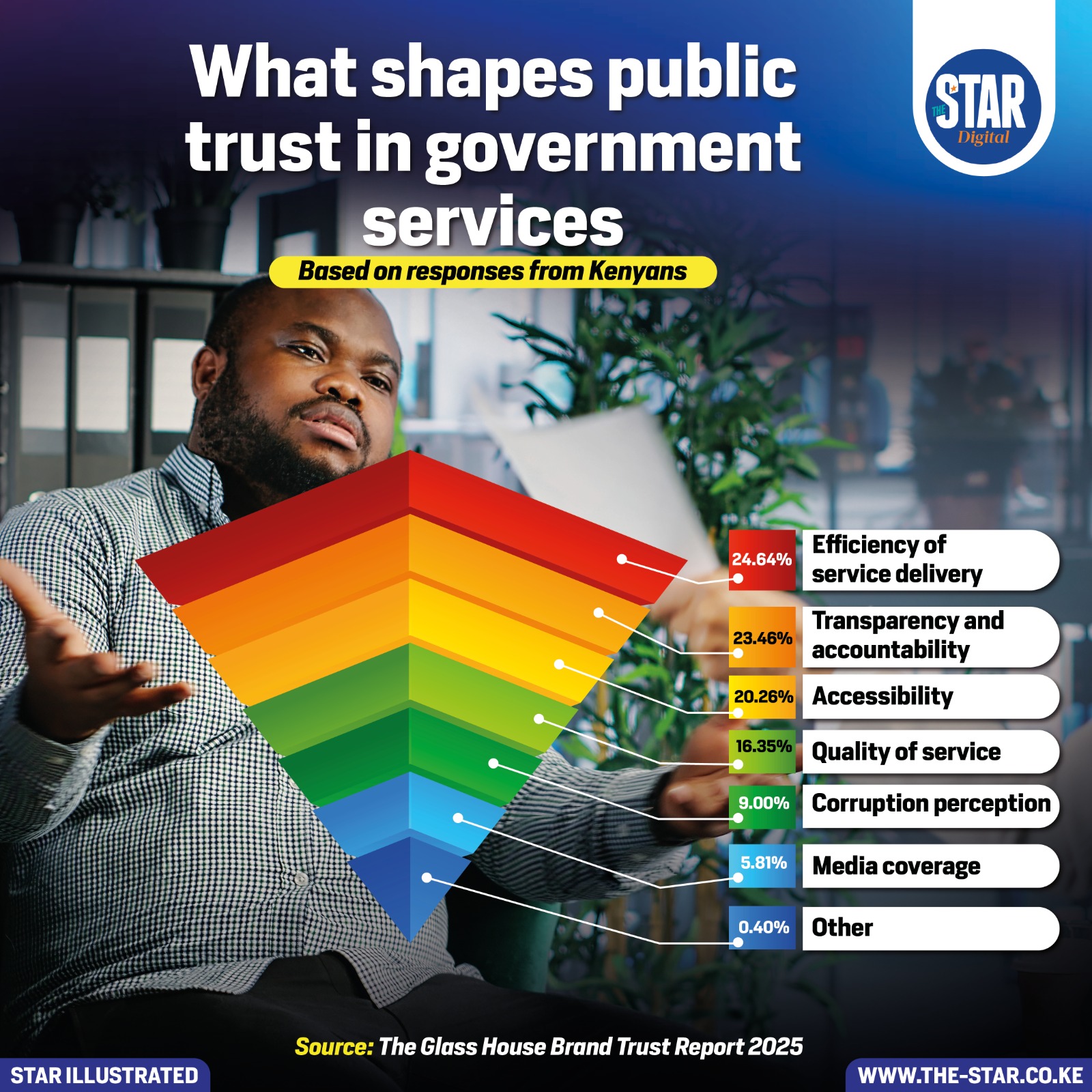
For the average Kenyan, the primary driver of confidence in public institutions is Efficiency of Service Delivery, which accounts for 24.64% of what shapes their trust.
In a world where time is a precious resource, the speed and reliability with which a citizen can renew a permit or access healthcare speak louder than any policy document.
Closely following efficiency is Transparency and Accountability at 23.46%. This suggests that Kenyans are not just looking for results, but also for clarity on how decisions are made and how resources are managed.
Accessibility (20.26%) also plays a critical role, highlighting the need for services to be reachable for everyone, whether in urban centers or remote rural villages.
Interestingly, while Corruption Perception (9.00%) is often the headline-grabber in national discourse, it ranks lower than the tangible experience of service quality and accessibility when it comes to defining trust. This indicates a pragmatic shift: while citizens demand integrity, they define the "trustworthiness" of a government largely by its ability to function effectively.