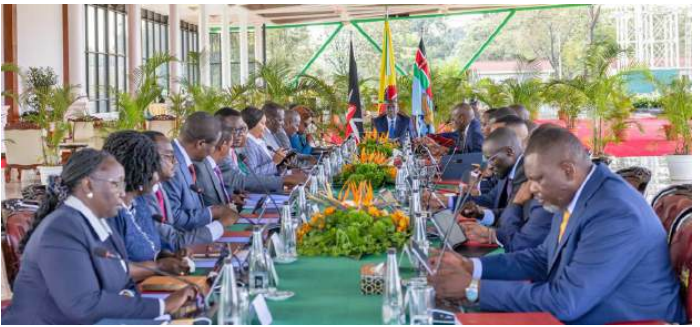
 President
William Ruto
chairs a Cabinet
meeting at
State House, Nairobi /PCS
President
William Ruto
chairs a Cabinet
meeting at
State House, Nairobi /PCS
The government has been asked to come clear on the cabinet’s resolution to set up a limited liability company to manage the Sh5 trillion wealth fund.
Opposition leaders, accountability and governance experts and members of the public who spoke to the Star are wondering if the state wants a private entity to manage its fund, or the Monday announcement means setting up a new parastatal.
On Monday, a State House dispatch indicated that the government would establish a new limited liability company to manage the fund billed as President William Ruto’s legacy agenda to transform Kenya into a developed country.
“National Infrastructure Fund will act
as the central vehicle for aligning public financial resources with national
development priorities, while operating under a corporate structure aimed at
improving governance, transparency and investment discipline,’’ the dispatch
read.
“Under the new framework, all
privatisation proceeds will be ring-fenced and invested strictly in public
infrastructure projects that generate and preserve long-term value,” the Cabinet
said.
According to the State House, every
shilling invested through the Fund is expected to crowd in up to Sh10 from
long-term investors, including pension funds, sovereign partners, private
equity funds and development finance institutions.
“This is a good dream. Although it is in its formative stages,
several aspects are not clear, especially regarding accountability. What will be the
structure of the new company to be formed to manage the fund? This question must
be addressed in detail,’’ governance expert James Kuria told the Star.
“We don’t want to see another looting
establishment formed before our eyes. Everything must be clear from the word go.
Will it be a parastatal under the
National Treasury?”
Former Budget Committee chairperson and Kiharu MP Ndindi Nyoro laughed at the plan to set up a company, terming the cabinet resolution as another ‘rubberstamped project’ from the State House.
“Who
will be the directors of the new company to be formed? Who will select them? There
is everything wrong with these hasty ideas.’’
The
vocal MP opposes the government’s plan to establish the National
Infrastructure Fund (NIF), accusing President William Ruto’s administration of
failing to account for nearly Sh4 trillion borrowed since 2022.
He
insists that before introducing another mega fund, the government must first
explain to Kenyans how the borrowed money has been spent and how the proposed
fund will be overseen.
Legal
expert Oloo Kuria, who says that by now, there is no standalone Act of
Parliament that formally establishes the Infrastructure Fund as a statutory fund,
thus making it null and void, echoes his views.
“I fear
that this will serve as a tool to look at Kenya’s resources.”
David
Ndayara on X observes that the government wants to keep the fund off the law as much as
possible so that it is controlled off the books. “We cannot trust billions of
public funds with politicians or state officers without checks.”
Wiper Party
leader Kalonzo Musyoka has criticized the establishment of the “alternative
financing mechanisms”, saying that they contradicted constitutional principles,
which emphasize transparency, parliamentary oversight, and equitable
distribution of fiscal responsibilities across generations.
“Ruto’s push for 'alternative financing
mechanisms' flies in the face of a Constitution that deliberately anchors
public finance in transparency, parliamentary oversight, and the fair
distribution of burdens across generations,’’ he said.
National
Treasury boss, John Mbadi, says that the government is working on the modalities of setting up the
Infrastructure Fund without having to precede the same with a Bill.
According to him, the plan is for proceeds of privatisation to
be split between the Sovereign Wealth Fund & the National Infrastructure
Fund in a 90:10 or 80:20 ratio starting 2026.
Apart from the Infrastructure Fund, the cabinet endorsed a Sovereign Wealth Fund Policy that sets out a
comprehensive framework for the prudent management and investment of revenues
from mineral and petroleum resources, dividends from public investments and a
portion of privatisation proceeds through a dedicated national fund.
“Anchored on inter-generational
savings, protection against external shocks and strategic investments with
commercial returns, the Sovereign Wealth Fund will strengthen fiscal
discipline, enhance resilience and support long-term national competitiveness,” the Cabinet said.
The framework is also intended to operationalise Article 201 of the Constitution on inter-generational equity and advance the Kenya Kwanza administration’s investment-led growth agenda.