
For decades, Western Kenya has carried the reputation of being the “sleeping giant” of Kenyan politics.
Yet, perhaps the more honest description is a giant repeatedly lulled back to sleep by a political leadership too comfortable in national privilege and too timid to champion the real aspirations of its people.
Today, as the political ground shifts beneath the feet of the old order, the Mulembe nation stands at a crossroads.
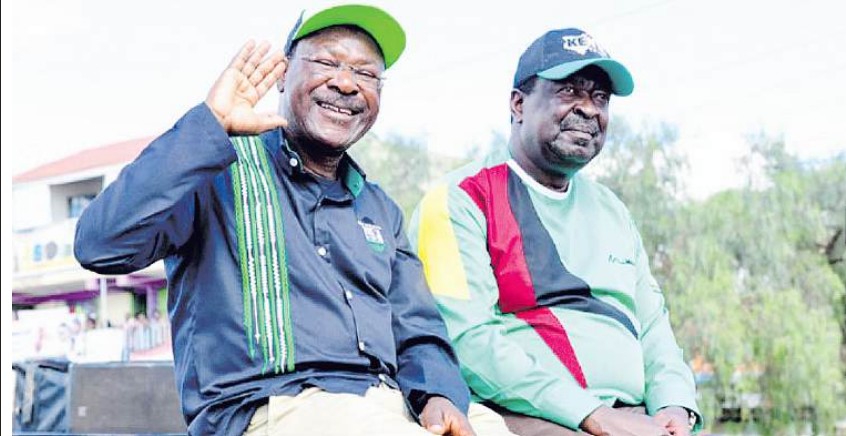
At the centre of this moment is a generational revolt—led by Trans Nzoia Governor George Natembeya, Nairobi Senator Edwin Sifuna, Saboti MP Caleb Amisi and Kabuchai MP Majimbo Kalasinga, among others—challenging the long-standing dominance of Musalia Mudavadi and Moses Wetang’ula.
The Mulembe nation is Kenya’s second-largest ethnic group with about 6.5 to 7 million people (2.6 million registered voters). Western Kenya deserves better than ceremonial leadership, polite negotiations and elite accommodation that benefits individuals more than communities.
The political economy of the region—its roads, industries, unemployment burden, collapsing sugar sector, chronic underdevelopment and unending fragmentation—reflect a truth we have tiptoed around for far too long: the current Luhya kingpins have perfected the art of managing expectations downward.
That downward management has cost the region opportunities, recognition and political leverage that its sheer demographic weight should naturally come.
The Cabinet Secretary has built an entire career around being dependable, reasonable, soft-spoken—and ultimately non-threatening.
His political moderation may appeal in diplomatic circles, but it has failed to inspire the region’s youth or galvanise a unified agenda. At moments when bold leadership is required, he leans instead toward consensus-building—even when consensus means silence.
If anything, Mudavadi has become synonymous with safe politics: politics that never risks, never disrupts and never translates into tangible outcomes for the people he claims to represent.
Western Kenya cannot afford a leader who is present at the high table but silent when the bill is being shared. Politics, in the end, is not about seating arrangements but about bargaining power.
Speaker Wetang’ula, on the other hand, has mastered transactional politics so well that many in his Bukusu base view it as a virtue. But his rise to the apex of parliamentary leadership has come at a cost.
The speakership, by constitutional design, neutralises political activism. Wetang’ula is now more a custodian of the system than a challenger of it. His national posture may enhance his personal stature, but it leaves Western Kenya voiceless at a moment when the region needs a fighter, not a referee.
What makes the current moment so politically significant is the emergence of a youthful, outspoken and unapologetically assertive bloc. Leaders like Natembeya are resonating because they are tapping into frustrations the old guard has long ignored: runaway poverty, joblessness, state neglect and a political culture in Western Kenya built on respectability rather than results. Natembeya’s bluntness has electrified a base tired of polite politics.
Sifuna has legitimised a new grammar of political courage—one unafraid to confront power and articulate the pain of ordinary people.
Amisi’s street-level authenticity speaks to a generation tired of boardroom bargains that never trickle down.
Kalasinga’s boldness signals a region rediscovering its political voice.
Under the informal guidance of Senator Bonny Khalwale—himself a paradox of establishment ties and grassroots instincts—this emergent group has struck a nerve. They embody what Western Kenya has lacked for years: clarity, urgency and a willingness to make political enemies—if that is what it takes to deliver.
The revolt is not personal. It is structural. It is a challenge to a leadership that has for far too long turned the region into a bargaining chip during every election cycle.
It is a challenge to a model of representation defined by appointments, not achievements. And it is a challenge to a pair of leaders—Mudavadi and Wetang’ula, who have become more invested in maintaining peace with the powers that be than in disturbing the peace for their people’s sake.
The broader truth is that Kenya is entering a more performance-oriented political era. Voters—especially in Western Kenya—are asking hard questions: Why is the region always negotiating from a position of weakness? Why are its leaders perennially in government but perpetually out of influence? Why is Western Kenya always voting but rarely counting? These are no longer whispers — they are demands.
The 2027 election will amplify this reckoning. Western Kenya is no longer a passive participant in national politics; it is becoming the battleground. And in battlegrounds, leaders who hesitate become liabilities. The Mudavadi-Wetang’ula axis must recognise that the days of deferred ambition are over. Their community wants representation that speaks loudly, mobilises boldly and negotiates fiercely.
If they cannot lead that transition, they must make way for those who will.
The Mulembe nation is blessed with numbers, diversity, talent and strategic location. What it lacks is transformative leadership. What it needs is a break from political complacency masquerading as stability. And what it must embrace is a new generation ready to redefine what is politically possible for Western Kenya.
History is shifting. The question is whether the old order will step aside gracefully—or whether the people will step past them anyway.







