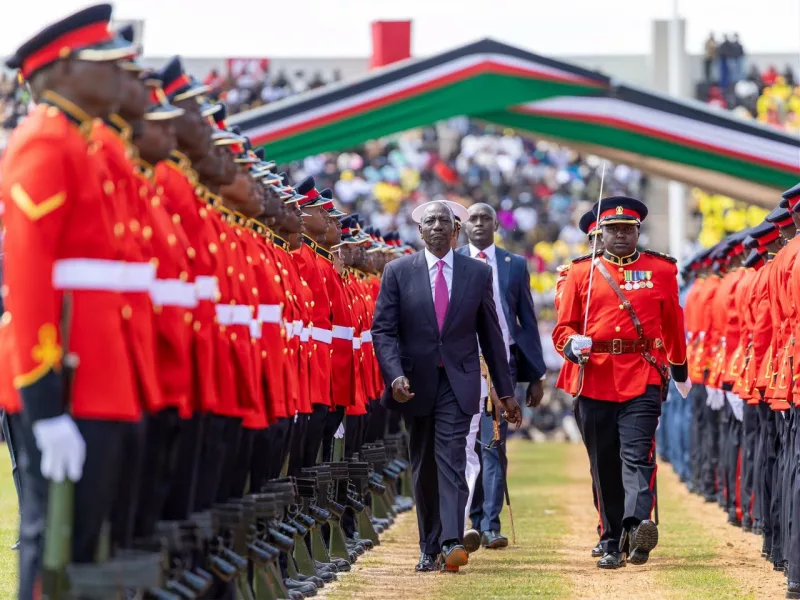
In the 2022 general Election, President William Ruto and the Kenya Kwanza coalition including his UDA party got paltry votes in the Nyanza region. Except for token seats in Kisii and Kuria, the former province voted for the Azimio coalition leader Raila Odinga almost to a man.
In a public engagement in Homa Bay soon after his inauguration, Ruto metaphorically linked his Nyanza votes to less than the size of a hare, in comparison to Raila's ‘elephant-size’ votes.
Nonetheless, President Ruto pledged to ensure the region got an equitable share of government development projects as it is part and parcel of the country.
These were the President’s early efforts to bring the nation together by direct engagement with populations that did not support him. He visited Homa Bay county twice in quick succession, first for a church service.
He later went to assess the state of infrastructural development and then launch his pet project of affordable housing.
The region was still smarting from the unbelievable defeat of their kingpin for the fifth time at the presidential ballot. In fact, the ‘sufuria’ protests were still routine and county residents and their leaders had gone flat-out to provide leadership in this regard to the entire nation.
Consequently, the region’s leaders, including the governor, MPs and MCAs, boycotted the president’s tour. But in his characteristic charm offensive, Ruto braved the storm and took the resentment in his stride.
He made critical pledges for development projects that were immediately dismissed by the local political class as cheap enticement propaganda.
As the protests became a clear threat to national stability, the clergy and the international community put pressure on Raila to consider a negotiated settlement over the political crisis. Raila reluctantly agreed and gave ‘irreducible’ conditions.
Ruto’s allies led by then Deputy President Rigathi Gachagua did not countenance the rapprochement. According to them, these were Raila’s perennial tactics to join government through the backdoor.
To buttress their position, Gachagua and compatriots coined the shareholding theory of government. They posited the regions that delivered the victory to Ruto deserved to be prioritised in national resource allocation.
The push by Gachagua put the President in a Catch 22 situation. He then deftly pushed for resolution of the dispute through a parliamentary bipartisan process.
Raila and his Azimio brigade distrusted the legislature as constituted to deliver a credible outcome. Therefore, when the National Dialogue Committee (Nadco) was eventually established, it incorporated key allies of both leaders from outside of Parliament.
Their mandate and agenda were also expanded to include issues beyond the biting economic conditions that had led to the ‘sufuria’ protests. The Nadco process mirrored the failed BBI undertaking by the Uhuru Kenyatta administration.
The BBI process was viciously opposed by the Tanga Tanga movement led by Ruto when he was Deputy President. He actually used the BBI as a key plank in his presidential campaign and an opportunity to break away from the shadow of his boss, President Uhuru.
Ruto conveniently used BBI to make Raila the government’s project and himself the martyr of the people’s suffering. It was against this toxic political environment that Ruto’s development overtures to Nyanza were viewed with contempt, and suspicion at best.
However, it has turned out that the region grossly underestimated Ruto’s resolve to deliver on his pledge to unite the country.
Ruto’s Bottom-Up Economic Transformation Agenda (Beta) contains key strategies for investment in the improvement of livelihoods through economic inclusion; modernisation of infrastructure; food security through increased agricultural production; construction of affordable and dignified housing; unlimited access to quality universal health care; enhancing youth employment by upscaling their skills to match global labor demands and expand labour market opportunities.
All these strategies are complementary and should be implemented to reinforce each other. Parliament has been engaged to support the policy through appropriate legislation.
The MPs and senators have been lobbied at every necessary stage to approve budget support for the ambitious projects.
In retrospect, it appears that if it were left to UDA mandarins, they would have implemented the policy in a skewed manner to exclude the regions perceived to be anti-government. Nyanza being the stronghold of ODM clearly qualified for isolation.
The region has consistently stood with Raila and earlier on his father Jaramogi, since the reintroduction of multiparty democracy.
Indeed, previous successive governments have strategically used this narrative to justify the policy directions that bypass the region in resource allocation.
In fact, the government routinely devotes more resources to security for containment in the region than for service delivery. Ever since the 1969 Kisumu massacre, the region and especially the Luo community, have suffered government hostility and borne the brunt of brutal security operations. In other towns, they are profiled and targeted for repression.
Since assuming the reins of leadership, Ruto has initiated key development projects in Nyanza that have remarkably transformed the region. The projects have economic ripple effects and demonstrable positive impacts on the lives of the residents. The affordable housing projects in Homa Bay and Kisumu counties have created employment opportunities for the youth.
Many young people had trained in artisan skills in TVET institutions but remained largely idle ¾ that changed. The projects have profoundly and positively impacted the local construction industry as well.
It requires a huge supply of building materials that are sourced from within the local communities as far as possible. The production of accessories and fittings has greatly promoted jua kali industries and boosted the Beta inclusivity agenda.
The affordable housing projects will support urbanisation and free up arable land for increased agricultural production. It will also provide water, sanitation, healthcare and help make education cost-effective and of quality. In Migori and Kisumu counties, the government has revitalised stalled irrigation schemes.
The Lower Kuja Irrigation Project in Nyatike constituency is close to the shores of Lake Victoria. It covers 19,000 acres, of which 7,500 are already developed and supporting 4,800 households through large-scale crop production.
The main crop is rice but diversification includes maize, tuber crops and sugarcane. The Ahero scheme was established in 1966 and covered 7,868 acres but it was neglected due to strained politics and was finally abandoned.
The current administration has revived it. The scheme now produces 59,000 metric tons of rice, mainly the popular sindano variety. The scheme has 30,000 beneficiaries.
Transport around the lake region has improved through increased allocation for infrastructural development and upgrades. The Lichota Airstrip in Migori county has been completed and is operating.
This will be complemented with a recent budget allocation of Sh4.2 billion for road improvement in the county. In the neighboring Homa Bay, the Kabunde Airstrip has been renovated to airport status.
The runway has been extended to accommodate large commercial and passenger aircraft. Road networks within and around the town have been upgraded to bitumen standards.
Perhaps the game changers in the county are the Rusinga Ring road and the Sori-Magunga road. The two projects have given the region’s fish products access to national and international markets at competitive prices.
The region’s fish produce had suffered from poor pricing for years due to the poor road network that hampered efficient delivery to consumers. Since fish is perishable, the catch was being sold almost at throw-away prices to middle men.
The Kenya Shipyard Limited and the Kenya Navy recently completed renovation of the MV Uhuru. The decision to establish a fully fledged operational base in Kisumu by President Ruto has significantly transformed marine transport in Lake Victoria. The base workers repaired vessels and ensured the safety of cargo and passenger boats.
Upgrading city roads and dualling of the bypasses have eased congestion within Kisumu and increased commercial turnover. The Kisumu International Airport Control Towers recently have been modernised, making the county the economic hub for the Great Lakes Region. These projects should be sustained beyond politics for posterity and the national public good.