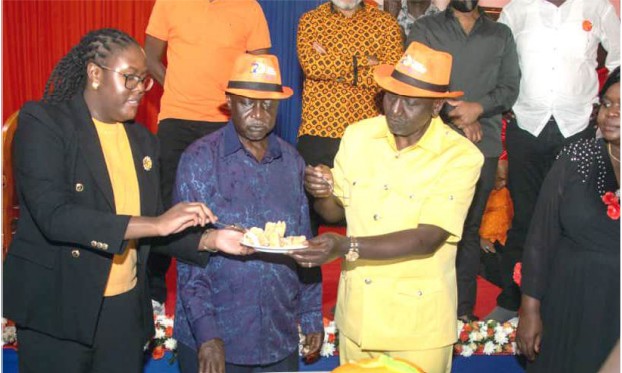
The ODM-at-20 celebrations after the interment of founding leader Raila Odinga brought interesting happenings to the fore. Open differences in opinion of political direction emerged at the fete.
Earlier, in what were Raila’s last days, party leaders seemed to pull in different directions They significantly involve cooperation with President William Ruto’s broad-based government and ODM’s leadership decisions. Three clear factions emerged. Soon after the funeral service, the differing voices became louder and followed a clear pattern.
The most disturbing came from Raila’s daughter Winnie Odinga who challenged the manner in which her uncle, Oburu Oginga, was made the party leader to succeed her father.
She also made some tantalising remarks regarding party officials who were working behind the scenes to ‘play poker’ with the party. She warned the unnamed officials of dire consequences and declared that ODM must retain its distinct identity.
Siaya Governor James Orengo had earlier delivered a fiery speech in which he was bitterly critical of the Kenya Kwanza regime. These were the same sentiments of outspoken ODM secretary-general Edwin Sifuna, who is also the Nairobi senator. Sifuna would later invite maverick
Embakasi East MP Babu Owino to address the gathering. Babu was the only legislator who is not a senior party leader to give a speech at the anniversary event.
Then on the other side of the isle, are the conservatives who occupy the centre of the party ideologically. Led by chairperson Gladys Wanga, they claim to have been Baba’s most loyal officials.
They have variously made public pronouncements about receiving last instructions directly from Raila while he was undergoing treatment in India.
The cast comprises Cabinet Secretaries Hassan Joho and parliamentary leaders such Junet Mohamed. Oburu has to contend with these factions as he navigates his new position.
Missing in action so far is Mama Ida Odinga. When Raila was alive, Ida had a controlling influence on her husband. This influence had direct influence on major ODM decisions.
Will she relinquish this important perch in the party hierarchy, even if it is ceremonial and not constitutional? Oburu has publicly promised to resolve the disputes quietly as a family and in a family setting.
This begs the question, is the Jaramogi family a corporate member of ODM? If that were case, wouldn’t a little courtesy to the existing party leadership hierarchy promote harmony much more effectively than a hard tackle?
The confusion that has engulfed the country’s largest party since Raila’s demise is cannon fodder for its competitors. However, the vitriol that was pervasive during the former Prime Minister’s last days, between the party and other opposition groupings, makes it almost impossible for any of them to inherit and benefit from ODM’s vast networks.
The Kalonzo axis of Azimio coalition leaders felt shortchanged once again by Raila when he took ODM to the broad-based arrangement with President Ruto. They expected that this agreement would have involved all the partners of Azimio so it would benefit equitably.
The decision by the former ODM leader to go it alone was therefore taken as betrayal. Kalonzo, Eugene Wamalwa and Martha Karua never hid their anger and frustration with Jakom.
They openly castigated his actions and fell just short of calling him a traitor. The fallout did not go down well with the Raila supporters. They interpreted it as disrespect to the party leader and akin to insubordination.
The support base considered the trio ungrateful people who sought to reap where they did not sow. They are, thus, not welcome into this fold however fragmented it is.
Further Kalonzo is facing stiff competition for the control of his Ukambani backyard. In the same vein, Eugene has to ward off the ‘tawe’ onslaught from Trans Nzoia Governor George Natembeya while Karua has disappeared under the shadow of Rigathi Gachagua and his DCP. Kalonzo’s vote basket is the Ukambani constituency.
This constituency, like any other, would be kept solidly intact if there were realistic hopes of being in government.
Pundits seem to agree that on his own, the former VP cannot mount a successful presidential campaign. He therefore must convince his opposition colleagues to nominate him as their compromise candidate. If he flew the United Opposition presidential flag, then his chances against Ruto would be big.
He might present a safe bet since he does not command a large following cutting across the country. Secondly, because of comparatively low resource outlay, he will rely largely on the generosity and goodwill of his coalition partners. He thus poses the least risk of reneging on the coalition agreement provisions regarding power sharing.
The biggest challenge they will face is a battle-hardened political strategist who enjoys the trappings of incumbency. Further, Kalonzo himself has never made any efforts to endear himself to the Raila constituency.
There have emerged at least three factions in ODM so far. The one for Luoland is further split into three, unlike the Coast and Western regions. All of them are seeking to fulfil Raila’s last wish to work with the government by positioning themselves as the bona fide leadership of the party. Each one of them has made claims to the effect that Jakom gave direct instructions on how to manage the broad-based agreement. If no truce is reached soon enough, then each will go their separate ways.
It is unlikely that they will reconcile because the stakes are high and pride has found residence in their midst. Each faction is focused on wresting control of the huge financial resources and vast grassroots networks bequeathed by Raila. Ruto is well known to each of them. He has worked with them closely at one stage or the other.
The President enjoys the advantage that he had a close and cordial working relationship with the ODM leader. Every leader in ODM is agreed that Jakom left them with Ruto.
This gives Ruto a head start but not an absolute advantage over the Raila constituency. The masses admire his workaholic streak and the consistency in his vision. Inheriting the Raila vote basket would be a boon to his reelection.
However, he has to manage the Luoland factions to his advantage. If he does not deploy dexterity, then the constituency may scatter to the four winds.
The faction that gravitates around Orengo will most likely not work with the rest. Unfortunately for them, they have lost much ground with the voters. There will be close to seven million new voters by 2027.
The ODM constituency will have almost half of these numbers. Ruto must design a strategy to speak to the hearts and minds of these young Kenyans directly without going through kingpins and gatekeepers.
He should further find a formula to work with the other factions of ODM as united front without necessarily forcing them into one political outfit.
Politics is largely about interests. Ruto has the yam and knife; he has the ability to satisfy the various interests to large extent. How he plays his cards determines the satisfaction levels of satisfaction by the various factions.
He must for his interest and assured success bring together vote blocs that will guarantee electoral victory. The current confusion in the ODM party presents a rare opportunity to build new bastions of solid political support.
The ODM fraternity has been built and sustained around a strong leader. They will be looking for a leader of similar mould to replace Raila and the President fits the bill.