

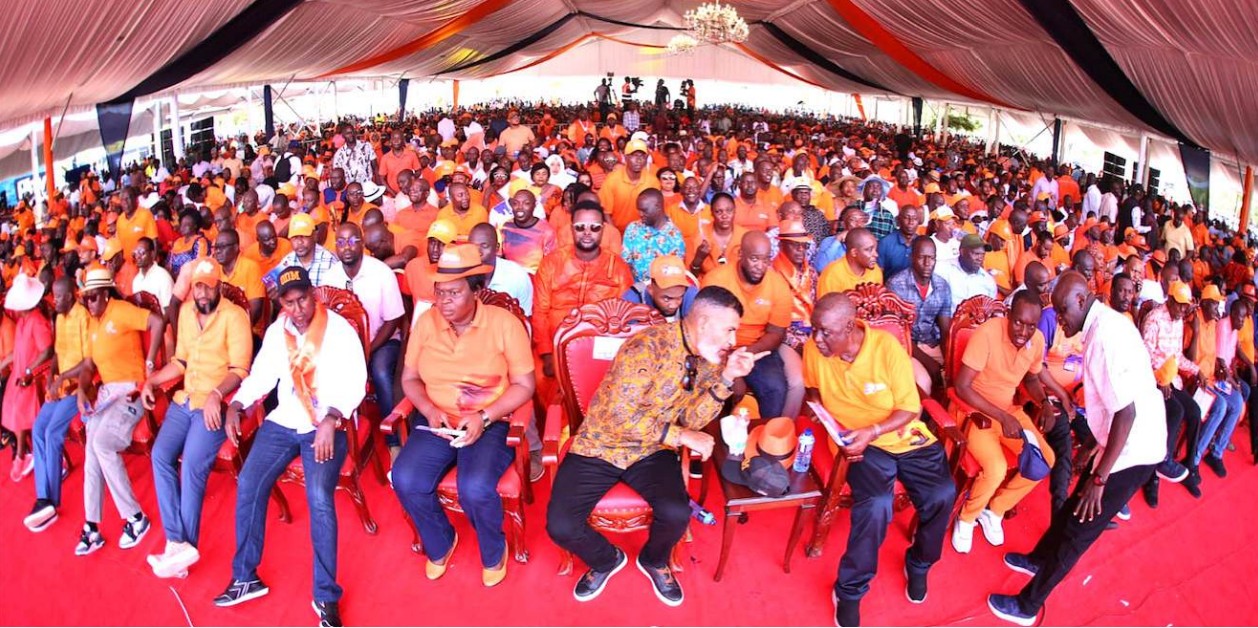
Watching the ODM at its 20th anniversary celebrations in Mombasa, over three days last week, I felt exactly as though I was witnessing a funeral ceremony.
There was a sense of deja vu, like we’d been here before, though I couldn’t figure if it reminded me more of Ford Kenya in 1994 after the death of Jaramogi Oginga Odinga.
Or the days preceding the implosion of Kanu, after President Moi opted to back Uhuru Kenyatta for president in 2002, forcing many senior elected Kanu leaders to exit the party.
Politicians have a manner of speaking that can baffle a newcomer to this country. When they refer to someone as “my very good friend”, they are about to unleash insults on the person, quite often a political foe for whom they have no time.
And when they appeal for unity in any organisation, especially within their political parties, you can be sure that unity is the last thing they intend. In fact, they are in all probability holding night meetings and strategising against each other.
And so, when the Orange nation descended on the coastal city of Mombasa, for a three-day fete at the end of last week, its luminaries appealed for unity, declaring that they would not be the ones to break up Raila’s party.
Indeed, the chairman of the celebration’s organising committee, Minority leader Junet Mohamed, started by asking all speakers to stick to the theme of the celebrations and avoid any discussions of 2027, the most controversial matter within the party. No one heeded his warning.
But once the microphone was set for speeches, everyone appeared on edge. The smiles were gone. Even the MC, usually calm during Raila functions, angrily and repeated lashed out at youths standing near the podium.
From the word go, anyone reading the room could see that without Raila, no one would be held back or caged into anyone’s preferred position. Those who wanted the party firmly aligned with the Ruto regime, and those who opposed the arrangement, came bearing the requisite political weapons for the day.
An observer had to pity the newly minted ODM leader Senator Oburu Oginga, the elder brother of the party’s departed iconic leader. The leaders took to the podium and feuded as if he wasn’t there.
It was a far cry from the usually tame speeches by rival party factions under Raila. And when Oburu’s time to speak came, he seemed completely worn out, burdened by divisions he had only inherited from his brother, and seemingly at a loss over what to do.
Some of the speeches were passionate and angry. CS Hassan Joho, a former ODM deputy party leader, alleged a plot within the party to “sacrifice him” and promised to face his enemies head on.
He didn’t say who exactly they were. Raila’s youngest daughter, Winnie Odinga, bluntly reminded everyone that the party was not available to be sold “during pillow talk”.
Secretary-General Edwin Sifuna demanded that important decisions of the party, including how to align during the next general election, be referred to the national delegates conference.
Irked by some of the speakers before him, Junet angrily retorted that at the rate things were going, everyone might free to take away his own piece of ODM. His remarks were rather shocking.
The National Assembly Minority leader has been one of the beneficiaries of Raila’s brilliant diversity mentality, enjoying uninterrupted terms as MP of Suna East in the Luo heartland.
He must surely be aware that the vicious fight for the soul of ODM will be fought, won or lost largely in Luoland. Given his unique position, his comment about breaking up the party into pieces sounded unwise.
Be that as it may, the overall assessment after the jamboree was that the positions had only hardened, and Raila’s nuclear family, following Winnie’s comments, had been sucked into the controversies. I submit that the divide will grow wider, and the scheming will get even more intense. The involvement of President Ruto will only make matters worse, because my impression is that he wants a malleable team he can work with to lead the party, rather than the most popular one.
The truth is quite straightforward. ODM was a creation of Raila, whose charisma and unique skills kept everyone within. Rivals dwelled freely within the movement because the larger-than-life profile of their leader kept competing interests at bay, expertly avoiding divisions.
Besides, the loyalty from a multi-tribal base that the former Prime Minister enjoyed among a cross section of Kenyans wasn’t really transferrable. With this in mind, my instinct is that there is no one in the party today who can command that entire base to not only stay in the party, but to go into the electoral cycle united.
I have drawn comparisons between ODM at this point and Ford Kenya following the death of Jaramogi in 1994. However, Ford Kenya at that time had a relatively easy time deciding that the party’s then vice chairman Michael Kijana Wamalwa would succeed the departed old man.
Even the choice of James Orengo to become Wamalwa’s deputy was relatively controversy-free. After all, Jaramogi had run a party of talented heavy-hitter politicians, a huge pool of brilliant men from whom successors were easy to find.
In contrast, Raila appears to have run a movement where a successor, either by design or otherwise, hadn’t been propped up. Additionally, the former PM sent mixed signals in the last months of his life, over the sticky issue of the party’s plans for the 2027 election.
In that scenario, Raila unwittingly handed to his party a problem that only he could have solved, and worse still, he passed on this problem to people so lacking in his own skills and capacity that it is almost certain that a resolution will not be coming soon.
It is with this background in mind that one has to wonder if last week the last time was the nation saw the monolith ODM in action. Obviously, all the diverse and competing interests had to come to the jamboree, which was in fact organised while Raila was alive and still in charge.
In the coming days and weeks, there will be party activities, including by-election campaigns and polls. But I believe that different factions will do these, each avoiding the other, possibly until the 2027 electoral cycle kicks in and every political bird decides where to flock.
As things stand, no side is willing to compromise on its stand. Those who hang onto the broad-based government for political survival will have to cling harder, and play sycophant even more passionately because the comfortable umbrella of Raila is no longer there. His absence makes them vulnerable to being assessed a little harshly by their UDA masters.
On the other side, those who feel that any association with the regime will hurt their own electoral plans will further entrench their position. Which leaves the inevitability that in the absence of a unifying figure in the party to bridge the growing gap, the more realistic prediction is that the party faces the spectacle of splinter groups.
It will be quite a shame, given the position that ODM has held in Kenya’s political sphere, but if Ford Kenya of 1994 taught us any lessons, it is that, in the words of young Kenyans, “you can’t force issues!”






