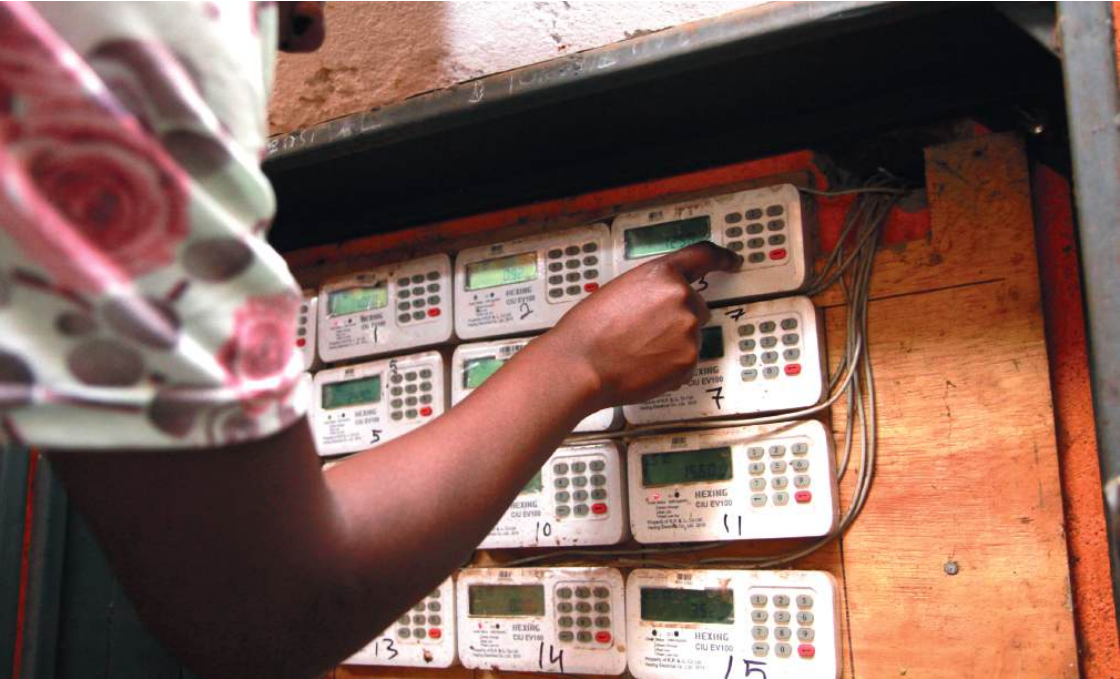
 A customer updates tokens on a pre-paid metre in Kangemi, Nairobi /ENOS TECHE
Kenyan households and industries could soon get a reprieve on their electricity bills after Parliament gave a nod to the lifting of the moratorium on Independent Power Producers, with a directive that they extend low-cost power under new guidelines.
This now sets the ground for Kenya Power to enter into new Power Purchase Agreements (PPAs) with IPPs in a move that will increase electricity generation, with the country's high renewable energy potential, mainly geothermal and wind, offering the base for cheaper power to consumers.
This will, however, depend on how Kenya Power negotiates for the PPAs, including avoiding long-term dollar-denominated contracts, cutting down on losses and completing stalled projects.
Findings by the Energy committee show that, should KPLC and other power agencies adopt the new recommendations, Kenyans will stand to save up to Sh6 billion annually, which would otherwise be recouped through customer billings.
David Gikaria-led the Energy committee, says that to achieve the reduction, within 36 months of adopting the report, KPLC must put measures in place.
These measures include conducting a load analysis to find technical losses. They must also correctly measure losses by installing tamper-proof check meters at generation plants.
“The goal is to lower system losses from 23 per cent to 14.50 per cent. Achieving this would save consumers about Sh6 billion annually. This money would otherwise be recouped through higher customer bills,” the committee noted.
Despite a strong renewable energy mix dominated by geothermal, hydro and wind, retail power tariffs in Kenya remain higher than those of many peer economies.
Analysts attribute the steep prices to long-term Power Purchase Agreements (PPAs) with Independent Power Producers (IPPs), high-capacity charges, system losses and exposure to foreign exchange fluctuations.
Compared to peer nations, Kenyans pay a variable rate for electricity, with recent figures from early 2025 suggesting an average of approximately Sh28 to Sh33 per unit (kWh) for domestic consumers.
As part of the proposed reforms, parliament adopted the committee’s recommendation that the moratorium on onboarding new IPPs imposed in 2021 as part of efforts to tame rising electricity costs be lifted.
The Ministry of Energy and state energy agencies have also been directed to immediately begin implementing the new measures.
Among the approved directives is a requirement that all future amendments to PPAs undergo legal scrutiny by the Attorney-General, who must issue advice within 30 days to prevent delays.
“All future amendments or variations to Power Purchase Agreements (PPAs) shall be subject to the Attorney General to advise, interpret, negotiate, draft, or perform any other function as may be necessary for the effective discharge of his or her duties pursuant to the Constitution, 2010,” says the report tabled in parliament.
The Ministry of Energy will also be required to submit a consolidated report to Parliament every six months to ensure transparency in contract variations and oversight of the sector.
The committee noted that Kenya currently has 41 EPRA-approved PPAs, many of which are long-term take-or-pay contracts averaging 20 to 30 years.
However, the ownership structures of several IPPs, most of which list foreign firms as shareholders, are contributing significantly to high retail tariffs.
To drive down future costs, Parliament directed the Ministry of Energy and EPRA to transition the country to a competitive auction scheme for procuring new renewable energy projects.
This would make Kenya adopt a similar model to South Africa’s IPP model, within 12 months.
“The shift is expected to promote price discovery, ensure competitive bidding and replace the Feed-in-Tariff system for new projects,” the committee noted.
Under the feed-in tariff, energy producers, like homeowners with solar panels, are paid a fixed, premium price for the renewable electricity they generate and have the right to "feed" this electricity into the main power grid.
In one of the most critical cost-reduction measures, Kenya Power has been given 36 months to include smart meters, high-efficiency transformers, smart grid technologies and capacitor banks to store idle power.
To safeguard power users from exchange rate fluctuations, under these new rules, all new PPAs must be denominated in Kenyan shillings or in hybrid structures combining local and foreign currency to reduce forex-linked costs passed on to consumers.
“Hybrid combination will ensure that local costs, taxes are priced in local currencies and debts or financing facilities costs are priced in their respective currencies,” The report says.
The committee further directed EPRA to review the time-of-use tariff within six months to extend cheaper night-time power rates and to develop a transparent pricing mechanism for Special Economic Zones (SEZs).
“EPRA must also create a transparent mechanism for setting nearly uniform, preferential tariffs for all Special Economic Zones (SEZs) to attract new investment. The current cheap rate of Sh5/kWh now only applies to the Naivasha Kedong SEZ.” The committee said in its findings.
The lawmakers are further recommending that, within nine months, Kenya Power and EPRA should review minimum stock obligations for heavy fuel oil under thermal plants and set minimum dispatch levels required by manufacturers.
Kenya Association of Manufacturers says that Kenya still retains its positioning as a top destination for investment in Africa, but high production costs must be addressed.
“To ensure we sustain this position, the government and manufacturers need to work together to unlock key competitiveness issues affecting our local manufacturing sector, such as the high cost of production occasioned by heavy taxation and high energy costs,” KAM chief executive Tobias Alando said at the just concluded Changamka Festival.
The report is the latest in a series of inquiries, four task forces and three parliamentary probes in the past six years aimed at lowering the cost of electricity.
Despite increased investment in renewable energy, retail tariffs have remained high due to capacity payment obligations, excess supply, and payments for deemed energy.
Previous initiatives, including a 2017 task force on PPAs, recommended reducing electricity costs by more than 33 per cent, but its findings were never made public.
Parliament now hopes the new measures, coupled with stricter oversight and competitive procurement, will finally address long-standing inefficiencies and deliver cheaper, more reliable power to consumers.