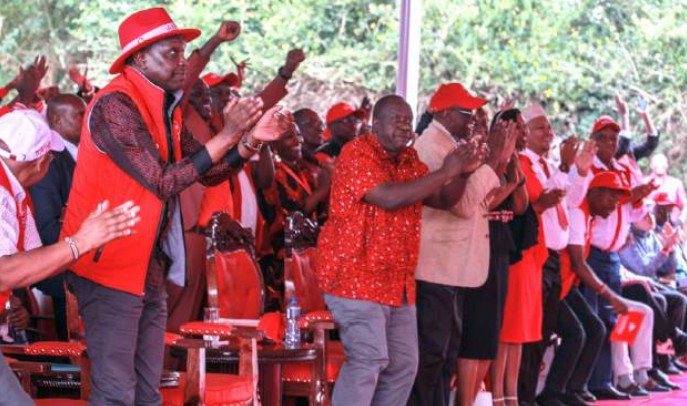
Kenya’s political landscape is rapidly changing as major parties hold back-to-back national delegates conferences (NDCs), signalling a heated season of realignments, rebranding and strategic positioning ahead of the 2027 polls.
In just three months, more than five political outfits have convened NDCs to endorse presidential hopefuls and unveil fresh leadership structures aiming to topple or weaken President William Ruto’s reelection bid. And importantly, some smaller parties want to align with Ruto to improve their bargaining positions in any future government.
They include Kalonzo Musyoka’s Wiper party, Martha Karua’s People’s Liberation Party, Uhuru Kenyatta’s Jubilee Party, Eugene Wamalwa’s DAP-Kenya and Jimi Wanjigi’s Safina Party.
Analysts say the growing wave of political activity marks the beginning of pre-election manoeuvring as party leaders seek to cement regional influence, control internal factions, and shape new alliances ahead of 2027.
Joining this list is the Usawa Kwa Wote Party led by former Murang’a Governor Mwangi wa Iria, which plans to hold its NDC on November 22 at Ufungamano House, Nairobi.
Democracy for the Citizens Party, led by former Deputy President Rigathi Gachagua, reportedly is also planning to hold its NDC after numerous postponements throughout the year.
In the Mt Kenya region, Usawa Kwa Wote joins a growing list of smaller parties, including The New Democrats (TND) led by Thuo Mathenge and The Service Party of Mwangi Kiunjuri. They have declared support for President Ruto.
Speaking to the Star, Mathenge said the ongoing NDCs reflect a maturing democracy and renewed political awareness across Kenya’s multiparty system.
“These conferences show democracy is evolving and parties are realising they must remain active and connected to the people beyond election seasons.”
He cautioned that Kenya’s post-election culture has too often revolved around personality-driven alliances rather than ideology or public interest, saying a shift is needed to enhance democratic growth within political institutions.
“We as TND believe in coalition politics rooted in values, not intimidation or opportunism,” Mathenge said. “Leadership should be judged by ideas, integrity and delivery, not loyalty to individuals.”
He cited the 2018 post-election pact between President Kenyatta’s Jubilee and Raila Odinga’s ODM, popularly known as “the Handshake”, as an example of how alliances can reshape the political order.
Wa Iria, in recent interview, revealed that his Usawa Kwa Wote’s upcoming NDC will define the party’s direction.
He hinted delegates will deliberate on aligning the party’s agenda with President Ruto’s development blueprint, while preserving what he called “Azimio’s values of peace and unity.
“We are determined to ensure the Mt Kenya region fully reaps the benefits of the government, even as we continue to remember Raila, who championed peace and unity,” he said.
Wa Iria, a vocal critic of Gachagua, recently adopted a reconciliatory tone toward the Kenya Kwanza administration after his recent appointment by Ruto to serve in the Kenya Kwanza administration.
Insiders say his NDC could pave the way for a post-election deal with the head of state, signalling a strategic shift away from his former Azimio alliance.
“Wa Iria wants to formalise ties with Ruto’s administration,” a source familiar with developments told the Star. “He is positioning himself alongside other Mt Kenya leaders such as William Kabogo of Tujibebe, Mwangi Kiunjuri of TSP and Moses Kuria’s Chama cha Kazi who have written agreement with Ruto.”
Political analyst Albert Kasembeli says Wa Iria’s NDC move is more than just a routine party meeting as it might serve as calculated political comeback aimed at reasserting his influence both in Mt Kenya and on the national stage.
He said the former governor might aim to capitalise on the recent divisions within the Mt Kenya region and take on Uhuru’s recent active political activities.
“Every major player in Mt Kenya is now fighting for relevance, Jubilee is struggling for identity, and smaller parties are seeking alliances. Wa Iria’s NDC offers him a platform to rebuild his base and negotiate from a position of strength,” Kasembeli said.
Thika MP aspirant and political analyst Ephraim Wainaina said the current wave of NDCs should not be dismissed as mere political activities.
He said political parties are positioning themselves in preparation for the next election, adding that opposition parties must remain united if they want to succeed.
“These conferences are power statements, not just meetings, each party is showcasing unity, numbers, and relevance in preparation for coalition bargaining,” Wainina said.
He added that there’s nothing unusual about the ongoing delegates’ conferences except that now they are taking place much earlier than usual, as each political party races to gain visibility and influence ahead of serious coalition negotiations.
President Ruto recently downplayed the opposition’s recent political activities and accusations, saying the former ODM leader Raila Odinga would have been his only formidable challenger.
Speaking in Malava, Kakamega county, during the start of his development tour on Thursday, the President said his rivals lack vision, policies and a clear development agenda.
He accused them of engaging in tribal and divisive politics rather than offering solutions that can uplift Kenyans.
“The only person I would have [seriously] competed against is Raila, but as for the rest, I’ll finish them off early in the morning,” Ruto said to a cheering crowd.
The head of state challenged rivals to present credible development policies instead of engaging in “empty politics”
Party of Democratic Unity national chairman Isaiah Gichu said the current flurry of political activities is purely strategic. He said both the government and the opposition are battling for regional control and political survival.
Gichu said unfolding developments are less about ideology and more about positioning, with every major player recalibrating their strategy to remain visible and relevant.
“We are witnessing a calculated contest for influence,” he said. “Both the opposition and the government are rebranding, reorganising, and strengthening their networks to ensure they don’t lose ground in key regions such as Mt Kenya, Western, and the Coast. Everyone wants to be seen as part of the winning side.”
Former Trade Cabinet Secretary Moses Kuria recently renewed his attack on Gachagua, accusing him of weak leadership and surrounding himself with inexperienced advisers.
He commented after the former DP’s allies rejected Kuria’s proposal for unity in the Mt Kenya region.
Kuria had made the unity offer conditional upon Gachagua ceasing what he termed as “verbal attacks” on women leaders.
“After my offer to work with our self-declared kingpin on the condition that he stops insulting women leaders, this is how his kitchen cabinet has responded to my gesture for the unity of our region,” Kuria wrote on X.
The former CS took aim at Gachagua’s inner circle, saying his leadership style falls short of the standards set by past leaders from the region.
“The problem with Rigathi Gachagua is that, unlike Jomo Kenyatta, Mwai Kibaki and Uhuru Kenyatta, he surrounds himself with neophytes and rookies,” Kuria said. “The bar has fallen too low.”
On the other hand, former DP and Kalonzo recently announced a strategy to merge their voter bases, aiming for a combined 12 million votes.
Gachagua said if given the leadership of the Mt Kenya region for 2027, he would ensure its unified support and combine efforts with the Akamba community to form the next government.
He also urged leaders, especially in Mt Kenya, to remain united and shun leaders working with the Kenya Kwanza administration.
Kalonzo maintained that the opposition will continue consolidating their base to ensure Ruto isn’t reelected.