

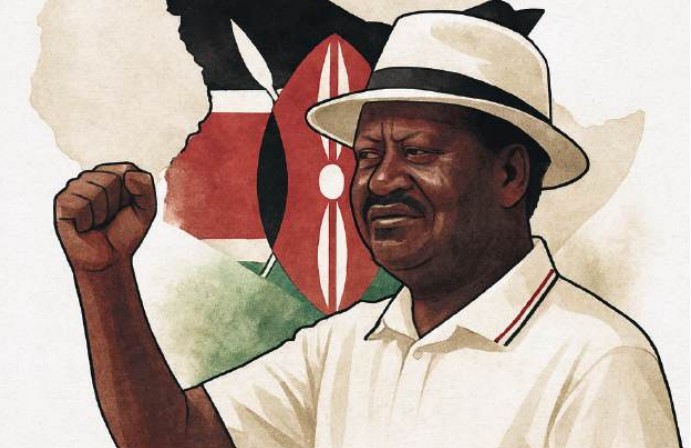
Raila Odinga was not just a candidate; he was a cause. His political life embodied the unfinished business of Kenya’s constitutional reform, the moral urgency of resistance and the symbolism of generational struggle.
From detention under Moi to the 2007 crisis and the 2018 handshake, his arc was one of defiance and resilience.
His death closes the chapter on the politics of struggle. What follows is a new era defined by pragmatism, generational transition and institutional realignment. The opposition must now evolve from protest movements to policy platforms.
It must trade martyrdom for strategy and symbolism for substance. Raila’s charisma was a scaffolding for many political careers.
His moral authority shielded allies from scrutiny, his popularity mobilised crowds and his legacy legitimised coalitions. Without him, the scaffolding collapses.
The faces of fallout
The former ODM leader’s death has cast a long shadow over Kenya’s political landscape, exposing the precarious scaffolding upon which many careers were built.
Kalonzo Musyoka, long positioned as Raila’s co-principal within the Azimio coalition, now faces mounting pressure to assume leadership. Yet, without Raila’s gravitas or national resonance, Kalonzo risks presiding over a fragmented alliance vulnerable to absorption by President Ruto’s expanding political machinery.
Martha Karua, whose principled stance once found ideological anchorage in Raila’s moral authority, must now recalibrate her role or risk drifting into political marginality.
Within ODM, the succession dilemma is even more acute. Hassan Joho, once touted as Raila’s coastal heir, must now transcend his regional charisma and cultivate national credibility amid internal party turbulence.
Babu Owino, a vocal youth figure who flourished under Raila’s protective umbrella, may struggle to assert independent leadership without institutional scaffolding.
Junet Mohamed, Raila’s trusted campaign strategist and confidant, finds his relevance tethered to ODM’s ability to cohere and reinvent itself. Wycliffe Oparanya, while often floated as a potential successor, lacks the national appeal required to galvanise a fractured opposition and may retreat to regional politics if the party fails to reorient.
In contrast, Ruto stands to gain strategically from this vacuum. As the opposition fragments, he may attempt to co-opt Raila’s legacy, either rhetorically or structurally, to consolidate power and neutralise dissent. Yet for all these actors, the central challenge remains the same: confronting the myth of succession.
Raila’s political capital was not a transferable asset; it was earned through decades of struggle, sacrifice and symbolic resonance. Loyalty to his ideals must now be demonstrated through principled action, not mere proximity.
The post-Raila era demands vision, courage and a redefinition of leadership beyond personality.
2027 election as a litmus test
The 2027 general election will serve as a profound litmus test for the country’s democratic maturity, particularly among millennial and Gen Z voters.
For these generations, Raila was not merely a political figure; he was a constant presence, a symbol of opposition, reform and defiance against entrenched power. His name appeared on every ballot they have ever known and his voice echoed through every major political moment of their lifetime.
In his absence, a psychological void emerges, unsettling the moral compass of a generation accustomed to rallying around his ideals.
This vacuum presents both a risk and an opportunity. There is the danger that young voters, disillusioned by the erosion of principled leadership, may disengage from the political process altogether.
Yet there is also the possibility that they will rise to reimagine opposition politics beyond personality cults, toward a more institutional, issue-driven and inclusive democratic culture.
This moment demands political imagination: the cultivation of new voices, the articulation of fresh visions and the construction of vocabularies of dissent that speak to the aspirations of a post-Raila electorate.
For ODM, the stakes are existential. As the party most intimately tied to Raila’s legacy, it must now confront the challenge of survival without its founder.
The question is whether ODM can reinvent itself as a coherent political institution or fracture into regional factions, each vying for relevance in a landscape no longer anchored by Raila’s unifying presence. The answer will shape not only the future of the party but the trajectory of opposition politics in Kenya.
Regional lessons and continental lament
Raila’s death reverberates far beyond Kenya’s borders, casting a sobering light on a broader continental crisis: the systematic dismantling of opposition movements across Africa.
His passing underscores the extent to which dissent has been institutionally weakened, not merely through state repression, but through the erosion of moral leadership capable of galvanising transnational solidarity.
Tanzania offers a cautionary example. In the aftermath of its most recent election, the country witnessed widespread violence, the suppression of opposition leaders and the stifling of civic space.
Yet, in a display of diplomatic expediency over democratic principle, the African Union and several regional heads of state hastened to endorse the outcome. Such gestures are not acts of solidarity; they are acts of complicity.
They normalise electoral injustice and signal to authoritarian regimes that brutality can be laundered through ceremonial legitimacy.
In this context, Raila’s absence is deeply consequential. He was one of the few African statesmen whose moral authority transcended national boundaries, capable of calling out hypocrisy and rallying support for democratic norms. His voice, forged in the crucible of resistance, carried weight in regional forums where silence often prevails.
Without him, Africa’s opposition movements lose not only a symbolic anchor but a strategic interlocutor, someone who could articulate the continent’s democratic aspirations with credibility and conviction.
His death left a void that will be felt not only in the 2027 election, but in the broader struggle for accountable governance across the continent.
Corrective action and strategic hope
Kenya must resist the impulse to mourn Raila’s passing with passive nostalgia. While the void he left is profound, it also presents a generational opportunity to reimagine and fortify the country’s democratic architecture. The moment demands deliberate action, not merely to preserve his legacy, but to transform it into institutional resilience.
First, the opposition must be restructured around enduring ideas rather than charismatic individuals. This entails investing in robust policy platforms, cultivating youth wings within political parties and embedding civic education into national discourse.
Second, the protection of dissent must be elevated as a constitutional imperative. Legal safeguards for opposition leaders, journalists and civil society actors must be strengthened to ensure that democratic contestation remains viable and secure.
Third, Kenya must demand greater accountability from regional institutions such as the African Union and the East African Community.
These institutions must be compelled to audit electoral processes and censure violence, rather than legitimising flawed outcomes through premature endorsements.
Lastly, the political engagement of millennial and Gen Z citizens must be deepened. Beyond casting ballots, these generations must be empowered to shape political discourse, policy priorities, and institutional reform.
As the largest economy in East Africa, Kenya’s political culture, however imperfect, has long served as a regional reference point. Raila’s legacy is inseparable from that reputation.
His courage, resilience and refusal to be silenced must now be institutionalised, not merely memorialised. In doing so, Kenya can honour its contribution not by imitation, but by innovation.
Legacy vs loyalty
In the final reckoning, the true measure of the former Prime Minister’s legacy will not be found in the number of those who stood beside him, but in the conviction of those who now stand for what he stood for. Loyalty, in the realm of politics, is often performative, easily declared, rarely tested. Legacy, by contrast, is demanding.
It requires courage, clarity and continuity. Kenya now and soon stands at a crossroads, compelled to choose between the comfort of nostalgia and the challenge of reinvention.
Raila may be gone, but the ideals he championed, constitutionalism, justice and the audacity of democratic imagination, I hope, were not interred with him. These principles are not relics of a bygone era; they are the scaffolding upon which Kenya’s future must be built.
The 2027 election will serve as a referendum not merely on party politics, but on the nation’s capacity to evolve beyond personality cults and toward institutional integrity.
Let it be recorded, not as a lament but as a declaration, that Raila’s death did not mark the end of opposition politics; it signalled its rebirth. And in that rebirth lies a continental promise.
Across Africa, where opposition movements have been systematically weakened and moral leadership is in retreat, a new generation is watching.
They are not yet fully formed, but they are rising. Millennial and Gen Z Africans, restless, connected and unafraid, will one day step forward to reclaim the continent’s democratic destiny.
They will not inherit greatness; they will forge it. And when they do, his legacy will not be a memory; it will be a foundation.







