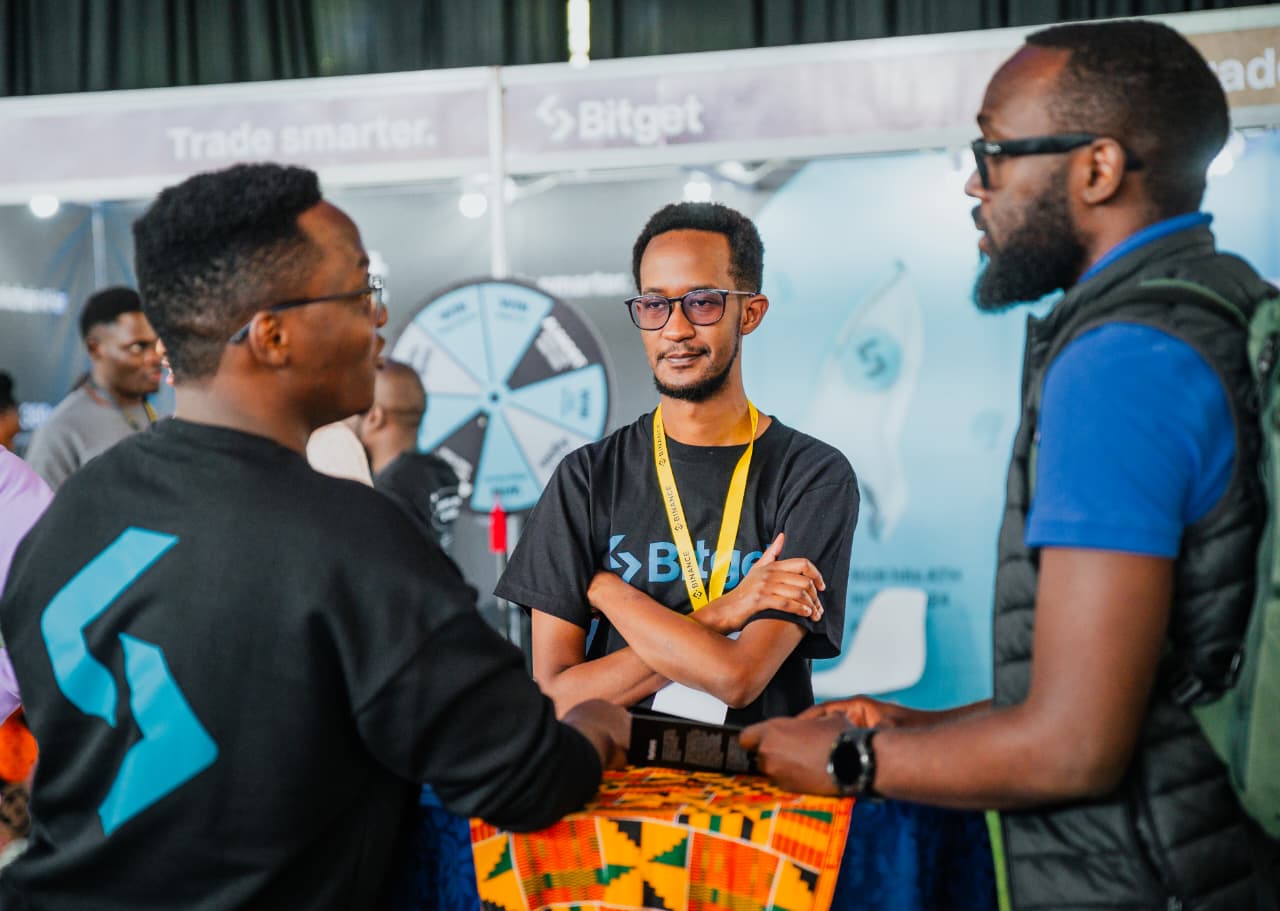
 Users at Bitget's desk at their event in Nairobi./HANDOUT
Global cryptocurrency exchange Bitget has announced that trading in its U.S. stock-linked futures has surpassed Sh129 billion in cumulative volume, a milestone that highlights the rapid growth of digital trading products blending traditional finance and crypto markets.
The surge, which has seen trading double in just two weeks, points to fast adoption of stock-style exposure inside a crypto app by users who already fund their accounts in USDT and switch seamlessly between crypto and stock-linked markets on mobile.
“Crossing the Sh129 billion mark in such a short time shows how fast traders are embracing stock futures as part of a unified digital trading experience,” said Gracy Chen, the Chief Executive Officer of Bitget.
“It’s a signal that the line between traditional markets and digital assets is disappearing, and our Universal Exchange model is where that convergence is happening first.”
The platform launched USDT-margined perpetual futures on 25 major U.S. stocks, including Apple, Amazon, Meta, and Microsoft, before expanding to contracts such as Netflix (NFLXUSDT), JD.com (JDUSDT), and QQQUSDT, which tracks the Nasdaq 100 index.
The products target traders who want exposure to global equities but prefer the flexibility of a 24/7 crypto interface. Bitget said the new products are part of its Universal Exchange (UEX) model, which combines crypto, tokenised stock products, and on-chain markets on a single platform.
“We are building an environment where users can access diverse financial markets without moving between different platforms or brokers,” Chen added.
“This is what the future of trading looks like: unified, borderless, and accessible to anyone with a smartphone.”
Across Africa, particularly in Kenya, where cryptocurrency use has been growing, traders are increasingly turning to peer-to-peer (P2P) channels to convert local currency into USDT for trading.
This allows them to take positions on familiar tickers such as Apple (AAPL), Nvidia (NVDA), and Tesla (TSLA) without going through foreign brokers or dealing with exchange rate restrictions.
Bitget said the 24-hour trading window and low transaction fees, as little as 0.0065 percent, have made stock-linked futures attractive for users who prefer managing both crypto and equity-style assets in one place. Leverage of up to 25 times is available, though the company cautioned that traders should be aware of the risks associated with high-volatility assets.
“These are not company shares, so users don’t receive dividends or voting rights,” Bitget clarified in a statement.
“They are derivatives that mirror price movements of the underlying stocks, allowing users to go long or short depending on their market outlook.”
Founded in 2018, Bitget now serves more than 120 million users globally and has positioned itself as the world’s largest Universal Exchange (UEX).
The exchange also runs Bitget Wallet, a non-custodial crypto wallet that supports over 130 blockchains and millions of tokens. Despite its growing popularity, Bitget reminded users of the risks inherent in trading derivatives.
“Digital asset prices are subject to fluctuation and may experience significant volatility,” the company said in its risk statement.
“Investors should only allocate funds they can afford to lose.”
As the boundary between crypto and traditional markets continues to fade, Bitget’s Sh129 billion milestone signals the accelerating pace at which digital platforms are redefining global investing, with Kenya’s growing crypto community taking notice.