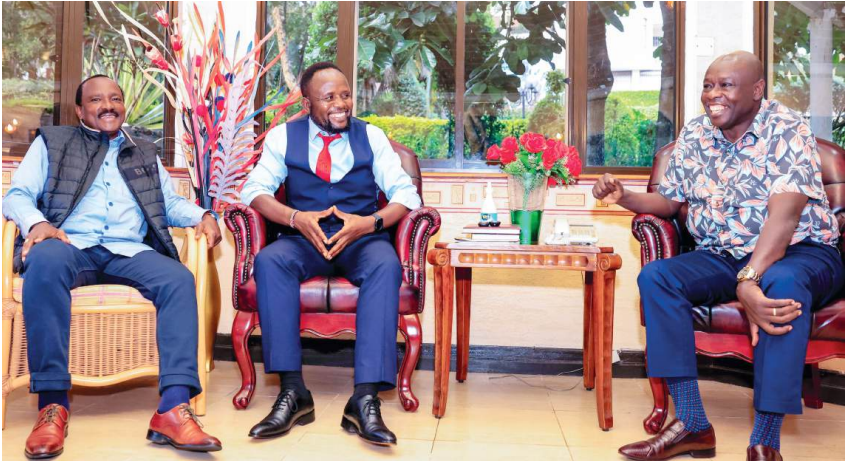
 Wiper leader
Kalonzo
Musyoka, Trans
Nzoia Governor
George
Natembeya
and former
DP Rigathi
Gachagua
during their
meeting in
Karen, Nairobi,
on Thursday
/DENISH OCHIENG
Wiper leader
Kalonzo
Musyoka, Trans
Nzoia Governor
George
Natembeya
and former
DP Rigathi
Gachagua
during their
meeting in
Karen, Nairobi,
on Thursday
/DENISH OCHIENG
Former Deputy President Rigathi Gachagua has reportedly agreed to support Wiper leader Kalonzo Musyoka’s presidential bid for the 2027 elections.
This alliance comes as Gachagua, who was impeached last year, looks to reshape his political future while positioning himself strategically for a potential return to power.
According to sources close to Gachagua, the former DP will not run for the presidency but instead will receive 50 per cent of Kalonzo’s government—should they succeed in defeating President William Ruto in the upcoming election.
An MP from Central Kenya familiar with the negotiations, remarked, “The deal is done and sealed.”
In this arrangement, Trans Nzoia Governor George Natembeya is expected to serve as Kalonzo’s running mate, while Fred Matiangi is slated for the position of Prime or Chief Minister. Further political alignments include Eugene Wamalwa, who is earmarked for the role of Speaker of the National Assembly and Martha Karua, who may take on the role of Senate Speaker, if she does not secure the Kirinyaga gubernatorial seat.
This coalition-building effort involves a select group of individuals, including Gachagua, Kalonzo and a trusted lawyer tasked with drafting a power-sharing agreement in preparation for the elections.
Despite his impeachment, questions remain about Gachagua’s political future and whether he can contest future elections.
According to legal experts, an impeached official may face restrictions when it comes to running for office again.
However, the specifics depend on the grounds for impeachment and the legal framework governing electoral candidacy in Kenya.
A prominent lawyer noted that while Gachagua's ouster could impact his political aspirations, it does not automatically disqualify him from contesting future elections.
The lawyer emphasised the importance of understanding the legal nuances surrounding impeachment and electoral eligibility, stating, “It’s essential to examine the terms of the impeachment and the relevant laws to determine if Gachagua can run again.”
Gachagua has hinted at a political alliance with Kalonzo for some time, suggesting that the Wiper leader has been a loyal ally to the Mt Kenya region during challenging times.
He believes the region owes Kalonzo for his past support of former President Mwai Kibaki and 2027 is viewed as the appropriate time to repay that debt.
Gachagua has expressed confidence that he can rally at least 70 per cent of Central Kenya voters to back Kalonzo, while also encouraging the Wiper leader to secure similar support from his Kamba community.
The coalition sees an opportunity to capture a substantial share of the vote, aiming for at least 40 per cent of the total countrywide votes, supplemented by another 20 per cent from Western and Nyanza regions.
This strategy reflects a calculated approach to build a broad base of support across various ethnic groups, which is crucial in the country’s multi-ethnic political landscape.
With their proposed line-up, the coalition believes they could secure as much as 70 per cent of the vote, potentially making Ruto the first Kenyan President to serve only one term.
During a development tour in Kakamega last week, Ruto dismissed the opposition as “non-starters.”
He criticised those positioning themselves against him, claiming they lack vision, policies and a coherent development agenda.
“The only person I would have taken on is Raila, but as for these others, I’ll deal with them first thing in the morning,” Ruto stated, emphasising his belief that the current political landscape is driven by tribal politics rather than substantive ideas.
The President accused his opponents of spreading division and hatred, challenging them to present credible policies that address the needs of ordinary Kenyans.
His remarks highlight the contentious nature of Kenyan politics, where alliances and rivalries can shift rapidly, often influenced by ethnic backgrounds and historical loyalties.
Instant analysis
As Gachagua and Musyoka continue to build their coalition, the political landscape in Kenya remains dynamic and unpredictable. With Ruto’s administration facing increasing scrutiny and opposition, the 2027 elections promise to be a pivotal moment in the country’s political history. The unfolding alliance between Gachagua and Musyoka could reshape the electoral map, offering a formidable challenge to Ruto’s presidency. As both leaders prepare for a battle that many believe could redefine Kenya’s future, the nation watches closely, aware that alliances forged in the backrooms of political negotiations can have profound implications for governance, representation, and unity in a country still grappling with its complex ethnic dynamics.