When businessman Ahmed Badawy speaks, few would imagine he once competed on the green turf of the Malaysian Futsal Premier League in that South-east Asian country.
His voice is so full of conviction, it is easy to imagine strikers afraid to dribble past him in a football field during his heyday as a centre back.
Badawy, aged 42, told the Star he bought football boots months ago in a futile attempt to relive those memorable days when he ate, drank, talked and slept football.
“I have never used those boots,” he says laughing.
He enjoys playing football more than watching it because playing is about strategy, something he learnt from many footballers and which he compares to life.
However, he has never abandoned his workouts to keep his body in shape.
Badawy’s days start as early as 4.45 am, when he wakes up for fajr prayer, before hitting the beach for morning runs, yoga and walks, depending on the day of the week. Then he takes a swim, a daily constant regardless of the day of the week.
He takes his three children to school then goes to work. Afterwards, he hits the gym.
“Swimming is every day for me. After living outside Kenya for many years, I have come to realise we have very beautiful beaches,” he said.
Working out is his way of dealing with the stresses of demanding work.
Born in Mombasa’s Old Town, also known as Kibokoni, Badawy moved to Saudi Arabia almost immediately, because his parents lived there.
“My mother had come from Saudi Arabia in August 1983 for the summer holidays and immediately after I was born we went back to the Gulf country, where I stayed until I was five years old,” Badawy says.
In the early 1980s, there were very few international schools in Saudi Arabia. English was not spoken in those days and his father did not want him growing up knowing only the Arabian culture.
“Kenya’s education system then was better,” Badawy says.
“So I was brought back to Kenya to start my educational journey at Memon nursery and primary school [in Mombasa].”
It was while in Form 1 at Alidina Visram, in 1998, that he made his first business deal, delivering goats for Eid celebrations to members of his extended family.
Badawy would go to Mariakani, buy the goats cheaply and deliver them to relatives.
After completing Form 4, he became the agent and broker for a man who bought cars, refurbished and sold them.
“I used to approach car owners and convince them to sell their cars to us, then we restored them for onward sale in upcountry.”
He then moved to Malaysia, where he joined Sunway College in Subang Jaya for his ACCA (Association of Chartered Certified Accountants) course before pursuing a Bachelor of Science in Applied Accounting at Oxford Brookes University in partnership with the ACCA.
He did the degree course in almost half the time, instead of the standard four years.
“We were five who were lucky to finish the course in two-and-a-half years. We put in the extra effort because the failure rate at ACCA is usually high,” he says.
His first posting was in Dubai, where got an auditor’s job at Ernst and Young, before leaving to become an investment analyst at the International Petroleum Investment Company—a sovereign wealth fund for the Abu Dhabi government.
It was in Dubai that he met one of his role models and mentors, businessman-politician Suleiman Shahbal (now East African Legislative Assembly MP), who asked him to manage the planned Nairobi office of Investment Dubai company.
That’s how he returned to Kenya in 2011.
He worked for almost 12 years, culminating in the award-winning Sh6 billion Buxton Point Affordable Housing Project in Mombasa.
During this period, Badawy also sold fish in Nairobi, buying them from fishermen across the Coastal strip from Vanga to Lamu, before processing them and delivering them to shops, restaurants and other customers.
He was looking for investors for his fish business when suddenly the Buxton Point project came up and he had to abandon the blue economy.
“After we completed Phase 1, I asked to leave so I could start my own project, saying I could not work in Shahbal’s shadow forever.”
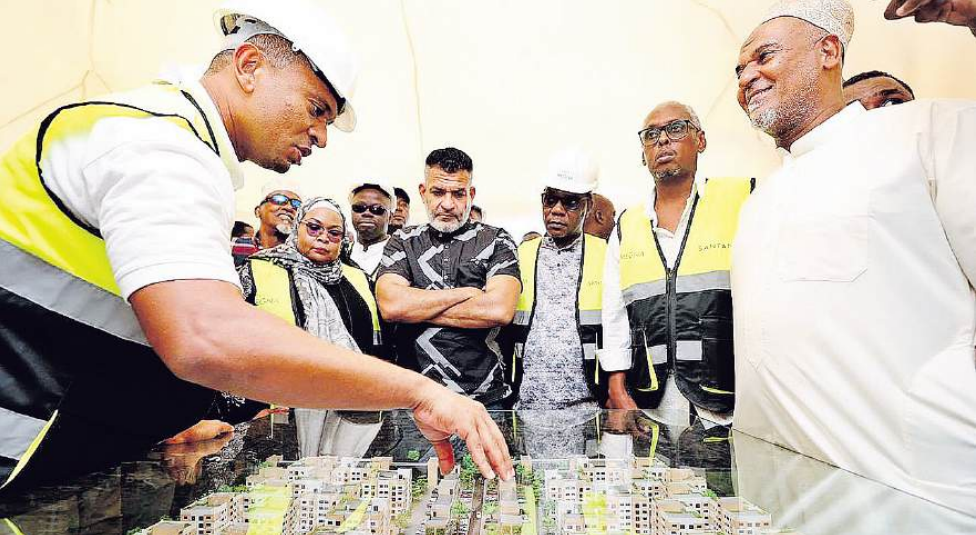
Badawy established Megna Homes, the company responsible for the Santana affordable housing project in Kisauni that is set to be the face of the Kwa Sonko area of Mtopanga.
Santana, he says, is a project that embodies what he believes in.
“I believe housing units should have amenities that make the basic standard of living decent and accessible to everyone. You don’t need to pay a lot of money to live in an environment where there is a playground, jogging track and beautiful garden, among other advantages,” he says.
Badawy is passionate about having an environment where children can safely play and be children for their all-around well-being.
So passionate is he that he did his master’s degree in Business Administration’s thesis in 2018 on affordable housing in Mombasa. It was a first at Strathmore University.
“We are offering all perceived luxury amenities, which to us are the basic amenities that developments must have.”
The need for housing units in Mombasa county is enormous because of the growing population, especially in Kisauni, which is its biggest and most populous subcounty, he explained.
Mombasa county holds the weight of three counties, including Kilifi and Kwale.
He values family and makes sure he is home by 7 pm.
“I have small children aged nine, six and two and I make sure I am the one who puts them to bed at least four times a week,” the businessman says.
He adds that it is easy to lose focus on the family because of business if one is not careful.
“That is where most people go wrong,” Badawy says.
“Do not let your business life interfere with your family life. Try to strike a balance to avoid these small fights at home.”
He doesn't schedule night meetings and when he gets home, puts the phone away.
“I go to bed around 8.30 pm. And by 9.30 to 10pm I am already asleep because I have to wake up at 4.45 am,” Badawy says.
He learnt some of these traits from his business partners, mentors and role models, which he added to his innate sales skills.
“Because of the business acumen, I have learnt from people like Shahbal, Amin Manji and others like my uncle, who taught me things I couldn't have learnt in any class.”
“Of course,” Badawy says, “I also draw a lot of inspiration from my father and grandfather for their values and value system.”