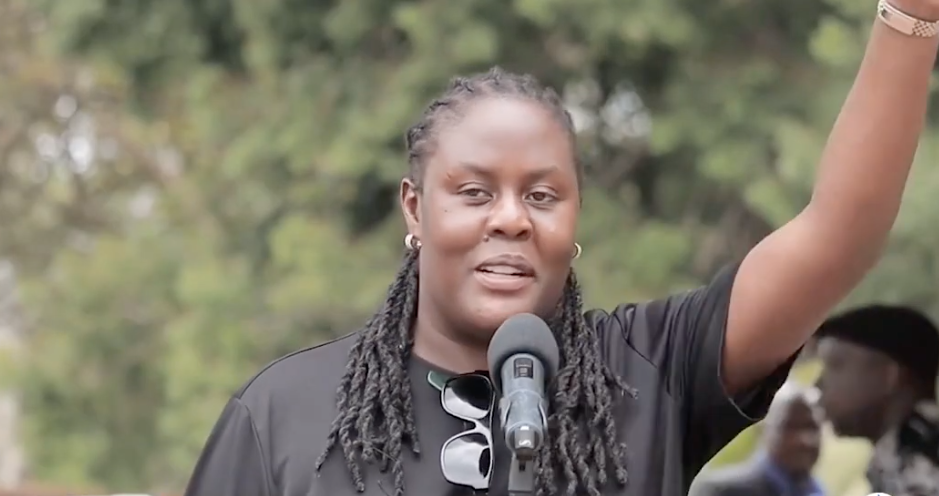
 East African Legislative Assembly (EALA) MP Winnie Odinga addressing a delegation from Migori which had visited to honour the late former Prime Minister Raila Odinga.
The somber occasion of Raila Odinga’s funeral was, as is often the case in Kenyan politics, interlaced with potent political theatre.
Amidst the eulogies and cultural dirges, a single, pointed remark from his daughter, Winnie Odinga, cut through the grief and set the political stage abuzz.
Turning to President William Ruto, she declared her readiness to “come back home”.
The statement, delivered from the heart of the Odinga family’s political stronghold, may have simply been a daughter expressing her longing, having served as a representative in East African Legislative Assembly since November 2022.
But, the jury is out on whether it was a political manoeuvre, interpreted by some netizens as the opening gambit in Winnie’s transition from regional representative to a central player on the Kenyan stage.
Winnie’s return is not that of a private citizen seeking a quieter life. Her service as a member of the East African Legislative Assembly has provided her a platform, a profile and a veneer of technocratic experience.
Her remarks signal an intention to trade Arusha for Nairobi, to step out of her father’s considerable shadow and into the full glare of the national political arena.
The question now echoing through the corridors of power and in living rooms is a simple one: what does this mean for the country?
Speculation on a potential role for Winnie is rife, informed by her unique blend of experience, academic qualifications and, most significantly, her political lineage.
Three possible scenes emerge: a run for elective seat, a Cabinet-level appointment or a party leadership role.
The most straightforward path would be to contest for a parliamentary seat, perhaps in her family’s Siaya backyard. A by-election for a constituency, or a calculated run for a governorship in 2027, would grant her a direct platform and a legitimate, democratically-earned voice in national affairs.
Going by the dalliance between her late father and Ruto that yielded a reconfigured government, Winnie could be a prime candidate for a ministerial role.
Given her background—a Master’s degree in Public Policy and experience in the legislative assembly—a ministry like East African Affairs, Foreign Affairs, or even ICT and Digital Economy could serve as a merit-based appointment.
A more gradual approach would see her formally take up a senior position within the Orange Democratic Movement, solidifying her role as a custodian of the Odinga political legacy. This would allow her to build her own power base from within the party machinery.
But, as with all things in Kenyan politics, the public’s reaction is a study in contrasts. On social media, the conversation is polarised.
Proponents, the #TeamWinnie brigade, argue that she represents a fresh, articulate and educated face for a new generation of Kenyan leadership.
They see her Eala experience and global perspective as assets the country desperately needs, framing her not just as ‘Raila’s daughter’ but as a qualified professional in her own right.
Conversely, sceptics are vocal in their criticism. Winnie’s potential ascent as the epitome of political dynasty-building—a "Kenyan monarchy". For them, her comment to the President was a presumption that a top role is hers for the asking, rather than being earned. They question what she has truly built for herself, independent of her famous surname.
Whichever way, making room for more women in leadership positions, given the unique, development-oriented way women tend to think—is in my view, a huge plus.
How she chooses to reintegrate and how the system accommodates her, will be a telling test for Kenya’s democracy. It will reveal whether the nation is ready to embrace a new generation of leaders, even when they emerge from old shadows, and whether we value meritocracy enough to demand it, even from our most famous political families.
Most importantly, the gold standard of Kenyan democracy remains the ballot box. If Winnie truly wishes to lead, the most legitimate path is to subject herself to the will of the people in a competitive election. A successful campaign would grant her a mandate that is unassailable, silencing critics who cry foul over dynastic succession. It would prove her mettle, build her own brand and demonstrate that she can connect with the electorate on her own terms.