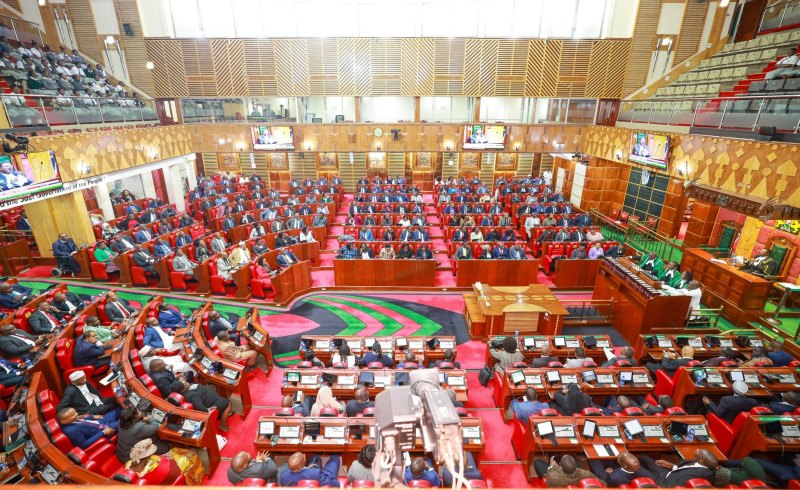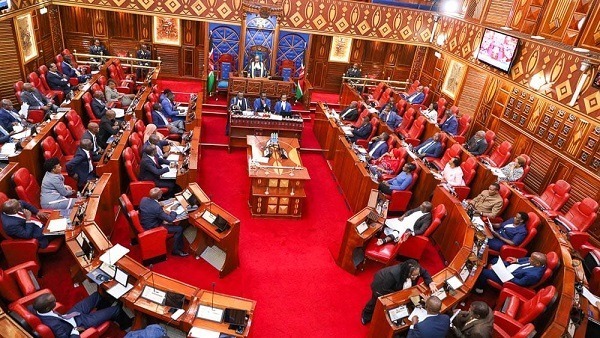
Parliament has renewed efforts to enact the long delayed and resisted two-thirds gender rule to comply with the constitutional requirement for gender equity in public appointive and elective bodies.
A state-sponsored Constitution of Kenya (Amendment) Bill, 2025, has been introduced in the Senate for the first reading.
During the campaign and again in March last year, the President said his administration is committed to achieving the two-thirds gender principle.
Sponsored by Senate Majority leader Aaron Cheruiyot, it seeks to introduce a “gender top-up” mechanism to bridge the gender gap in Parliament.
The Bill also proposes to ensure at least five per cent of all legislators are persons with disabilities (PWDs), in line with constitutional provisions promoting inclusivity.
Specifically, the proposed law aims to amend Constitution Articles 97 and 98, allowing for nomination of additional special-seat members whenever Parliament fails to meet the two-thirds gender threshold following a general election.
“The principal object of this Bill is to amend Article 97 of the Constitution to nominate additional special seat members of the National Assembly if, after declared results of a national election,” the Bill reads.
“… the membership of the National Assembly does not conform to the constitutional principle that not more than two-thirds of the members are of the same gender.”
Similarly, Article 98 would be amended to provide a formula for nominating extra members to the Senate to ensure gender parity.
The Constitution stipulates that no public body, elected or appointed, shall consist of more than two-thirds of members of the same gender.
Successive Parliaments have failed to pass the enabling legislation to implement this. Major enabling legislation has failed four times, with three failures in the National Assembly and one in the Senate. The primary reason is failure to attain a quorum and many male legislators chose to remain away.
More than 10 attempts in different formats have been floated.
In 2020, Chief Justice David Maraga made an unprecedented move by advising then President Uhuru Kenyatta to dissolve Parliament over its failure to enact the two-thirds gender rule, following a High Court order issued four years earlier.
CJ Maraga accused Parliament of defying court directives and displaying “a lackadaisical attitude” towards the constitutional obligation.
“It is incontestable that Parliament has not complied with the High Court order in Constitutional Petition No 371 of 2016. For over nine years now, it has failed to enact the legislation required to implement the two-thirds gender rule,” he said in his advisory.
Under the constitution, if Parliament fails to pass such legislation as directed by the courts, the Chief Justice is empowered to advise the President to dissolve the House.
“If Parliament fails to enact legislation in accordance with an order under clause (6)(b), the Chief Justice shall advise the President to dissolve Parliament and the President shall dissolve Parliament,” he said.
The new amendment Bill also seeks to institutionalise representation of persons with disabilities.
“The Bill seeks to amend the sonstitution to provide for additional seats in the National Assembly and Senate to implement the principle that at least five per cent of members in elective and appointive bodies should be persons with disabilities,” the Bill reads.
Currently, there are 81 women in the National Assembly and 21 in the Senate. The National Assembly has 266 men, or 76.8 per cent.
Senate has 45 men, both elected from the counties and nominated, hence an additional 23 women are required to meet the gender principle if the top-up were to happen today.
The two-thirds gender controversy has been bitter and long-drawn-out, dealing a blow to certified persons with disabilities, youth, marginalised groups and minorities.
Parliament has been unable to implement the two-thirds rule despite a number of attempts over the years ¾ more than 10 in different formats.
Instant analysis
The proposed legislation marks Parliament’s latest attempt to comply with constitutional requirements on gender parity and inclusivity, after more than five botched attempts. By amending Articles 97 and 98, the Bill aims to guarantee that no more than two-thirds of Parliament’s members are of the same gender and at least five per cent are persons with disabilities.