When President William Ruto announced that former Prime Minister Raila Odinga would be accorded a State Funeral, few Kenyans were surprised.
To many, it was a fitting gesture for a man who had defined Kenya’s political landscape for over five decades, a statesman whose influence stretched far beyond politics, and whose passing united the nation in grief.
But behind the solemn speeches, flag-draped casket, and national mourning lies an intricate, multi-layered process.
Organising a State Funeral in Kenya is not just a ceremonial event; it is a logistical, diplomatic, and security undertaking that involves months, sometimes years, of planning and coordination.
Who qualifies
Kenya typically accords State Funerals to sitting or former Presidents, Vice Presidents, Former Prime Ministers and other individuals deemed nationally significant by the Head of State.
A National Funeral, while similar in stature, may be extended to leaders who have played pivotal roles in public life, such as ministers, freedom fighters, or prominent international figures with deep ties to Kenya.
The decision is made at the highest level, usually by the President, in consultation with Cabinet and the family of the deceased.
The nature of the funeral determines the level of state involvement, funding, and ceremonial honors to be provided.
In the case of Raila Odinga, President Ruto’s decision symbolized not only respect for his service but also national acknowledgment of his contribution to democracy, governance, and unity.
The Committee
Once a State Funeral is declared, the National Funeral Steering Committee is immediately formed.
It is typically chaired by the Head of Public Service or a senior government official, with membership drawn from multiple ministries and security agencies.
For Odinga’s funeral, the committee was chaired by Deputy President Kithure Kindiki and co-chaired by Senator Oburu Oginga, bringing together national and local leadership for coordination.
The committee is divided into several subcommittees, each tasked with specific roles:
• Protocol and Communications: Handles coordination of ceremonies, speeches, and official communication with the public and the media.
• Security and Intelligence: Oversees venue security, airspace restrictions, and crowd management.
• Logistics and Transport: Plans the movement of the body, dignitaries, and attendees, including the use of military or police escorts.
• Finance and Procurement: Manages budgets, payments, and supplies, often using direct procurement to meet tight deadlines.
• Health and Welfare: Ensures the presence of ambulances, emergency medical teams, and hygiene facilities at major venues.
Daily planning meetings ensure that every element, from flag protocols to parking, runs seamlessly.
Security: Most sensitive
Security remains the backbone of any State Funeral.
The Ministry of Interior, working closely with the National Police Service, Kenya Defence Forces (KDF), and National Intelligence Service (NIS), develops a comprehensive operational plan to cover all venues and routes.
Measures include:
• Airspace control, especially during the arrival of foreign dignitaries or military flypasts.
• Venue sweeps and background checks for participants.
• Crowd zoning (VIP, media, general public).
• Escort convoys for the body and visiting heads of state.
Thousands of officers are mobilized to manage the crowds, especially during public viewings.
Surveillance drones and mobile command centers are often deployed to ensure security and real-time coordination.
Venues, Ceremonies, and Honors
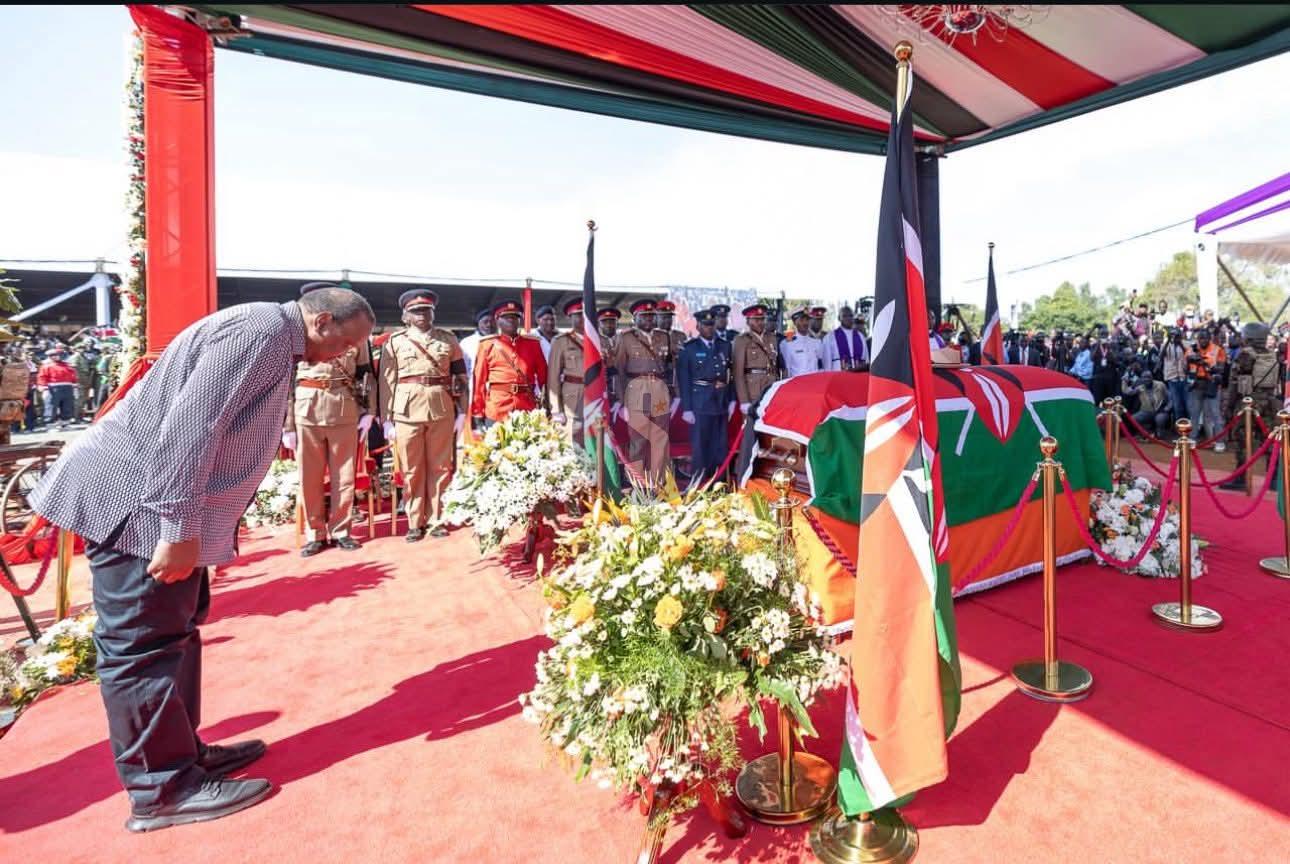
The body of the deceased often lies in state at Parliament Buildings, where the public is invited to pay their respects.
This stage can last several days, as seen during the funerals of President Mwai Kibaki and Daniel arap Moi.
The national funeral service typically takes place at a major venue, Nyayo Stadium, Uhuru Gardens, or Kasarani Stadium, depending on expected turnout and security considerations.
Military and ceremonial honors are conducted under the supervision of the Kenya Defence Forces.
These may include:
• A 21-gun salute for Presidents, or 17 for senior national leaders.
• A guard of honor and military pallbearers.
• Playing of the National Anthem and other solemn music.
• Use of a military hearse or gun carriage.
• Flypasts or flag formations by security forces.
After the main service, the body is transported, often via military aircraft, to the burial site, which is usually the family home, a national cemetery (rare), or a designated state monument.
Roads are closed or diverted to facilitate processions, and locals along the route often line up to pay their final respects.
Funding and Logistics
The national government funds State and National funerals, either through special allocations or emergency budgets.
Costs can run into hundreds of millions of shillings, covering security operations, transport, tents, sound systems, public amenities, and live media coverage.
Given the scale and urgency, procurement is often fast-tracked. Vendors may be contracted directly to meet the strict timelines associated with such events.
Public Communication and Mourning
Information flow during a State Funeral is tightly controlled.
The Steering Committee designates a government spokesperson to issue daily updates on logistics, ceremonies, and visiting dignitaries.
In some instances, the committee chair and co-chair can issue regular update via press conferences.
The President may declare national mourning days, during which flags are flown at half-mast nationwide.
In Odinga’s case, seven days of mourning were declared, allowing the country to collectively honor his legacy.
Religious rites are observed according to the deceased’s faith, blending solemn prayers with state protocol.
Why It Matters
Kenya’s State Funerals are more than symbolic. They serve as moments of unity, reflection, and respect for public service.
They also demonstrate the government’s capacity to mobilize resources and maintain order during emotionally charged national moments.
From Mwai Kibaki’s military farewell in 2022 to Raila Odinga’s sendoff, the tradition of State Funerals continues to evolve, combining precision, respect, and national pride.
Behind the grandeur are hundreds of unsung professionals, planners, police officers, medical teams, and soldiers, who work tirelessly to ensure that Kenya’s heroes are honored with the dignity they deserve.
Because in the end, a State Funeral is not just about mourning a leader, it is about celebrating a life that shaped a nation.