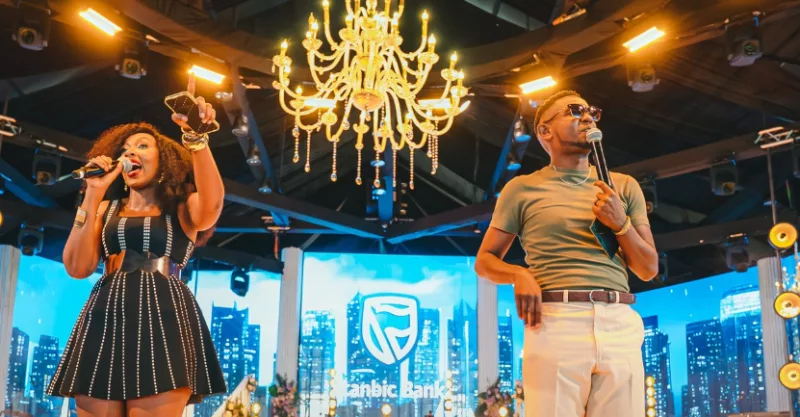
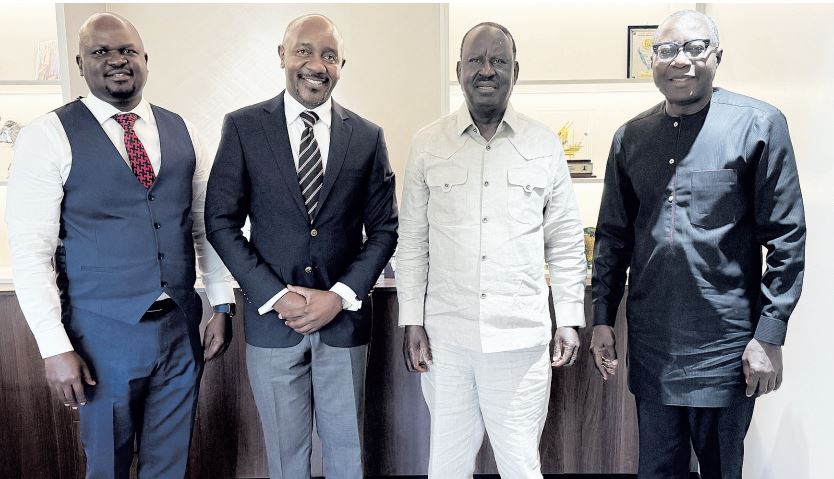
 Radio Africa Group Editorial Director Paul Ilado, CEO Martin Khafafa, former Prime Minister Raila Odinga and Radio Africa Group Director Patrick Quarcoo./FILE
A mighty tree has fallen. In death more than in life, Raila Amolo Odinga will mould the future of Kenya for generations to come.
His political enemies called him Machiavellian but never doubted his stature as a master strategist, a political colossus and a shaper of destinies.
I knew Raila by name in the late 80s and early 90s, but finally met and connected with him in early 2000, when I came back to Kenya to start the Radio Africa Group.
Kenyan radio was largely bland and surprisingly apolitical for a country where politics shapes every moment of our lives.
When I created Crossfire with my team, we connected on a deeper political basis with Raila, as he became one of our go-to telephone guests, always sharing a clear perspective on Kenyan politics and the future of our democracy.
I interviewed him many times and behind the scenes, he helped me understand deeply the very nature of politics.
During that period, our relationship blossomed through an incredible network—including Moody Awori, the late Otieno Kajwang, but most of all, through the late Ezra Bunyenyezi.
In an incredible twist of fate, when William Pike and I started our media journey to building East Africa’s first commercial radio network, the first person I pitched to about building the network and who joined us was Ezra.
Impassioned, ebullient, far-sighted and risk-taking, he only asked one question: ” Can I trust you”? It was a most curious question, but over the years, I have now understood why he asked.
For the circle of friends, Ezra introduced me to—most of whom lived in a political world shaped by mistrust and constantly shifting political sands—innate trust was very strangely the core of their deepest relationship.
When he introduced me to Raila, he simply said to him, “You can trust him.”
Turns out, when Raila went into exile, he was the man who paid for his ticket to Europe, without Raila ever knowing.
It took over a decade for Raila to realise who did it—through the representative of an international organisation then—but Ezra never said so.
You might quietly disagree with Raila—and we did twice—but he always respected where you stood.
He was a man with a deep understanding of human nature and circumstances, often willing to forgive and rebuild focused on a clear outcome.
He was always an expected surprise, because once an election was over, he had already game-played his next 50 moves, quietly impacting the country, Parliament, politics, government and appointments.
Raila always took the long view.
Many years ago, I met him at a wedding of a very young man—he was one of the earliest guests arriving ahead of everyone else.
Sitting next to him, I asked why of all things he was at the wedding of a junior and completely unknown journalist.
His answer was a study in humanity. He said this was a good young man with a bright future. He had been friends with the man for 25 years at the time.
The young man grew to be one of Kenya’s biggest editors and through thick and thin, always remembered when as an unknown, Raila was there for him.
Raila knew instinctively where to invest in relationships and manage them. He had an incredible knack for remembering occasions, historical facts, faces and the people along his journey with incredible clarity—which is why many connected with his humanity, warmth and humility—with a loyalty that goes beyond tribe and nationality.
In life, I marvelled at his ability to shape every government formation in Kenya through the Kibaki, Uhuru and Ruto presidencies.
He did what was tactically expedient but strategically configured to leave him quietly in control of his own destiny and that of the nation.
Many have asked me: Were you surprised about his alliance with President [William] Ruto?
I wasn’t, because they are like a shadow of each other.
Indefatigably hard-working, brilliant political chess masters, long-sighted, smartly pragmatic to the core and even when you completely disagreed with them, ultimately men of their word and honour in private.
Death has robbed Kenya of its greatest political stabiliser.
For the President, it leaves him without a reliable and stabilising ally. For many, the biggest regret is he leaves ODM and Nyanza without an appointed successor—but such is the nature of politics. Great men and women must rise and become leaders—as he did through adversity—not bequeathed to become shapers of our national destiny.
In our last meeting four months ago, I asked him the one question he always expected me to ask: Are you standing, or are you supporting this time?
He smiled and we had a long conversation explaining the options. After an hour, we stood up for our normal pictures.
He said he was unwell—he looked slightly unsteady—but resolute and clearer than ever.
“Time will tell, but for now, we have to stabilise Kenya. We are working well with your other friends,” he said.
Fare thee well Raila Amolo Odinga, man of many names and many parts. The history of Kenya cannot be written without your name on it. Your ink has dried. There is no more to write. You played your part to the very last.