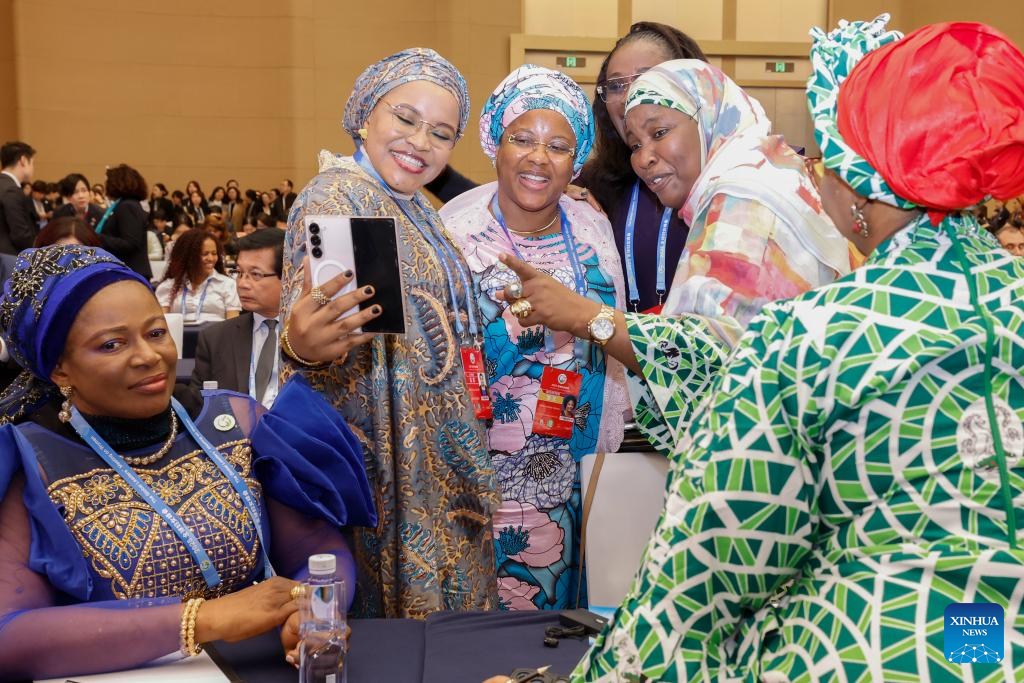
 Participants make a video call while attending the Global Leaders’ Meeting on Women in Beijing, China, on October 13 /XINHUA/ZHANG YUWEI)
In an age where economies are driven by innovation and nations compete on ideas as much as industries, one truth remains constant – no society can truly progress if half of its population is left behind. Women are not just participants in development; they are its foundation. From the farms of rural Kenya to the laboratories of Shanghai, from Nairobi’s start-ups to the villages of Southeast Asia, empowering women has become the key to unlocking inclusive growth.
Thirty years after the historic Fourth World Conference on Women in Beijing, the world gathered again in the same city this year – to measure how far we have come and to renew our collective commitment to equality. The conference’s original message – ‘Action for Equality, Development, and Peace’ – still resonates deeply. It reminds us that gender equality is not a Western ideal or an abstract slogan; it is a universal principle that determines the strength and sustainability of any nation’s development.
Over the last three decades, much has changed. Globally, more than 190 countries have enacted laws protecting women’s rights. Educational opportunities for girls have expanded dramatically, and women have entered leadership roles once closed to them. Yet, despite these achievements, inequality persists. Millions of women and girls still live in poverty, face gender-based violence, or are excluded from education and digital opportunities. For Africa, where women make up more than half of the agricultural labour force yet own less than 20 per cent of the land, the gap between promise and reality remains wide.
That is why the recent Global Leaders’ Meeting on Women in Beijing carries such weight. Beyond the ceremony and speeches, it represents a renewal of global will – a reminder that the struggle for women’s equality is far from over. The conference emphasised four priorities that resonate strongly with developing regions like ours: peace, development, governance and cooperation.
First, peace is the bedrock of women’s progress. Across the Horn of Africa and beyond, conflict and displacement continue to devastate lives. Women and girls are often the first to suffer and the last to recover. The message from Beijing was clear: sustainable peace and security are prerequisites for women’s empowerment. It is only in an environment of stability that education, entrepreneurship and participation can flourish.
Second, the meeting emphasised high-quality development that includes and benefits women. As technology reshapes economies, the world is entering what many call a new industrial revolution. The challenge – and opportunity – is to ensure women are not left behind. Empowering women through education, access to finance and digital inclusion is no longer optional; it is essential for global competitiveness. Countries that have recognised this — including China, which now has one of the world’s highest proportions of women in tech entrepreneurship – show that inclusion drives innovation.
Third, improving governance and legal protections remains central. Laws alone cannot change mindsets, but they set the framework for equality. Governments must ensure that policies promoting women’s participation in leadership, business and public service are not only written but implemented. In Kenya and across East Africa, the push for greater female representation in politics, education and corporate boards must be matched with structural support – mentorship, childcare access, and flexible work systems.
Finally, global cooperation is essential. No single nation can achieve gender equality in isolation. The Beijing meeting highlighted the role of international partnerships, particularly in empowering women in developing countries. China’s continued collaboration with the UN and developing nations – including training programmes, scholarships and small-scale livelihood projects – shows how cooperation can translate ideals into tangible outcomes. These initiatives may appear modest individually, but collectively they form a global network of opportunity.
China’s experience offers a quiet but powerful example of what consistent policy, social investment and long-term planning can achieve. In just a few decades, the country lifted hundreds of millions out of poverty – including more than 690 million women – and drastically improved health and education outcomes. Today, women make up more than 40 per cent of China’s workforce and more than half of its online entrepreneurs. These figures are not mere statistics; they represent a model of inclusion that aligns with Africa’s aspirations for transformation.
Through platforms such as the Belt and Road Initiative, the Unesco Prize for Girls’ and Women’s Education and South-South cooperation projects, China has been sharing experiences and resources with developing regions. For Africa, this collaboration offers valuable lessons in linking gender equality to national development – not through dependency, but through mutual learning and shared progress.
As African nations push toward industrialisation and digital transformation, we face a critical question: who will lead this new phase of growth? The answer must include women – as innovators, policymakers and entrepreneurs. Whether in Kenya’s tech hubs, Uganda’s agricultural cooperatives, or Tanzania’s renewable energy projects, women’s leadership is already shaping the region’s future. What remains is to expand that potential through deliberate policy and partnership.
The spirit of the Beijing Declaration – and the renewed call from this year’s global meeting – is a reminder that when women rise, nations rise. Gender equality is not a luxury for prosperous countries; it is the pathway to prosperity itself. It is how nations build stronger economies, healthier communities and more resilient societies.
An old Chinese proverb says, “Steadfast dedication yields an enduring fragrance.” The work of empowering women demands exactly that – persistence, patience, and a shared vision. From Beijing to Nairobi, from Shanghai to Kisumu, the message is the same: investing in women is investing in humanity’s collective future.
When women thrive, the world moves forward.