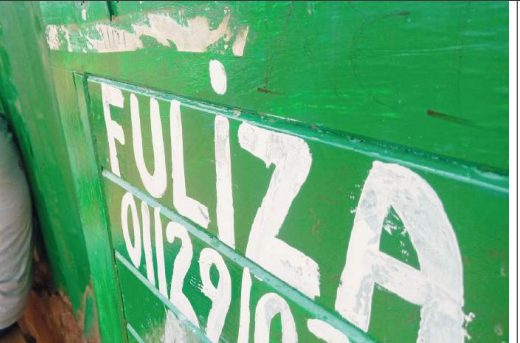
 A Fuliza point
along Waiyaki
Way, Nairobi
/FILE
A Fuliza point
along Waiyaki
Way, Nairobi
/FILE
Kenyans borrowed Sh110 million every minute via Fuliza, Safaricom's overdraft facility in 2024 as they fought a tough economy, characterised by the high cost of living amid depressed earnings.
Data from Safaricom's sustainability report unveiled early last week shows that the number of people relying on the loan facility during the period under review rose by 100,000 to 7.5 million, up from 7.4 million the previous year, with majority spending the money on basic household needs.
At the end of the financial year, at least Sh981.6 billion had been borrowed via the platform, translating to Sh2.7 billion per day compared to a daily borrowing of Sh2.3 billion in 2023.
According to the report, 4.07 million transactions were made in the review period up from 2.37 million, translating to an average of 186 transactions per minute.
The rise in short term borrowings— mainly used to meet essential needs such as food, bus fare and rent, signals increased debt dependence following a tough economic pressure dotted with massive job losses and high tax regime that has persisted after Covid-19 disruption.
The telco introduced Fuliza service in 2019 and it has become popular among Kenyans in meeting essential needs such as shopping, rent and supporting friends and family when there is no sufficient money in their M-Pesa wallets.
It charges customers a one-off 1.083 per cent interest and a daily administrative fee that depends on the outstanding balance. The Fuliza fee starts from Sh2 per day for Sh100 overdraft and goes up to Sh30 per day for Sh2,500 and above.
In a country where formal banking remains inaccessible to many, Fuliza provides financial inclusion at the touch of a button. However, beneath this convenience lies a troubling reality.
Claire Asigo, an American-based economic scholar, says borrowing for survival is a clear sign of a broken economic cycle.
"The debt reliance shows that households have depleted savings. Accumulation of debt is a kin to swimming to the deep without a life saver. The drowning is real. Sadly, most state policies are in place as short term."
She, for instance, chided the government’s plan to roll out Hustler Fund, questioning the rationale towards the policy.
"Why would a government sell debt to people drowning in debt already. How was the government planning to recoup the amount without clear social economic activities? Job cuts are real as firms either close shop or restructure," she said.
Fuliza is arguably the most expensive loan in Kenya, not only because of the daily charges attached to it, but also because of its ruthless repayment model: any money that enters a borrower’s M-Pesa account is deducted instantly, often before the borrower even gets a chance to use it.
Unlike traditional bank loans where interest is calculated annually or monthly, Fuliza charges daily fees that can quickly balloon into exorbitant costs. Depending on the amount borrowed, these charges range between Ksh 10 and Sh36 per day.
On paper, these numbers look small, but in practice, they translate into some of the highest effective interest rates in Kenya. Consider this: borrowing Sh500 on Fuliza and holding it for 10 days attracts daily fees of Sh10.
That means you pay Sh100 on top of the principal — a 20 percent cost in just ten days. If projected on an annual basis, the implied interest rate would be astronomical, surpassing the caps that regulators impose on commercial banks.
For borrowers who live paycheck to paycheck, these daily charges pile up silently, draining limited income and perpetuating dependence on the very service they think is saving them.
Digital lenders are also cashing on the borrowing for survival, with the latest report indicating that households borrow close to Sh13 billion every month.
According to Digital Financial Services Association (DFSA), 5.5 million Kenyans have at least three loans for 40 registered entities, with majority borrowing for consumption.
The sector has recorded 3.32 million accounts up from 0.6 million in the past two years even as CBK moves in to intensify regulatory framework to protect consumers who continue to complain of high rates and harsh debt recovery methods.
The proposals, still in draft form, underscore Kenya’s push to formalize a sector that has operated with limited regulation.
About eight million Kenyans accessed Sh180 billion in loans from digital credit providers (DCPs) in 2024, thanks to improved smartphone and internet penetration.
Digital lender's lobby chairman Kevin Mutiso, while confirming that households are relying on short-term loans survive, noted that most loans taken from his members are pumped into social economic activities.
"Loan talent are not entirely spent on food and other basics. Some are going towards growing businesses. That is actually the trend we should observe in the coming days," he said.
However, due to lax regulations and the lack of recovery guarantees, the sector has faced a maelstrom of digital harassment and predatory interests.
As the tough economy bites, Kenyans have limited options to put food on the table. Yet, the situation is only worsening.
The latest survey by Tifa shows that 64 per cent of Kenyans interviewed between August and September overwhelmingly feel that their personal and family economic conditions have deteriorated since the last general election compared to 54 per cent who were interviewed in May.
High tax regime is perceived as having negatively affected the cost of living and eroding personal finances for most Kenyans, with 82 per cent saying it led to Increased cost of basic goods and services such as food, transport and utilities.
Close to 31 per cent say it has increased taxes on their salaries or income. 21 per cent say the most recent finance bill has reduced their disposable income or savings.
The report further highlights that every one in four Kenyans is jobless with 17 per cent either unemployed or job hunting. 25 per cent are working full time, 23 percent self-employed and with 15 percent working part time.
A section of Members of Parliament have raised concerns over deteriorating economic situation, even as the government data shows that all is well.
The Parliamentary Budget Office director Martin Masinde says that despite official figures showing economic growth, citizens are grappling with a severe decline in purchasing power, forcing many to live ‘hand to mouth’.
“There was a consecutive negative growth in real wages per employee, coupled with rising inflation, between 2020 and 2023, signifying a reduction in purchasing power for individuals," the Parliamentary Budget Office said in a report presented to Parliament.