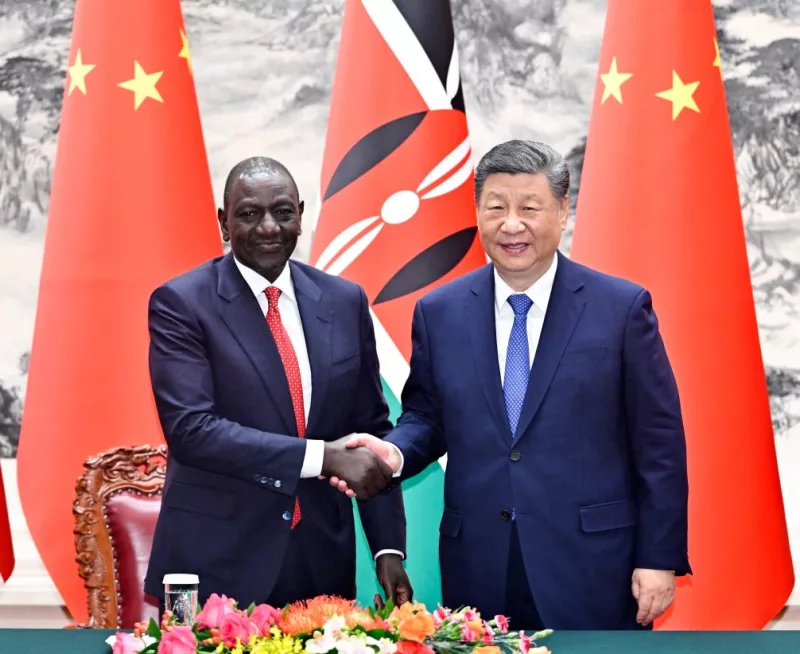
Kenya’s recent conversion of a $5 billion Standard Gauge Railway loan from the US dollar to the Chinese yuan marks a watershed moment in the continent’s financial evolution.
National Treasury Cabinet Secretary John Mbadi confirmed the conversion would save the country about Sh32.35 billion annually, a decisive fiscal reprieve at a time when many African economies face tightening global credit and volatile exchange rates.
But beyond the immediate savings, Kenya’s move signals a deeper strategic realignment: a gradual diversification of Africa’s external debt portfolio and a quiet but unmistakable shift in the global financial axis.
For decades, the US dollar has been the dominant currency of trade, finance, and debt across the developing world. While this dollarised architecture offered stability, it also created vulnerability—tying the fate of African economies to interest rate cycles and policy shifts far beyond their borders. The recent surge in US interest rates has exposed this fragility, making external debt servicing one of the most pressing fiscal challenges for African treasuries.
Strategic pivot
Kenya’s decision to denominate its loan in yuan represents not merely a currency swap but a strategic hedge – a step towards insulating the economy from the volatility of dollar-based obligations. It also deepens Kenya’s financial ties with China, a principal trading partner and lender, whose currency is now increasingly being used in bilateral and regional settlements.
By converting part of its external exposure into yuan, Kenya becomes one of the first African countries to make operational what many finance ministers across the continent have long advocated – diversification of currency risk and broadening of monetary partnerships to enhance fiscal resilience.
The shift comes at a time when the African Union is consolidating its Common African Position on Debt, endorsed by African Ministers of Finance in Lomé and reaffirmed at the eighth Specialised Technical Committee on Finance, Monetary Affairs, Economic Planning and Integration held in Johannesburg last week. The AU’s framework calls for a sustainable, transparent and coordinated debt management strategy anchored in Africa’s fiscal sovereignty.
Common debt vision
At the heart of this common position is a bold proposition: that Africa must redefine its engagement with the global financial architecture, moving from dependence to design. The Lomé Declaration urges countries to collectively negotiate debt-restructuring terms, explore local currency financing mechanisms and engage with emerging global blocs to secure fairer borrowing terms.
The AU Commission, through commissioner Francisca Belobe, has urged that this declaration be formally included in the G20 Summit agenda – a timely move as South Africa assumes the G20 presidency. This would ensure that Africa’s voice is not peripheral, but central, in shaping discussions on debt sustainability, credit transparency and the reform of global financial institutions.
Kenya’s currency conversion thus resonates with the broader continental narrative a move from reactive debt management to proactive financial sovereignty.
Global context
Globally, China’s yuan is gaining influence as developing nations seek alternatives to the dollar-dominated system. By promoting yuan-denominated trade and finance, Beijing offers countries like Kenya a path to manage currency mismatches and reduce the financial strain caused by dollar fluctuations. Yet, this diversification must be managed prudently to avoid new forms of dependency.
South Africa’s forthcoming G20 presidency themed ‘Solidarity, Equality, and Sustainability’ – offers an unprecedented platform to articulate this new African economic philosophy. Africa must use this moment to press for reform of the international financial system, especially in areas of debt restructuring, credit rating transparency and concessional finance.
To fiscal resilience
Kenya’s yuan conversion, while pragmatic, also raises broader questions about how African economies can achieve long-term fiscal resilience. The answer lies in coordination, innovation and the courage to challenge old orthodoxies. Africa’s debt strategy cannot be left to individual nations negotiating in isolation. The AU’s common position provides the blueprint for collective action, ensuring that Africa speaks with one voice when it matters most.
As global economic power tilts eastward and multilateral reforms gain momentum, Africa has a rare opportunity to reposition itself not as a borrower of last resort, but as a credible and coordinated economic bloc capable of shaping its own financial destiny.
Kenya’s decision, therefore, should not be viewed in isolation. It is part of a larger continental awakening, a recognition that the path to sustainable prosperity lies in strategic diversification, policy innovation and continental solidarity.
Africa’s time to lead on financial reform has arrived. The question now is whether we will seize it with unity and vision or allow it to pass us by, once again.