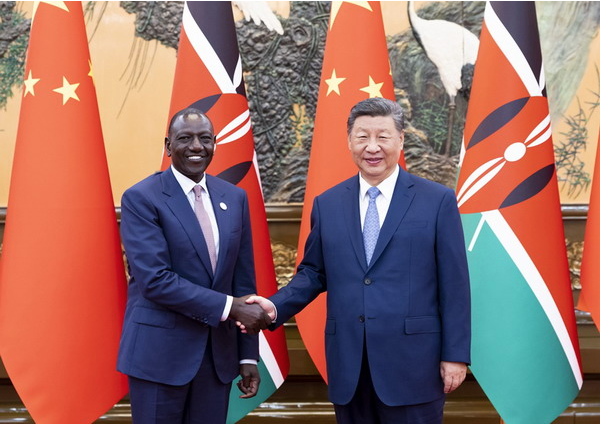
 President William Ruto and Chinese President Xi Jinping /FILE
The global order is undergoing profound shifts. From heightened geopolitical tensions between major powers, to the resurgence of economic protectionism, to the looming expiry of preferential trade arrangements like the African Growth and Opportunity Act, Africa faces a moment of truth.
The continent must decide whether to remain a bystander in a turbulent world or to assert its agency in defending and shaping multilateralism.
The stakes could not be higher: Africa’s development aspirations, economic resilience and strategic relevance depend on a rules-based global order that upholds fairness, inclusivity and cooperation.
Multilateralism – the system where nations work collectively within established institutions and frameworks – has never been perfect. Yet, for developing regions like Africa, it provides a platform to balance inequalities in global power and amplify otherwise marginalised voices. In the absence of strong multilateral structures, global decision-making often defaults to the interests of dominant powers, leaving weaker economies exposed to the whims of unilateralism.
China, in recent years, has positioned itself as a consistent advocate for multilateralism, particularly in the Global South. Beijing has emphasised respect for the United Nations, the World Trade Organization and other multilateral platforms as the foundation for fair global governance. Initiatives such as the Belt and Road have been framed not only as infrastructure investments but as vehicles to strengthen connectivity, trade and cooperation across regions. By supporting Africa’s push for industrialisation and integration, China has given tangible form to the principle that development should be shared, not hoarded by a few. This approach stands in contrast to protectionist currents elsewhere, offering African nations an alternative model of partnership based on mutual benefit.
China’s defense of multilateralism has also been evident in global climate and health governance. During the Covid-19 pandemic, China engaged in vaccine distribution and medical support through international channels, reinforcing the idea that global crises require collective solutions. On climate change, Beijing has backed mechanisms like the Paris Agreement, encouraging collaboration rather than unilateral action. For Africa, such engagement is significant: it signals that at least one major power is willing to reinforce global frameworks that give smaller nations a voice. This alignment provides African countries with valuable diplomatic space to push for reforms, mobilise resources and resist being sidelined in a fragmented world.
The renewed surge of protectionism threatens Africa’s hard-won gains in integration into the global economy. Richer countries are increasingly shielding domestic industries under the pretext of safeguarding jobs, national security, or even environmental sustainability. While these justifications may sound appealing domestically, they often mask a retreat from global solidarity. For African exporters, this resurgence creates new barriers. Whether in textiles, agriculture, or nascent manufacturing, producers risk losing access to lucrative markets at precisely the time when the continent is seeking to industrialise under frameworks like the African Continental Free Trade Area (AfCFTA). In such a climate, multilateral rules – anchored in the WTO and reinforced by regional blocs – are the best safeguard against arbitrary market closures or punitive tariffs. Without these rules, Africa faces a future of economic vulnerability and dependency.
The possible expiry – or at least uncertain renewal – of Agoa underscores the fragility of unilateral trade concessions. Since its inception in 2000, Agoa has provided preferential access for African goods into the US market, helping spur growth in textiles, apparel and agriculture in countries like Kenya, Ethiopia and Lesotho. Yet the very design of Agoa reveals Africa’s structural disadvantage: it is a programme decided in Washington, not negotiated on equal footing.
Its continuation depends not on Africa’s performance alone, but on shifting political winds in the United States. This is a sobering reminder that Africa cannot build its economic future on unilateral arrangements, however generous they may appear. Instead, the continent must rally behind reciprocal, negotiated and rules-based systems that reduce dependence on the goodwill of external partners. A stronger multilateral order ensures that trade preferences are embedded in long-term agreements, not subject to sudden expiry or politicised debate.
Critics sometimes portray multilateralism as a surrender of sovereignty. In Africa’s case, the opposite is true. When powerful states act unilaterally, weaker nations often find themselves without recourse, forced to comply or risk isolation. Multilateral institutions, however flawed, create a framework where disputes can be arbitrated, coalitions can be built and smaller countries can negotiate as equals. Consider climate change negotiations. Africa contributes the least to global emissions yet suffers disproportionately from their consequences. Without a multilateral platform such as the United Nations Framework Convention on Climate Change, African countries would have little leverage to demand climate finance, technology transfer, or accountability from major polluters. It is multilateralism that has enabled Africa to push for concepts like climate justice and loss-and-damage funding.
For Africa to stand up for multilateralism, unity is essential. Fragmented positions dilute influence. The AfCFTA is not just an economic integration project; it is also a political statement of Africa’s readiness to negotiate as a bloc. Acting collectively, African nations can push for reforms in institutions like the World Bank, IMF and WTO, ensuring these reflect the realities of a multipolar world rather than the dominance of a few. Africa must also invest in diplomatic capacity. Global negotiations are complex, technical and often dominated by well-resourced delegations from advanced economies. Building African expertise in trade law, finance and technology governance is critical to making the continent not just a participant but a shaper of global rules.
The world is at risk of fragmenting into rival blocs, where the rules of engagement are dictated by competition rather than cooperation. For Africa, which has long struggled with the legacy of marginalisation, this scenario would be disastrous. Development requires stability, predictability and open exchange – not the uncertainty of a world order where might is right. By championing multilateralism, African nations can anchor their development in fairness and inclusivity. They can also position themselves as constructive global players at a time when others are retreating into narrow nationalism. This is not about idealism; it is about pragmatism. In a volatile world, multilateralism is Africa’s shield, its voice, and its opportunity.