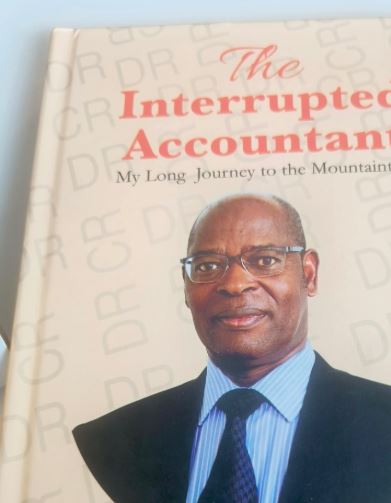
In his new autobiography, ‘The Interrupted Accountant,’ Philip Kinisu, the former PwC Regional senior partner and former chairman of the Ethics and Anti-Corruption Commission, dedicates a chapter to family and social relationships.
“I decided long time ago to operate on the principle of inner family and extended family,” he writes.
This was for the practical purpose of managing his guilt when he could not afford to meet the numerous demands from relatives for assistance.
Given his long and successful accounting career, Kinisu is without doubt a man of means who plays his part in lifting up the less fortunate around him.
But that is not how it always was; wealth and opportunities accrue over time.
Like with many Kenyans in employment, Kinisu faced pressure from relatives needing a helping hand even when he could hardly assure his own sustenance.
Being his family’s first-born, he was obligated to pay his siblings’ school fees, to meet their medical bills and link them to job opportunities.
Some lucky ones made it through school and even got jobs, only, in his words, “to properly screw up!”
In those instances, “The relief you hoped for sharing the family burdens goes out the window,” he writes.
The emotionally grounded family chapter offers a compelling glimpse into the intricate dynamics of sibling relationships, moving beyond the surface of family ties to explore how individuals raised under the same roof can evolve into vastly different people due to personality, upbringing and parental influence.
“That jobs and opportunities for advancement are scarce means that those of us who have a semblance of capacity to assist will remain in the minority,” he writes, adding, “For the lucky few among my acquaintances, there is (was) family money to support deserving relatives. The majority, however, were and remain, like me, with numerous poorer relatives who could use a helping hand.”
Themes of identity, individuality, familial love, upbringing and social inequality are vividly present in the text as Kinisu explores the reality that sharing blood or a household does not guarantee similar paths in life.
In every family, there are siblings who thrive and those who struggle – sometimes because of their own nature, but often due to the environments shaped by their reaction to the fortunes of other family members.
The tone throughout this introspective and honest memoir is one of empathy.
There is no attempt to romanticise family relationships; instead, the author uses a grounded and emotionally mature voice to address painful realities like inequality within families, favouritism and the consequences of neglect.
Despite the challenges and differences, the tone also becomes conciliatory and forgiving, as the author chooses unity over resentment by supporting all his siblings equally.
“I have not been blessed with a crowd of high performing siblings or their families. If destiny is pre-determined, there is no telling how many doctors, accountants, politicians, entrepreneurs or other successful persons will emerge from my father’s base. If I did it, many others can and will.”
Reflecting on his own successes, including topping his classes at nearly every level of study from Malaha Primary School in 1968 to the University of Nairobi’s Faculty of Commerce in 1979, he quips, “I fulfilled my responsibilities by being hard-working in each situation.
But I can ask the question: Why was I able to work hard and some others weren’t? If you call it choice, then why did I make that choice? If you call it innate ability, then why did some other students not have it?”
Connected to other chapters where the author grapples with his identity as a being, the book reveals Kinisu’s deep intellect and connection with his ancestors, which provides a marker for his social relationships.
“Kinisu has, in a simplified and succinct manner, tried to answer the age old question of his and our origin as a human species,” Edward Ouko, the former Auditor General of Kenya and a friend of Kinisu’s since their days at the University of Nairobi in the mid-1970s, writes in the foreword to the book.
“He makes reference to authoritative sources as well as traditions. But it is how he brings up the impact of recent scientific discoveries and expanding knowledge about our world that will leave the reader questioning what we know or take for granted.”
Published by Free Press Publishers, the book will be launched today at the Serena Hotel




Comments 0
Sign in to join the conversation
Sign In Create AccountNo comments yet. Be the first to share your thoughts!