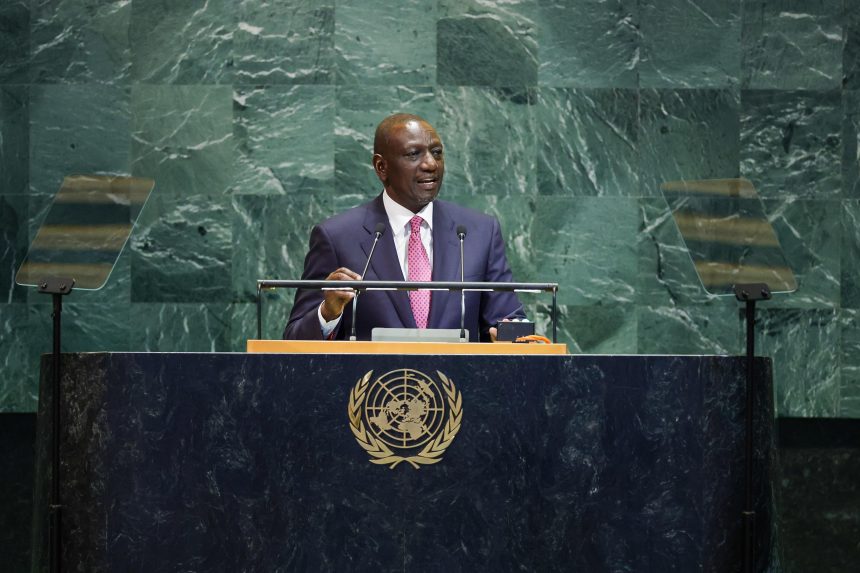
When President William Ruto took to the podium at the 80th Session of the United Nations General Assembly (UNGA) this year, he did so with a message that was both urgent and unapologetic: the multilateral order must be reformed to serve all nations, not just the privileged few.
At this historic juncture, when the world is confronting overlapping crises of debt, climate change, conflict, and technological disruption, Kenya stood tall, reminding the intinternational community that global governance cannot afford to remain frozen in the geopolitics and geoeconomics of the post-Second World War.
Founded when most African nations were still yoked by colonialism, the UN and other post-war institutions must evolve inclusive architectures or lose relevance and legitimacy
For Kenya, Africa, and indeed for the developing world, the call for reform is not an academic exercise.
It is a matter of survival, dignity, and fairness. The global financial system, for instance, continues to punish African economies with egregious lending conditions based on spurious risk ratings while offering concessional credit to wealthier countries in the North.
The result is a vicious cycle of debt and austerity, locking out millions from opportunities for growth.
At UNGA, Kenya pressed for reforms that would allow developing nations fairer access to development finance, debt relief mechanisms that do not strangle economies and global financial institutions that recognize the promise and potential of Africa rather than overplay its risk profile.
For Kenya, this would mean reduced cost of capital, more predictable financing for infrastructure, and ultimately, a stronger foundation for jobs and livelihoods for citizens.
For Africa, it would mean liberation from a system that too often keeps its people at the margins of global trade, investment pathways and prosperity.
Reform of the United Nations Security Council was another central strand of Kenya’s message.
Through the Committee of Ten (C-10), President Ruto amplified Africa’s long-standing demand for permanent representation at the UN Security Council.
Today, a continent of 1.4 billion people remains on the menu of Security Council debates but absent from the table where those debates are decided.
Kenya argued that this exclusion not only undermines the legitimacy of the UN but also weakens the effectiveness of global peace and security efforts.
From Sudan to the Democratic Republic of Congo and Somalia, Africa’s conflicts dominate the Councils agenda, yet Africa is denied a permanent voice in shaping solutions.
For Kenya, a country that has consistently contributeded troops, diplomacyacy and ideas to global peace efforts, the question is simple: how can peace be forged without the participation of those most affected?
For the region, meaningful reform would bring decisions closer to the lived realities of those affected by conflicts and open the door to more durable solutions.
Climate change was a matter of significant attention to Kenya’s delegation at #UNGAAt80.
As Chair of the African Union’s Committee of Heads of State and Government on Climate Change (CAHOSCC), President Ruto emphasized that Africa, the least polluting continent yet the most affected by climate shocks, cannot continue to be an afterthought in global climate financing.
With over 90 percent of our electricity grid powered by renewables, Kenya is already showing what a green future looks like.
Yet scaling this requires financing that is accessible, predictable, and fair, as Kenya argued during an event on scaling up climate adaptation financing hosted by the Global Centre on Adaptation and the African Development Bank.
Speaking a day after President Trump’s address to the Assembly, where he expressed skepticism on the criticality of climate action, President Ruto’s message that carbon emissions’ impacts on atmospheric conditions were undeniable affirms that climate change is a matter on which Kenya agrees to disagree with her close, strategic partner.
Underlying all these calls is Kenya’s conviction that multilateralism itself must be reimagined.
The challenges of our age, pandemics, artificial intelligence, cross-border crime, cyber threats, cannot be solved by unilateralism or narrow national interest.
They require inclusive, representative, and responsive institutions. Nairobi is already positioning itself as Africa’s hub for digital governance and AI leadership, making the case that Africa cannot be left behind in the fourth industrial revolution.
At the High Level Multistakeholder Launch of the Global Dialogue ?n Artificial Intelligence Governance during UNGA, Kenya pressed for frameworks that guarantee interoperability of data, equitable governance of didigital infrastructure, and innovative financing for AI capacity-building across the developing world. Our position is clear: Africa’s youth cannot simply be consumers of technology, they must also be creators and regulators, shaping the ethics and future of AI itself.
But reforms at the global stage must also translate into hope at home.
That is why Kenya wove economic diplomacy tightly into its UNGA agenda.
By attracting partnerships and commendation for its affordable housing programme, Kenya demonstrated how multilateral engagement can drive real social transformation.
At the Kenya Investment Forum in New York, convened by KenInvest, a high-level panel headlined by President Ruto discussed Investment Opportunities in Kenya, bringing together key global players driving capital flows and investment growth.
Discussions here centered on the investment projects pipeline and regulatory choke points that constrain the business climate. Similarly, through the Global Africa Business Initiative (GABI), Kenya positioned Africa as the next frontier for investment, spotlighting opportunities from agriculture to energy, technology to infrastructure.
For Kenyans, this could translate into new jobs, new industries and an economy that speaks to the aspirations of our youth. For Africa, it signals a continent ready to claim its rightful place as a driver of global growth.
Kenya’s message at UNGA was therefore both a call for urgent action and a promise. The caution is that a multilateral system that excludes, ignores, or marginalizes will not survive the crises of our century.
Reformed, inclusive and equitable global governance institutions, on the other hand, promise to deliver peace, prosperity, and dignity for all.
This is why Kenya will continue to speak loudly and act boldly, because reform is not just about the world out there, it is about every Kenyan farmer, studentent and entrepreneur who deserves a system that works for them.
It is about every African who dreams of a continent respected, represented, and resilient.
And it is about a region that knows peace is fragile but also knows that with fairness, justice, and reform, it can not only endure but perhaps, thrive.
Korir Sing’oei, is the Principal Secretary, State Department for Foreign Affairs