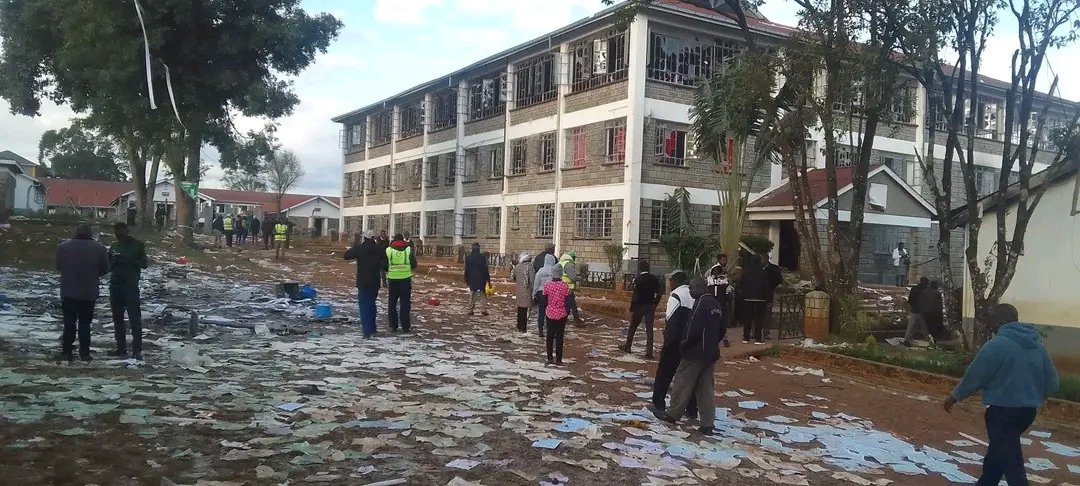
 The aftermath of the recent student unrest at Litein Boys in Kericho county. /HANDOUT
A wave of school fires has hit the country in recent days, sparking fears that the trend could jeopardise preparations for national exams which are barely a month away.
Whereas no fatalities or casualties have been reported, the trail of destruction points to a certain degree of anger that could have been simmering for long and only needed a small trigger to explode into the full-blown volcano of mayhem we are witnessing.
In Kericho, Bomet and neighbouring counties, more than 10 secondary schools have in recent days been rocked by violent student unrest, with millions of shillings’ worth of property destroyed.
Among the institutions indefinitely closed are Litein Boys, Chebonei Girls, Kamungei, Koiwa Boys and Tengecha Boys.
At Litein High School, students set ablaze the administration block, dormitories, classrooms and staff houses in a rampage that stunned the community.
In a statement on September 24, the school board of management through the chief principal called for patience following social media speculation on the course of action taken after the unrest.
"I wish to inform all stakeholders that we shall keep the public updated on any official developments. Until then, we kindly request stakeholders to disregard misleading information and rely only on information released through our school official communication channels,” the principal said.
Tengecha Boys High School also witnessed chaos when a dormitory housing more than 100 learners went up in flames.
Though locals helped contain the blaze, teaching and learning were suspended indefinitely.
In Cheptenye Boys, a similar dormitory fire broke out as students attended evening classes, damaging two blocks.
City schools have not been spared either.
At Nairobi's St George’s Girls Secondary School, more than 1,800 students were sent home indefinitely on September 8 following a night of chaos and confrontation between students and teachers.
The unrest began late Sunday, September 7 after reports of an altercation between a teacher and a Form Three girl.
Students had reportedly been outside observing the “blood moon” during the full solar eclipse when the altercation occurred.
In an official communication the following day, the school confirmed the incident and assured parents that steps were being taken to address the matter.
“We kindly request all parents and guardians to remain calm and supportive as the investigation continues. Regular updates will be shared through the official school communication channels,” the school said.
The South Rift has been the most affected by student unrest so far, where authorities in at least five schools have been forced to close the institutions or send learners home as investigations continue.
The cost of rebuilding dormitories, classrooms and administration blocks is expected to run into hundreds of millions of shillings, with parents likely to bear part of the burden.
Education officials have promised thorough investigations into the causes of the fires, while boards of management are consulting with local leaders on how to restore calm.
Candidate classes, however, remain in limbo, uncertain whether they will sit their national exams in their own schools or be transferred elsewhere.
This wave of unrest echoes earlier episodes of student protest and school arson witnessed in the past decade.
Studies on student unrest in Kenya have shown that the pattern is cyclical, often intensifying in the months before major examinations.
Government's response has often been the appointment of committees of inquiry or formation of task forces whenever student unrests and violence occur on unprecedented scale.
One such extreme occasion followed a May 2001 dormitory fire at Kyanguli Secondary School in Machakos, which killed 67 students.
A 2014 research study titled Students, Arson and Protest Politics in Kenya: School Fires as Political Action concluded that student protest violence was rarely spontaneous but instead a form of political action born of frustration.
It recorded that in peak years, hundreds of schools across the country went on rampage.
The findings came alive when in 2016 and 2017, 130 and 126 schools respectively went on rampage, leaving behind a trail of destruction.
According to the report, protests often involved attacking teachers, confronting police, destroying property and, in extreme cases, loss of life.
It also observed that state responses—such as indefinite closures, arrests and requiring parents to foot repair bills—did little to address underlying grievances.
"Criminal charges were unsuccessful because of corruption and the ages of the students while parents and guardians were forced to pay for damages," the report noted.
The National Crime Research Centre (NCRC) in its 2017 report Unrest in Secondary Schools in Kenya similarly pointed to systemic issues within school environments.
It found that grievances over poor food, harsh discipline, limited student participation in decision-making, lack of counselling, and poor communication channels were key drivers of violence.
The NCRC noted that unrest peaked in second term, a time coinciding with internal examinations, leading to the perception that “fear of mocks” was a major catalyst.
Another scholarly work, An Investigation into Arson in Secondary Schools in Kenya (2015), highlighted how boarding schools, run as “total institutions”, created oppressive environments that often denied students outlets for grievances.
The study argued that where dialogue and representation were absent, arson and violent protests became symbolic acts through which students expressed their frustration.
In the recent cases, there have been suspicions that external forces were involved.
Local communities, outsiders and even political actors have been accused of infiltrating school protests to loot or incite destruction, complicating the narrative around causes of unrest.
This was after it emerged that some stolen items that went missing from teachers' quarters have since been recovered in Kericho town and surrounding markets.
With the Kenya Certificate of Secondary Education (KCSE) examinations scheduled to begin on October 21 and run until November 12, the stakes are high.
Parents, teachers and government officials are under pressure to ensure the school calendar is not disrupted and candidates are not disadvantaged, even as reconstruction and investigations continue.
But beyond rebuilding walls and replacing mattresses, the real challenge may be whether the root causes of unrest are finally addressed.
Kenya has been here before. Fires and riots have scarred schools in cycle after cycle, with reforms promised but rarely implemented.
As the country braces for another examination season, the question lingers: are these new fires the result of sheer exam pressure overwhelming candidates, or do they represent the deeper discontent that research has long flagged as the true catalysts of student unrest?