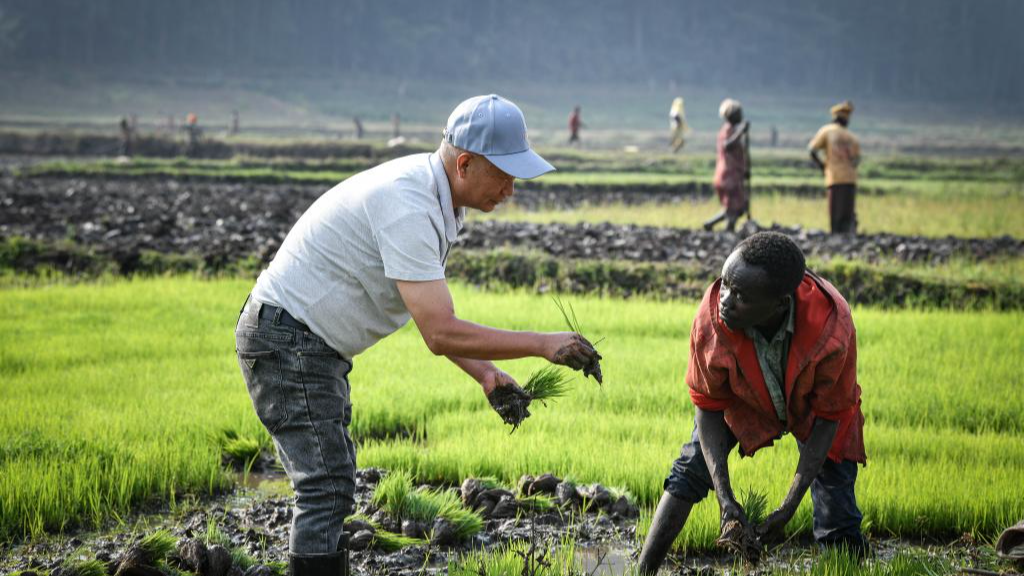
 A rice expert guides a local rice farmer on how to transplant seedlings in the rice fields in Huye District, Rwanda, August 14, 2024. /Xinhua
This achievement was not the end, but rather the beginning of a new chapter. Recognising that poverty eradication must be followed by sustainable policies, China introduced a five-year transitional period to consolidate progress, safeguard against relapse and advance rural revitalisation.
As 2025 concludes this transitional phase, China’s accomplishments in poverty reduction and rural renewal deserve careful reflection — not only as a domestic triumph, but also as a valuable lesson for the world.
At the heart of China’s success is a robust system of monitoring and intervention. Unlike past approaches in many developing nations that relied on broad, generalised aid, China established a mechanism to continuously track the well-being of low-income populations. This allowed policymakers to identify emerging risks and respond with targeted support, ensuring vulnerable households did not slip back into poverty. By marrying state leadership with grassroots engagement, China has proven poverty alleviation cannot be treated as a one-time project but must function as a living, adaptive system.
Equally striking has been China’s relentless investment in rural infrastructure. Paved roads, highways, modern energy grids, expanded 5G coverage, clean water systems, and postal services have turned once-isolated villages into connected communities.
This is not mere charity — it is empowerment. Infrastructure not only improves quality of life but also creates pathways for commerce, education and healthcare. In this sense, China’s poverty alleviation drive is also a modernisation strategy, one that narrows the urban-rural gap and integrates neglected regions into the national development story.
Employment has been another critical pillar. Poverty is most effectively eradicated not by handouts but by providing dignified, sustainable work. China’s efforts to stabilise employment and increase incomes have included vocational training, fostering local industries and encouraging entrepreneurship.
From specialty agriculture to rural tourism, communities have been encouraged to leverage their unique strengths. This approach acknowledges that poverty alleviation is not a one-size-fits-all endeavour but must draw upon local culture, geography and resources.
Behind these practical measures lies an innovative governance model. China shifted from reliance on general growth theories to what it calls “targeted dripping irrigation”, whereby resources are deliberately directed to where they are needed most.
This reflects an important truth: with thoughtful state guidance, development can reach every corner of society. Moreover, the integration of poverty alleviation, relapse prevention and rural revitalisation into a unified framework ensures gains are protected for the long term. This “three-in-one” model has become a central feature of China’s development philosophy.
Environmental sustainability has also been woven into the strategy through the “Green Rural Revival Programme.” By emphasising ecological restoration alongside economic development, China has shown that poverty eradication and environmental protection need not be in conflict. On the contrary, improving living conditions while safeguarding natural resources creates a healthier, more resilient countryside, and helps bridge the gap between urban and rural development.
The guiding principles behind this remarkable achievement are as significant as the policies themselves. Strong leadership by the Communist Party of China, a people-centred ethos and the spirit of self-reliance have driven these reforms. Equally important has been China’s step-by-step approach, which avoided shortcuts and instead built lasting systems over time. This combination of top-level design and grassroots participation explains why China has managed to achieve in a few decades what took some countries centuries.
Importantly, China has not confined its vision of poverty alleviation to its own borders. Through South-South cooperation, the Belt and Road Initiative and development funds, it has extended support to other developing nations. By sharing its experience — especially the concept of “targeted poverty alleviation,” now recognised in UN documents — China positions itself not merely as a beneficiary of globalisation, but as a contributor to global human progress. Its assistance goes beyond financial aid to include technology transfer, capacity building and the creation of platforms that help partner countries stand on their own feet.
As the final year of the transitional period unfolds, China can confidently claim it has not only lifted millions out of poverty but also redefined what modern poverty alleviation looks like. Its strategy blends pragmatism with vision, economic growth with social equity and national development with international responsibility. For nations still struggling with entrenched poverty, China’s journey offers a powerful lesson: with strong leadership, clear priorities and a genuine commitment to the well-being of the people, poverty is not an inescapable destiny but a challenge that can be overcome.
China’s poverty alleviation is more than a domestic achievement — it is a contribution to global governance, a model of inclusive development and a reminder that the fight against poverty is a shared human mission. In an era of widening inequalities worldwide, China’s story is not just one of national pride but a beacon of hope for millions across the globe.
Onyango K’Onyango is a Journalist and Communications consultant