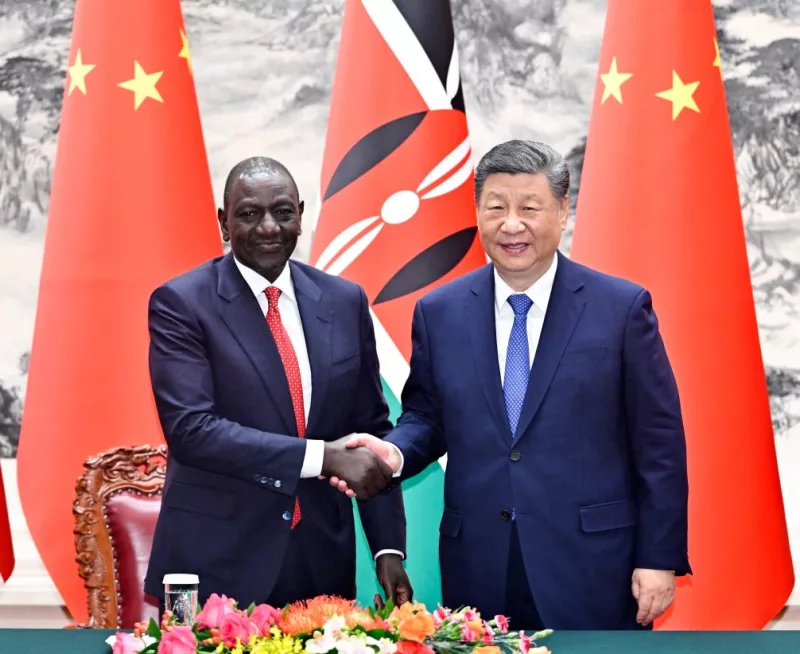
President William Ruto and his Chinese counterpart Xi Jinping./FILEThe 21st Century global economy is
increasingly driven by technical skills and technological proficiency. For
developing nations like Kenya, with a burgeoning youth population and ambitious
development goals under the Vision 2030 blueprint, bridging the gap between
education and employability is not just an aspiration but an economic
imperative.
In this critical endeavour, a strategic partnership
with the People’s Republic of China, particularly in the realm of Technical and
Vocational Education and Training (Tvet), has emerged as a transformative
force.
The collaboration, spearheaded by entities like
AVIC International, is not merely a transfer of resources but a comprehensive
capacity-building exercise yielding profound beneficial outcomes for Kenya’s
socio-economic landscape.
Advertisement
Advertisement
By equipping tens of technical colleges in key urban
centres like Nairobi, Mombasa and Eldoret with modern equipment, the initiative
addressed a fundamental challenge: the disconnect between outdated training
methods and the dynamic needs of modern industry.
Providing equipment for key tracks like electronic
electrical, machining and rapid prototyping processing meant that students were
no longer learning obsolete techniques but were gaining hands-on experience
with technology used in contemporary workshops and factories.
However, equipment alone is insufficient without
skilled instructors to wield it. The first phase’s dual approach: training Tvet
teachers locally and providing opportunities for advanced training in China; created
a multiplier effect.
Kenyan educators were upskilled with modern
pedagogical techniques and technical knowledge, which they then cascaded to
countless students. The opportunity to train in China exposed the instructors
to cutting-edge industrial practices and global standards, enriching the Kenyan
Tvet curriculum with international best practices. This focus on human capital
development has been a cornerstone of the partnership’s success, ensuring the
benefits extend far beyond the physical infrastructure.
By assisting in the design of academic programmes,
courses and textbooks, AVIC International partnered with Kenya to revitalise
the Tvet curriculum itself. This shift from simply providing tools to
co-creating knowledge systems is a significant evolution.
Advertisement
Advertisement
The training programmes diversified to include
critical fields for Kenya’s development: automotive maintenance, refrigeration
and air conditioning, agricultural machinery operation, and civil engineering,
among others. This direct alignment with key sectors of the economy namely agriculture,
manufacturing and construction; ensures the skills being taught are precisely
those demanded by the market.
The most telling metric of this partnership’s
success is the outcome for the students. It is estimated that more than 80 per
cent of graduates from these programmes have found satisfactory jobs. This
statistic is monumental in a country facing youth unemployment challenges. It
signifies a direct pipeline from the classroom to meaningful employment,
boosting household incomes, fostering economic stability and curbing social
unrest.
With an annual training capacity of 10,000 students
in the second phase alone, the partnership is systematically creating a new
generation of technically competent artisans, engineers and entrepreneurs who
are equipped to drive local industries and attract foreign investment.
The partnership’s scope extends beyond formal Tvet
institutions to include strategic national entities like the National Youth
Service.
The provision of engineering machinery, vehicles,
agricultural equipment and communication equipment to the NYS between 2009 and
2017, coupled with skills training, enhanced the service’s capacity to
contribute to national projects and youth empowerment.
This synergy amplifies the partnership’s impact,
creating a broader ecosystem of skill development that supports both civilian
and national service pathways.
Beyond the direct project implementations,
initiatives like the annual Africa Tech Challenge (ATC) sponsored by AVIC
International foster a spirit of innovation and healthy competition among
African youth.
Such platforms not only showcase talent but also
inspire a greater interest in technical careers, helping to change the
perception of vocational training from a last resort to a prestigious and
lucrative career path.
The
Kenya-China development partnership in the Tvet sector stands as a compelling
model of South-South cooperation. It transcends the simplistic donor-recipient
dynamic, evolving into a collaborative, multi-phase strategy focused on
sustainable capacity building.
As this collaboration continues to deepen and
expand, its legacy will be measured not just in the number of graduates, but in
the sustained economic transformation they engineer for generations to come.

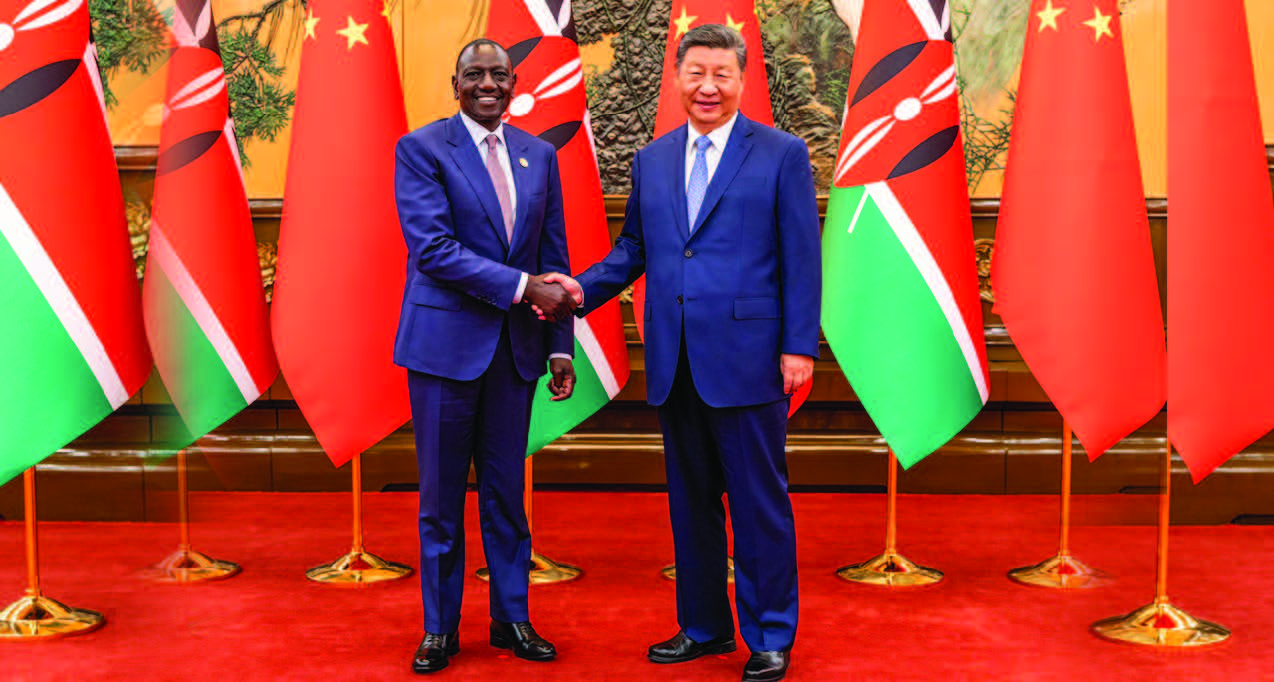 President William Ruto and his Chinese counterpart Xi Jinping./FILE