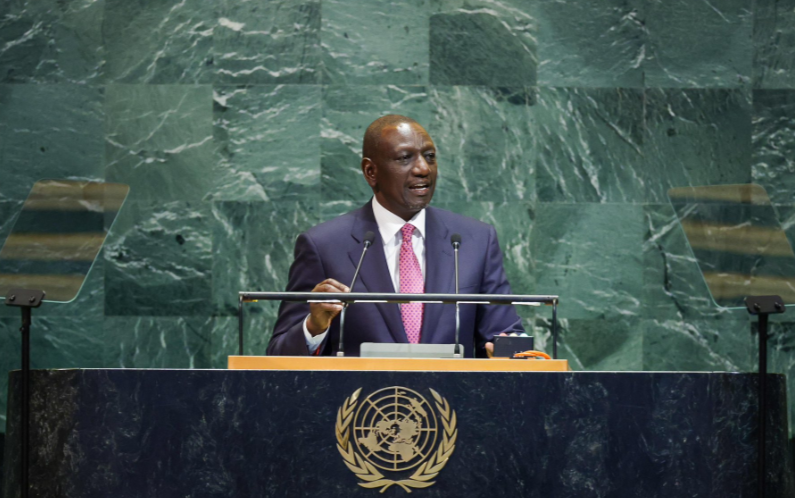
 President William Ruto addressing the United Nations General Assembly in New York on September 24, 2025. /PCS
Africa has sustained its push for permanent representation on the United Nations Security Council to amplify its voice in decision-making at the world’s most powerful multilateral body.
The demand has been championed by the African Union for two decades and has been given renewed urgency by leaders such as President William Ruto, who used his speech at the ongoing United Nations General Assembly in New York to press the case in dramatic terms.
“Africa deserves two permanent seats with full rights, including the veto, and two additional non-permanent seats on the UN Security Council,” Ruto declared.
“Reforming the Security Council is not a favour to Africa; it is a necessity for the United Nations’ own survival.”
His remarks captured both the frustration and the ambition behind the continent’s frustration that Africa, with 54 countries, is the only region without a permanent seat.
The demand is not new.
The African Union’s Common African Position, set out in the Ezulwini Consensus and the Sirte Declaration, insists that the continent must have at least two permanent seats on the Security Council, with all the privileges and prerogatives currently enjoyed by the five permanent members.
Anything short of that, African leaders argue, perpetuates the historical injustice that left Africa out of the original power-sharing deal struck in 1945, when the UN was founded.
At that time, most African countries were colonies, and the permanent seats were allocated to the great powers of the day—the United States, the Soviet Union (now Russia), China, the United Kingdom, and France.
That exclusion matters more today because Africa features so prominently on the Security Council’s agenda.
Conflicts in the Sahel, the Horn of Africa, the Great Lakes region, and West Africa dominate council deliberations.
Further, the continent is home to the majority of UN peacekeeping operations and provides some of the largest troop contingents.
Yet when binding decisions are made in New York, Africa’s role is limited to temporary, rotating membership without the veto power that defines real influence in the council.
President Ruto underscored this contradiction in his fiery address to the General Assembly on Wednesday, September 24.
“Africa dominates most of the Security Council’s agenda, provides some of the largest contingents to UN peacekeeping, and bears the heaviest costs of instability,” Ruto told delegates.
“Yet we remain the only continent without a permanent seat at the table where decisions about our destiny are made. You cannot claim to be the United Nations while disregarding the voice of 54 nations. It is not possible."
The workings of the Security Council underscore why the demand matters.
The council has 15 members in total, five of them permanent and 10 elected for two-year terms.
For a substantive resolution to pass, nine members must vote in favour, but none of the permanent five may exercise their veto.
That means a single permanent member can block any action, whether on sanctions, peacekeeping, or intervention.
Africa’s argument is simple: it cannot be right that the continent most affected by these decisions lacks a permanent voice in taking them.
Changing this architecture, however, is not straightforward. Amending the UN Charter requires a two-thirds vote in the General Assembly and ratification by two-thirds of member states, including all the current permanent members.
In practice, that gives the P5 a veto over reform itself. Some observers have proposed halfway solutions, such as creating permanent seats without veto rights or voluntary restrictions on veto use.
But the African Union has consistently rejected half measures, maintaining that genuine reform must mean full parity, including the veto.
The implications for the UN and the world are significant. Granting Africa permanent seats would increase the council’s legitimacy, especially in the Global South, by making its decisions more representative.
It would give African states greater ownership over international responses to crises on the continent and elevate African perspectives in global security debates.
At the same time, adding new veto holders could make consensus harder to achieve, raising the risk of deadlock.
That tension—between legitimacy and efficiency—sits at the heart of the reform debate.
Ruto sought to cut through that dilemma by reframing the issue. He argued that Security Council reform is not simply about Africa’s entitlement but about the UN’s credibility and relevance.
“Institutions drift into irrelevance when they do not adapt,” he said. “Reforming the Security Council is not a favour to Africa; it is a necessity for the United Nations’ own survival.”
By positioning Africa’s claim as part of a wider renewal of multilateral institutions, Ruto made the case that reform strengthens the UN for all, not just for Africa.
What comes next will depend on diplomacy in New York and unity in Africa.
The African Union’s Committee of Ten continues to push the Ezulwini Consensus, but the challenge will be maintaining a common voice while negotiating with major powers who may prefer limited reforms.
Ruto’s speech adds momentum to that campaign by making Africa’s demand impossible to ignore at the highest stage of global politics.
Seventy-nine years after the Security Council was created, the structure that gave permanent power to five states still reflects the balance of 1945, not the demographics, politics, or challenges of today.
Africa’s demand for permanent seats is therefore two-pronged.
It's a moral claim aimed at redressing an injustice rooted in colonial exclusion, and a practical one, which seeks to align the UN’s most powerful body with the realities of the world it purports to govern.
Ruto’s forceful intervention at the UNGA has ensured the debate will not be ignored.
The coming months will show whether it triggers genuine reform or simply adds to decades of stalled negotiations.
What is clear is that Africa’s demand for a permanent seat is no longer framed as a request—it is presented as a test of the UN’s relevance in the twenty-first century.