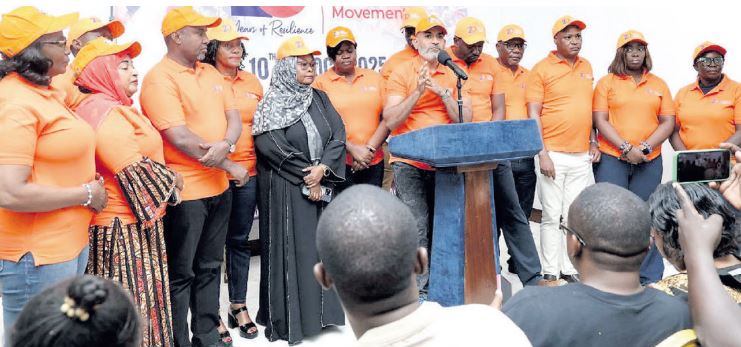
 ODM members at deputy party leader Abdulswamad Nassir’s office on Saturday /JOHN CHESOLI
The Orange Democratic Movement turns 20 this year. It’s quite a milestone, which makes it Kenya’s longest-surviving large political movement, with a significant and uninterrupted presence in elective politics and the legislature since the 2007 election.
The major parties against which ODM has competed in most of the past elections, such as PNU, TNA, and Jubilee, are either firmly in the political graveyard or are headed there faster than one can say “vote!”
Deservedly, the Orange party is throwing a bash to celebrate this enviable achievement. As if on cue, they have picked the seaside city of Mombasa to host the extravaganza next month, October 10 to 12, evidently hoping brisk ocean breeze can blow life back into the dying revolutionary embers of the party’s ideology.
For as sure as night follows day, this ODM at 20 is a far cry from the ODM that captured the imagination of the nation in its early years, when it had real fire in the belly.
The ODM party was a product of the 2005 referendum, when political leaders opposed to the proposed new constitution, riding on the orange symbol voted NO against their banana counterparts who voted YES.
ODM gradually coalesced into a movement. The NO side was made up largely of the Liberal Democratic Party faction of the ruling Narc-Rainbow coalition, led by Raila Odinga and their Kanu allies, led by then Kanu chairman Uhuru Kenyatta and secretary-general William Ruto.
The Kanu side quietly returned to their party after the referendum assignment was done, but the LDP wing, whose ministers had just been fired by President Mwai Kibaki, needed a new vehicle. But since most of the leaders held parliamentary seats on Narc coalition tickets, and couldn’t join another party yet, a relatively unknown lawyer allied to Kalonzo Musyoka, known as Daniel Maanzo, became the custodian of the newly registered ODM documents.
It wouldn’t be long before controversy in the party over who would be its presidential flagbearer in the 2007 election tore it apart, with Maanzo and Kalonzo taking off with the party’s instruments (remaining with ODM-Kenya), leaving Raila and his faction facing a partyless period, just a few months to election. It was at this juncture that another variant of ODM popped up, having been registered by another relatively unknown lawyer, Mugambi Imanyara. A deal was struck for the acquisition of Imanyara’s ODM party by Raila.
This period also coincided with a mass movement of the Kalenjin community towards Raila. The people of Rift Valley had by 2007 acquired a siege mentality, angry at perceived persecution by the Kibaki regime, which had since 2003 foolishly sacked Kalenjins en masse from the civil service. Uhuru, who was then Kanu chairman, backed Kibaki’s re-election, while Ruto, who had been Kanu secretary general up to that point, was amongst the last through the door into Raila’s brand new ODM, making it just in time for the September 1, 2007, party presidential nomination date.
Today, factions of the Orange party like to hype a certain category of “members” that it calls “founders”, with promises that these founders will be a key fixture at the 20th anniversary celebrations. Clearly, they do not mean Maanzo or Imanyara, and certainly not former Mvita MP Najib Balala, who in 2005 at a post-referendum public rally became the first to float the idea that the victorious “Orange Revolution” be transformed into a political party.
This party faction uses “founders” merely as a feel-good reference to President Ruto. It would be interesting to pick the minds of this wing of ODM on why the party’s “founders” now belong to different parties, the circumstances under which they left, and, indeed, if those circumstances changed along the way for them to be VIP guests at the party jamboree.
Be that as it may, the party is at a crossroads. Beyond the two-decade celebrations and the emergence of fancied “founders”, ODM’s biggest headache today, should be whether it will see its 25th anniversary. Perhaps the biggest reason the political outfit has overcome adversities and attempts at state emasculation, aside from the enigmatic and larger-than-life presence of its leader, Raila, has to be that members and allies always knew what the party stood for. Today, outside Luo Nyanza, it is safe to say that key bases are drifting away fast.
There are parallels to be drawn between Raila’s NDP co-operation with President Moi’s Kanu, between 1997 and 2002, with today’s ODM arrangement with President Ruto. With the former, party members saw Raila as a future president, with years ahead to influence the country’s politics and position his supporters favourably. Today, the unsaid fact is that all the scheming and plotting is done with the knowledge that the ODM boss may not run again or may not be a factor for too long.
The stark reality the party must live with is that without a personality as big as Raila, moving forward the party hasn’t cleared the way for a leader who can keep its massive non-Luo bases in counties as diverse as Busia, Mombasa, Kilifi, Kakamega, Kisii and the Maa community. To make it worse, the emergence of a transactional wing in the party, ready to make whatever deals are on the table, will negate the ability of the party to be a credible watchman of democracy for the people.
This week, a video popped up on social media showing some party luminaries, secretary-general Edwin Sifuna, chairperson Gladys Wanga and National Assembly Majority leader Junet Mohamed, apparently at a Mombasa eatery and dancing to the 2007 runaway hit Raila by Ohangla artist Onyi Papa J. The song immortalised the then ODM presidential candidate. As the song plays on and leaders shake to its beat, a voice sounding like that of Likoni MP Mishi Mboko enters the audio, beseeching the other leaders to “return the party to that vibe of 2007”.
I know many disillusioned members of the party who long for those nostalgic periods when the party was a powerful, predictable revolutionary movement, with focused leadership, a powerful grassroots network and a strong desire to capture power at the ballot to implement its manifesto. Today, there is confusion within its ranks about the direction the party is headed. The irony is not lost of a 20-year-old movement now having to be subservient to much younger parties such UDA, only around for a mere three years.
A political watcher of the outfit can’t help wishing that leaders like Governors Anyang’ Nyong’o (Kisumu) and James Orengo (Siaya), who were Raila’s peers in the Second Liberation struggle, were younger today. The quality and ideological grounding the two have always brought to the party is today missing within the emerging crop of leaders. Nyong’o was the first ODM secretary general and the father of its ideological positioning. Together with Orengo, and working closely with Raila, they have always exuded calm assurance to party faithful, that regardless of whatever arrangements the outfit entered into with others, the people’s guardian would never slumber, making it possible that ODM at 20 could be the last such extravaganza for the Orange movement. Will there be ODM at 25? Time will tell.